Number and Operations—Fractions Develop understanding of fractions as numbers.3Explain equivalence of fractions in special cases, and compare fractions by reasoning about their size.cExpress whole numbers as fractions, and recognize fractions that are equivalent to whole numbers. Examples: Express 3 in the form 3 = 3/1; recognize that 6/1 = 6; locate 4/4 and 1 at the same point of a number line diagram.
3nf3cOpen FolderOpen File×Description:
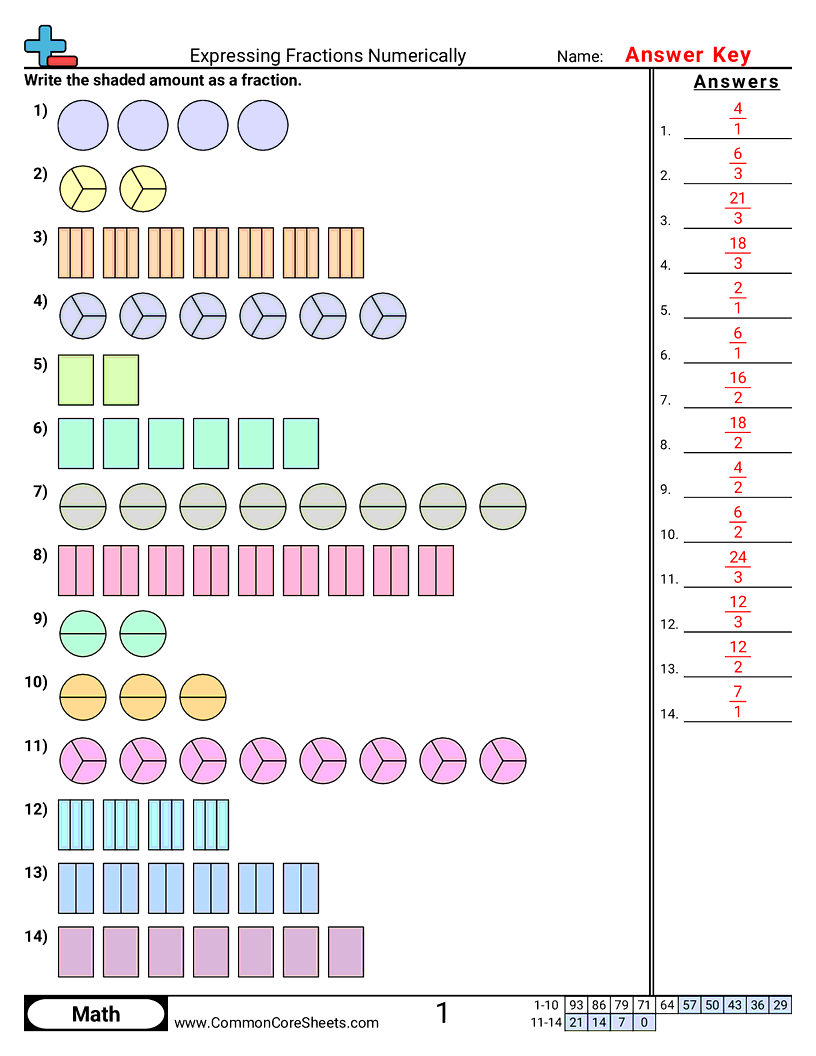
"This worksheet is designed to enhance children's understanding of expressing fractions numerically. With 14 engaging math problems, it provides an excellent learning tool for mastering fractions, supporting individual learning pace. Remarkably, the worksheet is customizable to students' needs, can be converted into interactive flashcards, and is perfect for distance learning. A comprehensive resource cultivating mathematical proficiency."
×Student Goals:
3nf3cOpen FolderOpen File×Description:
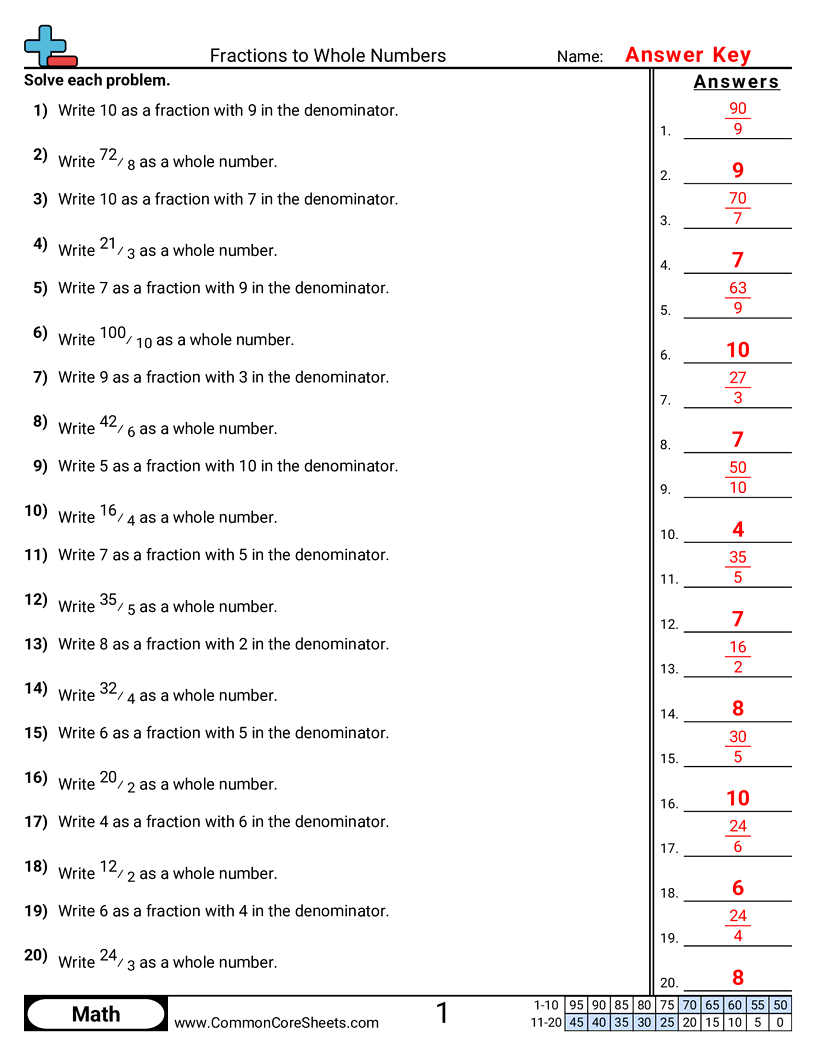
"This worksheet is designed to enhance children's math skills by focusing on converting fractions to whole numbers. With 20 unique problems, examples include transforming fractions such as 32/8, 90/10, and 56/8 into whole numbers. The customizable nature allows this worksheet to be converted to flashcards or adopted in distance learning scenarios, providing a versatile approach to mastering essential math concepts."
×Student Goals: Understanding of Fractions and Whole NumbersUpon successful completion of this worksheet, students should have a clear understanding of the relationship between fractions and whole numbers. This understanding serves as a fundamental building block in grasping the broader concepts in mathematics. The exercises included allow students to transform fractions into their equivalent whole numbers, strengthening their knowledge and application of division and multiplication.Enhanced Computational SkillsWorking through these problems encourages students to apply their mental math skills, specifically in division. This strengthens their overall arithmetic abilities, and with regular practice, students should find that these computations become easier and quicker.Critical Thinking and Problem-Solving SkillsEach fraction to a whole number problem requires students to use problem-solving and critical thinking. They need to recognize the relationship involved in changing fractions to whole numbers. This will improve their ability to analyze mathematical equations or problems and develop strategic ways to find solutions.Familiarity with Number PatternsSolving these fractional problems also allows students to notice number patterns, which is an integral part of number sense. Observing how numbers relate to each other in fractions and how they translate into whole numbers will help build logic and reasoning skills.Boosted Confidence with MathThis worksheet provides a gradual progression in its difficulty level from simpler to more complex transformations. Upon completion, students should gain confidence in handling fractions and whole numbers, ultimately making them feel more at ease with the subject of Math.Preparation for More Advanced Math TopicsThe core concepts of fractions and whole numbers form the basis for more complex mathematical topics that students will encounter later on, such as ratio and proportion, geometry, and algebra. Hence, mastering this worksheet aligns with preparing students for advanced math endeavors.
3nf3cOpen FolderOpen File×Description:
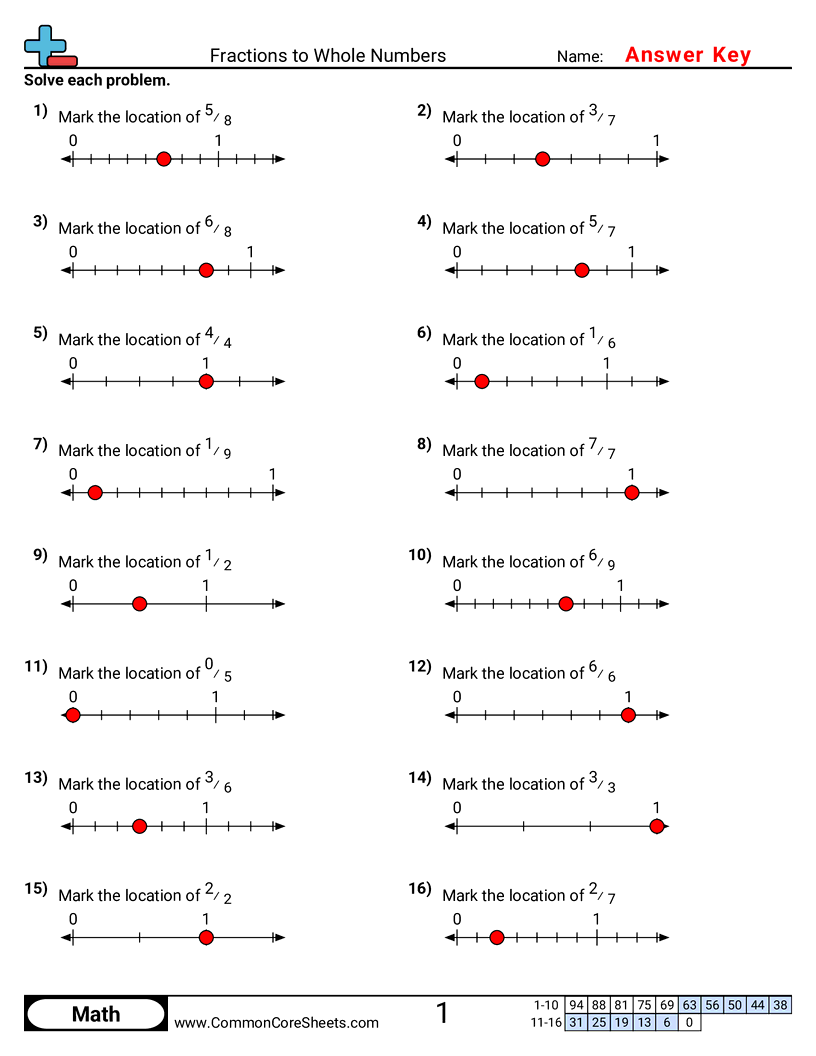
"This worksheet is designed to enhance a child's understanding of converting fractions to whole numbers, helping to solidify their base in math. Containing 16 diverse fraction problems, it allows students to visualize numbers and conceptualize fractions. This versatile tool can be customized to suit any learner's needs, converted into flashcards for interactive learning or adopted in long-distance learning scenarios. The perfect adjunct to any math curriculum, empowering smarter and efficient learning."
×Student Goals: Understanding of FractionsAfter completing this worksheet, students should have a strengthened comprehension of fractions as expressions of whole numbers. They would gain the ability to recognize and mark fractions on a numerical scale, understand their relative proportions, and visualize their equivalence to certain whole numbers. This solidifies their fundamental grasp on the concept of fractions, laying the groundwork for more complex mathematical computations.Ability to Convert Fractions to Whole NumbersStudents will develop the skill to convert fractions into whole numbers. They will learn that when the numerator and the denominator of a fraction are the same, the fraction amounts to the whole number one. This skill will be integral to their progression within the subject of math as they progress to more complex topics, like algebra.Mathematical ReasoningBy working through the problems on this worksheet, students will enhance their mathematical reasoning skills. They will make logical deductions to decipher the location of fractions along a number line, thus building their aptitude in quantifying fractions of a whole. Their ability to think critically, reason logically, and make accurate mathematical judgments will be greatly improved.Competence in Numerical RepresentationThis worksheet will train students to efficiently translate numerical data into visual formats. They will mark the location of various fractions on a number line, thereby converting abstract numbers into concrete, visual representation. This not only helps in enhancing their comprehension but also promotes their skills in data representation, an important competency in various academic and professional fields.Confidence in Handling FractionsLastly, by successfully completing this worksheet, students will have gained the necessary confidence to approach fraction-based problems. Fear or hesitation towards fractions is a common phenomenon among young learners. However, with practice and subsequent mastery of the topic, this anxiety can be mitigated. By building their knowledge and understanding, this worksheet will help foster the students' confidence, influencing not just their performance on future worksheets and exams, but also their enthusiasm towards learning.
3nf3cOpen FolderOpen File×Description:
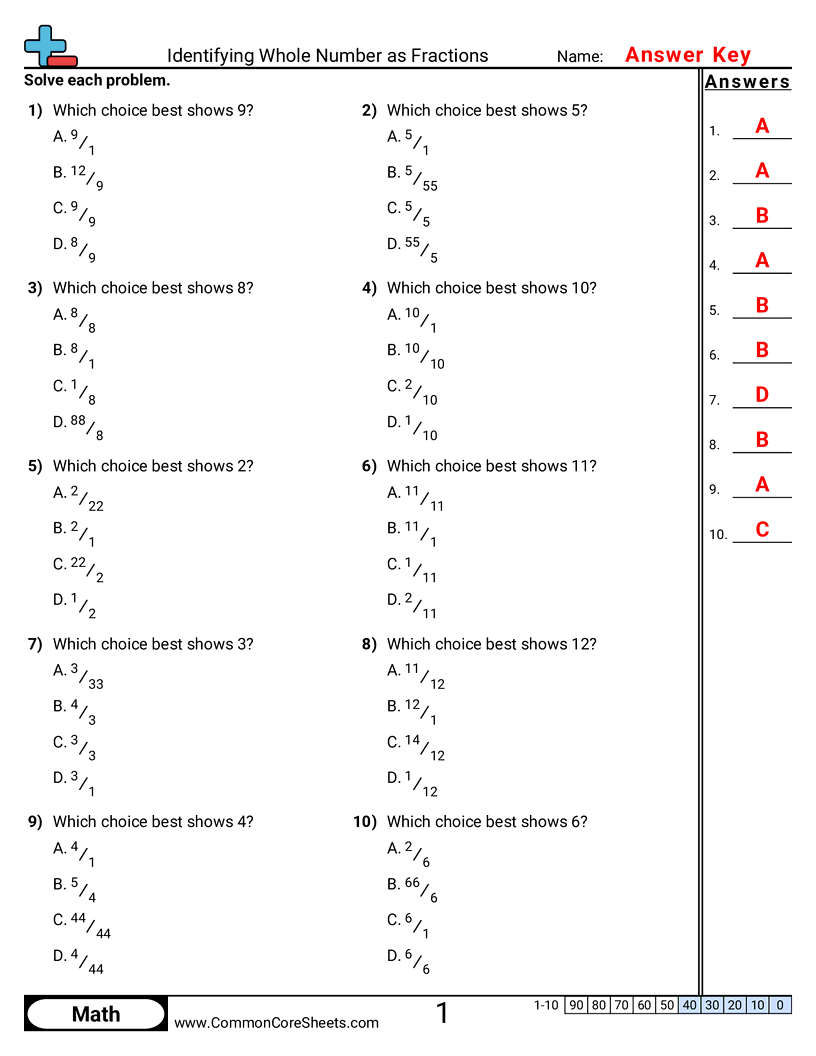
"This worksheet is designed to teach children the concept of interpreting whole numbers as fractions. With 10 interactive problems, learners are tasked to identify whole numbers represented by different fractions. Adaptable to multiple learning formats, the worksheet can be customized, transformed into flash cards, or effortlessly incorporated into distance learning programs, making math engaging and accessible for young learners."
×Student Goals: Understanding of FractionsUpon completion of the worksheet, students should have an enhanced understanding of fractions. They will be familiar with the concept that whole numbers can also be represented as fractions as they can identify different fractions that correspond to the same whole number. This will significantly improve their ability to manipulate and work with fractions, an essential component of mathematics.Problem-solving SkillsThis worksheet aids in developing problem-solving skills among students. They will learn to apply their mathematical knowledge to identify or select the best fractional representation of a given whole number. Through this process, students gain experience in breaking down problems and making informed decisions, thus cultivating their problem-solving abilities in general.Increased AccuracyRegular practice with such worksheets increases accuracy in handling fractions. This improved accuracy will come in handy while dealing with more complex mathematical problems later on. It will also reduce the likeliness of making errors, enhancing students' overall mathematical competence.Foundation for Advanced TopicsCompleting this worksheet lays a strong foundation for learners to understand and grasp more advanced mathematical topics. The understanding that whole numbers can also be fractions forms the basis of many complex mathematical applications and is crucial for later subjects such algebra and trigonometry.Confidence BoostSuccessfully completing this worksheet will boost students' confidence in their mathematical abilities. This confidence often translates into increased participation in class and improved performance in tests and exams. Confidence in one's mathematical abilities is crucial for academic success in this subject and can also fuel interest in learning more advanced mathematical concepts.Mathematical Language UnderstandingThis worksheet also helps students in understanding and using the mathematical language effectively. They acquire the ability to read, interpret, and write mathematical equations accurately, thus improving their mathematical communication skills.