Geometry Graph points on the coordinate plane to solve real-world and mathematical problems.1Use a pair of perpendicular number lines, called axes, to define a coordinate system, with the intersection of the lines (the origin) arranged to coincide with the 0 on each line and a given point in the plane located by using an ordered pair of numbers, called its coordinates. Understand that the first number indicates how far to travel from the origin in the direction of one axis, and the second number indicates how far to travel in the direction of the second axis, with the convention that the names of the two axes and the coordinates correspond (e.g., x-axis and x-coordinate, y-axis and y-coordinate).
5g1Open FolderOpen File×Description:
"This worksheet is designed to help children master the concept of creating rectangles using coordinate grids. With 11 practice problems, it offers hands-on math learning in a clear, interactive way. The worksheet can be customized according to individual student needs, transformed into flash cards for quick revision or incorporated into distance learning programs. It's a versatile and practical tool for educators and students alike."
×Student Goals: Understanding Coordinate Grid ConceptsUpon completion of the 'Creating Rectangles with a Coordinate Grid' worksheet, students should have developed an appreciation and understanding of coordinate grid concepts in maths, specifically regarding rectangle plotting and formation. They will possess the knowledge and confidence to plot vertices of rectangles using an X-Y coordinate grid. With this competency, students will be able to create rectangles on given coordinates and understand how the position of specific points on the coordinate grid creates different forms of rectangles.Improvement in Problem Solving SkillsEnhancement in problem-solving skills will be a significant accomplishment after the completion of the worksheet. The worksheet, having eleven problems, provides students with various scenarios where they leverage critical thinking and reasoning abilities to create rectangles using the coordinate grid. With the practice of different problem sets, students will gain the ability to solve complex rectangle plotting issues and decode problems related to the geometric aspect of mathematics.Enhancement in Geometrical SkillsGeometrical skills are at the heart of this exercise. By correctly forming rectangles on a coordinate grid, students demonstrate their ability to recognize shapes and their properties, improving their geometric aptitude. As young learners navigate this exercise, they also implicitly bolster their understanding of the importance of angle calculation, symmetry, spatial reasoning in rectangles, and knowledge that will be beneficial in further geometrical studies.Development of Analytical SkillsAnalytical skills are another key area of development for students completing this worksheet. Decoding the position of vertices helps in enhancing deductive reasoning skills and honing attention to detail. This analytical awareness will also enable students to draw conclusions about rectangular shapes and develop hypotheses about other geometric shapes.Boost in ConfidenceFinally, a boost in confidence is inevitable after successfully completing the worksheet. Conquering new concepts, applying them through problems, and perfecting their understanding ultimately leads to a sense of achievement and boost in belief level. Therefore, the worksheet plays a significant role in boosting the confidence that they will carry into other areas of their academic study and beyond.
5g1Open FolderOpen File×Description:
"This worksheet is designed to hone math skills by teaching children spatial awareness through marking locations on a grid. It features 12 problems, invaluable for developing students' understanding of coordinate systems. It's adaptable - it can be customized to challenge different ability levels or turned into flashcards for interactive study. An ideal tool for distance learning, it facilitates independent practice in a focused, engaging way."
×Student Goals: Build Spatial Recognition SkillsStudents who complete this worksheet should develop superior spatial recognition abilities. Spatial recognition is a vital part of mathematical understanding, especially in the field of geometry. This worksheet enables students to understand the layout of a grid, a foundational component of many mathematical concepts. It aids students in recognizing the horizontal and vertical axes on a grid and how they combine to form coordinates. This is a critical step in enhancing their spatial vision and their capacity to understand and describe the space around them.Enhance Problem-Solving SkillsThis worksheet will also play a crucial role in strengthening students' problem-solving skills. They're tasked with identifying and marking multiple specific locations on a grid, which promotes their ability to address issues individually and successfully. This interactive task encourages self-reliance and confidence in their problem-solving capabilities, which are essential skills in quantitative subjects like mathematics, but also have useful applications in day-to-day life.Comprehend and Use Mathematical LanguageBy marking locations on the grid, students should achieve a more thorough comprehension of mathematical language, particularly the terminology and principles related to coordinates and grids. Understanding this jargon is essential to communicating mathematical ideas and methods, as well as interpreting problems. The completion of this worksheet is a step towards fluency in mathematical language, which will be invaluable in more advanced study.Reinforce Coordinate System KnowledgeThe worksheet specifically focuses on the coordinate system, a fundamental aspect of mathematics. Therefore, students who complete this worksheet should learn or reinforce their capacity to read, understand, and utilize this system. Using a pair of numbers to represent a point in space is an abstract concept, and by physically marking these points on a grid, the idea becomes more concrete for students. This supports learning, retention, and future use of the coordinate system.Promote Accuracy and Attention to DetailLastly, this worksheet should enhance students' accuracy and attention to detail. It's essential to place the points precisely in the right spot to get the correct answer. Thus, the task encourages a thorough and careful approach to work, traits that are not only important in mathematics but also highly valued in many aspects of life
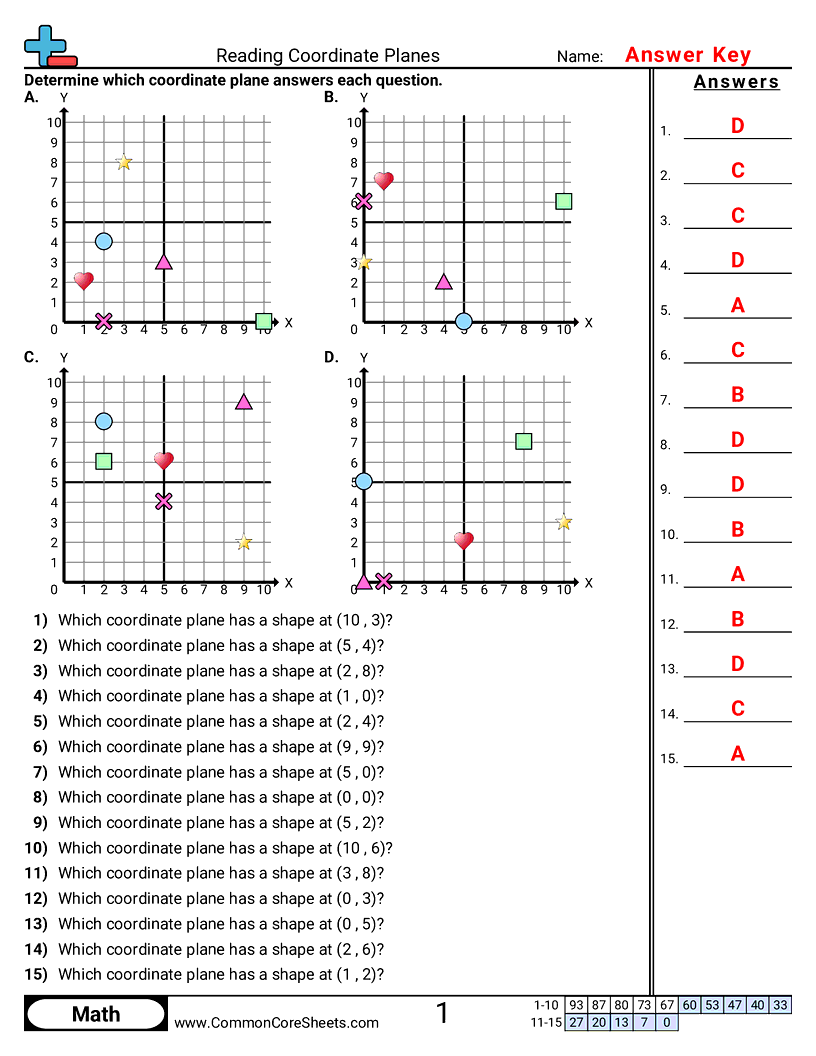
5g1Open FolderOpen File×Description:
"This worksheet is designed to bolster children's understanding of coordinate planes in mathematics. It houses 15 problems that challenge students to identify shapes positioned at given coordinates. Besides reinforcing key math concepts, the worksheet offers flexibility; it can be customized to meet individual learning needs, transformed into flashcards for easier assimilation, or adapted for distance learning environments. A perfect tool for comprehensive and engaging math education."
×Student Goals: Identification of Coordinate PlanesUpon completion of this worksheet, students should be able to effectively identify coordinate planes. They will be familiar with the correlation between a set of coordinates and its corresponding location on the coordinate plane, enhancing their ability to translate numerical information into a visual representation. This knowledge is fundamental to many areas of mathematics, especially geometric and algebraic understanding.Analytical SkillsStudents will have honed their analytical skills, given that interpreting coordinate planes requires an understanding of the relationship between two dimensions. Working through the 15 problems in this worksheet will foster strategic thinking and problem-solving abilities, underpinning their confidence to tackle more complex mathematical problems in future.Mastering Mathematical ConceptsCompletion of this worksheet will indicate mastery of the concept of coordinate planes, an integral part of the geometry curriculum. The proficiency gained in visualizing mathematical relationships and functional interactions is crucial not just in math, but also in numerous areas in the sciences, such as physics and computer science.Fundamental Metric InterpretationStudents will be practiced in interpreting fundamental metric coordinates, an important skill that finds application in real-world scenarios. These can range from reading maps in geography to interpreting data points on graphs in business, economics or scientific research. This trans-disciplinary skill will render their mathematical abilities more tangible and applicable to diverse fields.Independent Study and ConfidenceBy completing these problems independently, students will build confidence in their mathematical abilities. They'll be encouraged in their self-directed learning, which will promote resilience in future academic pursuits. The mastery and confidence students gain through this worksheet will leave them well-placed to tackle more complex maths topics with assurance and aplomb.