Ratios and Proportional Relationships Understand ratio concepts and use ratio reasoning to solve problems.1Understand the concept of a ratio and use ratio language to describe a ratio relationship between two quantities.
6rp1Open FolderOpen File×Description:
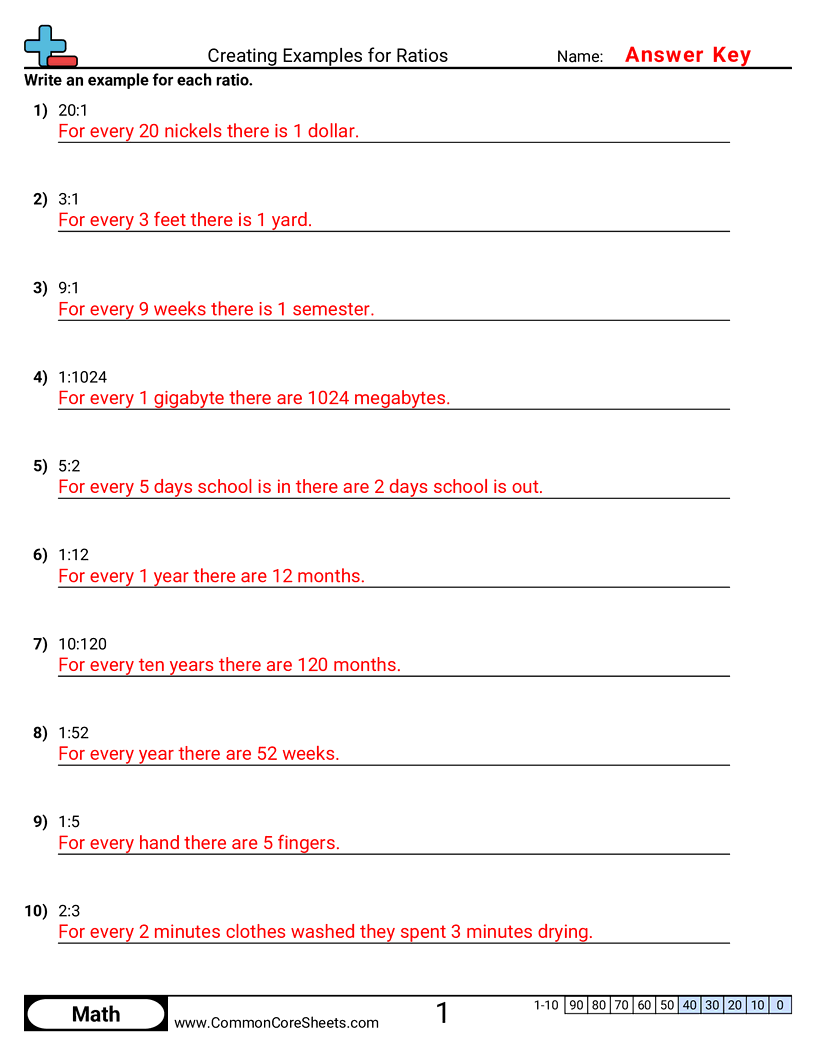
"This worksheet is designed to enhance children's understanding of ratios in a fun and engaging way. Featuring 10 unique math problems, it uses real-life examples to teach the concept of proportional relationships. Ideal for distance learning, it can be easily customized, providing flexible formats such as flashcards. This indispensable learning tool links math understanding to the world around us, making complex concepts accessible and enjoyable for young learners."
×Student Goals: Conceptual UnderstandingUpon completion of the worksheet on Creating Examples for Ratios, students should have a robust understanding of the mathematical concept of ratios. They should be able to identify and understand the relationship between two quantities expressed as a ratio, as well as understand the role of ratios in different real-world contexts, such as time management, the economy, demographics, and data storage.Problem-Solving SkillsThe worksheet aims to enhance students' problem-solving skills. After careful practice, students should have the ability to interpret ratio word problems effectively and then apply their knowledge of ratios to solve these problems based on various topics and in real-life situations. This includes understanding what ratios represent and how they can be used to compare quantities or measure performance.Application SkillsStudents will acquire the skill to apply their knowledge of ratios in practical situations. This would include the ability to convert between units of measurements (i.e., Weeks to a year, currency, measurement units, etc.), understand the ratio in population statistics (i.e., Number of boys to girls), and understand and process ratios and proportions in the broader spectrum of mathematical understanding.Critical ThinkingThrough working on the given problems, students will improve their critical thinking capability. They should be able to make connections between real-world situations and mathematical ratios, which forms the basis for proportional reasoning. Students will learn how to simplify and compare ratios, leading to better decision-making skills and logical thinking.Enhanced Mathematical VocabularyBy the end of this worksheet, students will acquire a stronger mathematical vocabulary. They should be comfortable with terms like proportions, equivalent ratios, simplifying ratios, and more. Knowing the correct terminology is essential for understanding and discussing mathematical concepts effectively and accurately.PrecisionFinally, this worksheet should foster student growth in recognizing precision in mathematics. Recognizing the importance of accuracy in calculating and interpreting ratios will ensure that they understand the consequences of errors. This understanding will further aid in improving the precision of their mathematical work, a transferable skill set which holds great importance in all walks of life.
6rp1Open FolderOpen File×Description:
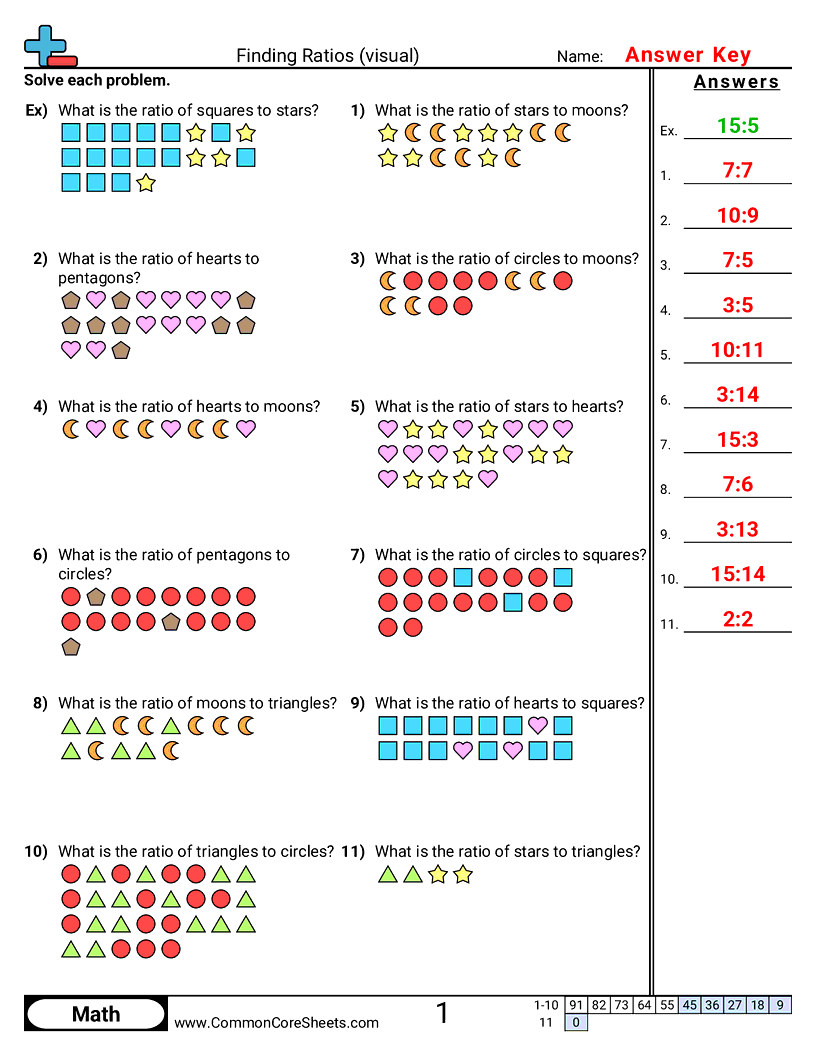
"This worksheet is designed to give children a visual approach to understanding ratios in math. Through 11 customizable problems, it uses various shapes like moons, squares, hearts, triangles, circles, and stars to teach the concept of ratios. Suitable for distance learning, this worksheet can also be converted into flashcards for easier recall and practice."
×Student Goals: Ratio Comparison SkillsAfter completing the worksheet, students should have developed and improved their ability to understand and apply ratio comparison skills. They should be well-versed with the concept of ratios, the relation it establishes between two quantities of the same kind, and the representation of this relationship. The problems in the worksheet encourage students to create a visual image and provide an understanding that a ratio is a comparison of two quantities. This could be a powerful tool for them to tackle practical problems involving comparisons.Critical Thinking and Problem SolvingStudents should be capable of handling situations that demand critical thinking. The math problems given make them analyze and establish a quantitative relationship between different shapes. This competency not only enhances their counting skills but also develops their problem-solving abilities. They should be able to apply these analytical skills in real life scenarios.Mathematical Language ProficiencyBy engaging with the worksheet, students should have improved their mathematical vocabulary and language proficiency. Terms like ratios, pentagons, squares, and triangles would become a part of their regular vocabulary, which will facilitate further mathematical learning. Gains in such a specific language domain can benefit students in their daily communication about quantities, numbers, and shapes.Confidence and IndependenceAfter solving all of the problems in the worksheet, the students should have gained confidence and become independent in tackling similar math problems on their own. This progression to independence signifies that they can handle such math problems in their exams or homework without needing constant assistance.Application of KnowledgeAfter completion, students should be in a position to apply their acquired knowledge to other mathematical problems and real-life scenarios. The understanding of ratios can be extended to varied contexts, such as determining proportions in cooking recipes, understanding scales on maps, or comparing statistical data. Therefore, the application of this knowledge will be far-reaching and quite practical.
6rp1Open FolderOpen File×Description:
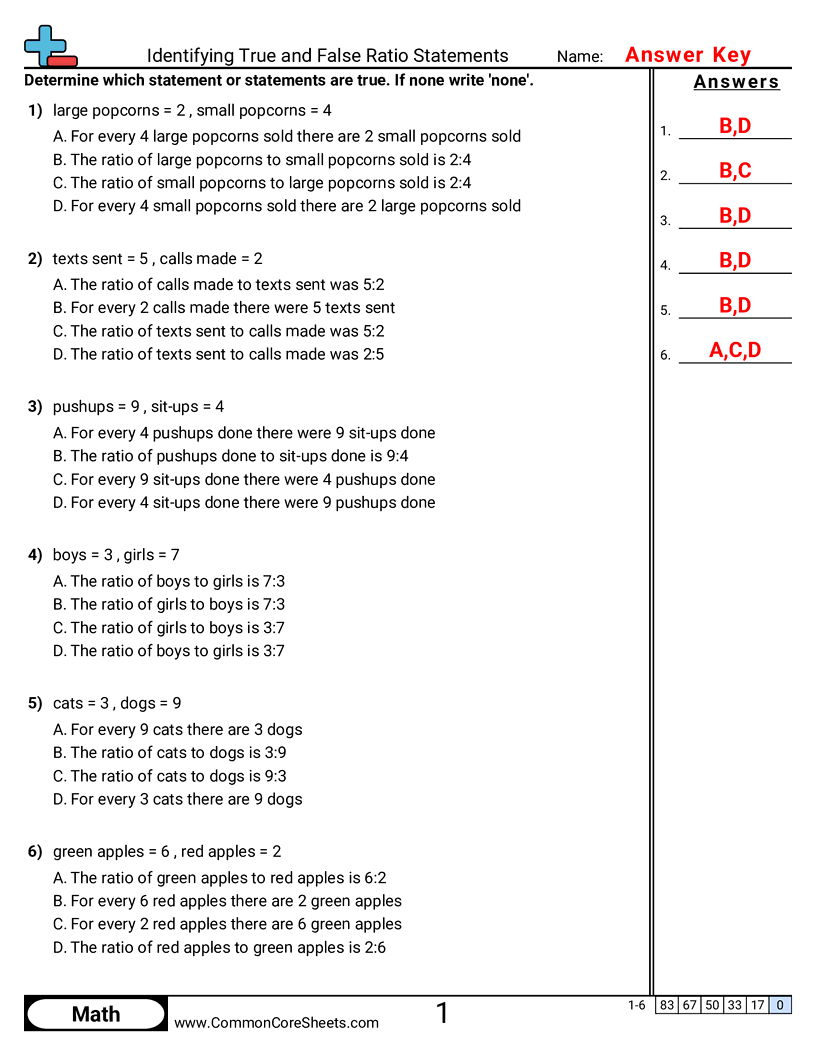
"This worksheet is designed to help children understand the concept of ratios in math in a fun and engaging way. It features 6 problems centered around everyday items and scenarios, helping children decipher true from false ratio statements. Converting this versatile resource into flashcards for easy review is a breeze. It is perfect for distance learning settings and can be customized to suit different learning needs and levels."
×Student Goals: Understanding Ratio StatementsUpon completion of the worksheet, students should have a thorough understanding of ratio statements. They will have learned how to identify ratios from given scenarios and apply their knowledge to interpret whether a ratio statement is true or false based on the provided context. This translates to an improved ability to interpret relational values in real-life situations.Problem SolvingThe worksheet will enrich the students' problem-solving abilities. By identifying true and false ratio statements through multiple choice problems, students will learn to solve mathematical problems analytically. This will not only sharpen their mathematical thinking but also enhance their strategizing and decision-making abilities.Critical ThinkingThe practice of determining true and false ratios requires careful reading and a keen sense of judgment, fostering critical thinking skills in students. This skill, vital both in and outside school, will be honed due to the interpretive nature of the exercises in this worksheet.Advanced Mathematical ConceptsCompletion of the worksheet will serve as a stepping stone towards understanding more advanced mathematical concepts. The basic understanding of ratios is a foundation for concepts like fractions, proportions, and similar figures. Hence, developing a clear understanding of ratios and how they function is important for students' evolving mathematical knowledge.Application of Math in Daily LifeBy completing the worksheet, students will learn how to apply mathematics to daily life scenarios. They'll understand the practical usage of math, specifically, how ratios function in everyday settings. This will ensure that students not only learn math theoretically but also realise its practical utility.Accuracy and PrecisionWorking on the worksheet will improve the students' accuracy and precision in mathematics. By identifying errors in false ratio statements, students will gain a heightened awareness of the importance of precision in mathematics.
6rp1Open FolderOpen File×Description:
This worksheet is designed to enhance children's understanding of mathematical ratios. It contains 12 carefully crafted problems, addressing practical examples such as vote distributions, home ages, combined genders, types of vehicles, clothing items, and game consoles. With features to customize, convert to flashcards, and adapt for distance learning, it's a versatile tool supporting varied learning approaches and styles. Ideal for encouraging in-depth comprehension of ratios in real-world contexts.
×Student Goals: Problem Solving SkillsStudents should be able to enhance their problem solving skills. Solving ratio problems often requires logical thinking and the application of foundational math principles. By working through the worksheet, learners will be able to grasp these core steps, aiding in their overall problem-solving abilities.Understanding of RatiosUpon completion of this worksheet, students should have a deeper understanding of ratios. They should be able to confidently distinguish and interpret ratios in multiple contexts. This foundational understanding of ratios is crucial in many areas of mathematics and everyday life situations. Therefore, accomplishing this worksheet signifies a significant step in the maturation of their mathematical competencies.Application of RatiosBy completing the worksheet, students should be able to apply the concept of ratios in real-life situations. The problems simulate real-world scenarios and train students to equate and understand ratios in various contexts. This capability is beneficial as the concept of ratios extends beyond classroom learning into elements of daily life.Critical ThinkingThis worksheet aids in the development of students' critical thinking skills. By tackling these problems, students will learn to identify the most effective strategies to use when calculating ratios. They will be capable of analyzing the information given, relating the parts to the whole, and determining the relationship between the different components, thereby enhancing their critical thinking skills.Mathematical CommunicationIn completing the worksheet, learners should improve their mathematical communication ability. This involves the use of proper mathematical language and symbols. Students will learn how to accurately articulate their understanding of ratios, both orally and in writing, fostering better mathematical communication.Confidence with NumbersAfter successfully completing this worksheet, students should feel more confident working with numbers and see the practical applications of their learning. They will be able to approach mathematical problems with less apprehension and more confidence, being self-assured in their own abilities to calculate ratios.