Ratios and Proportional Relationships Understand ratio concepts and use ratio reasoning to solve problems.3Use ratio and rate reasoning to solve real-world and mathematical problems, e.g., by reasoning about tables of equivalent ratios, tape diagrams, double number line diagrams, or equations.aMake tables of equivalent ratios relating quantities with whole number measurements, find missing values in the tables, and plot the pairs of values on the coordinate plane. Use tables to compare ratios.
6rp3aOpen FolderOpen File×Description:
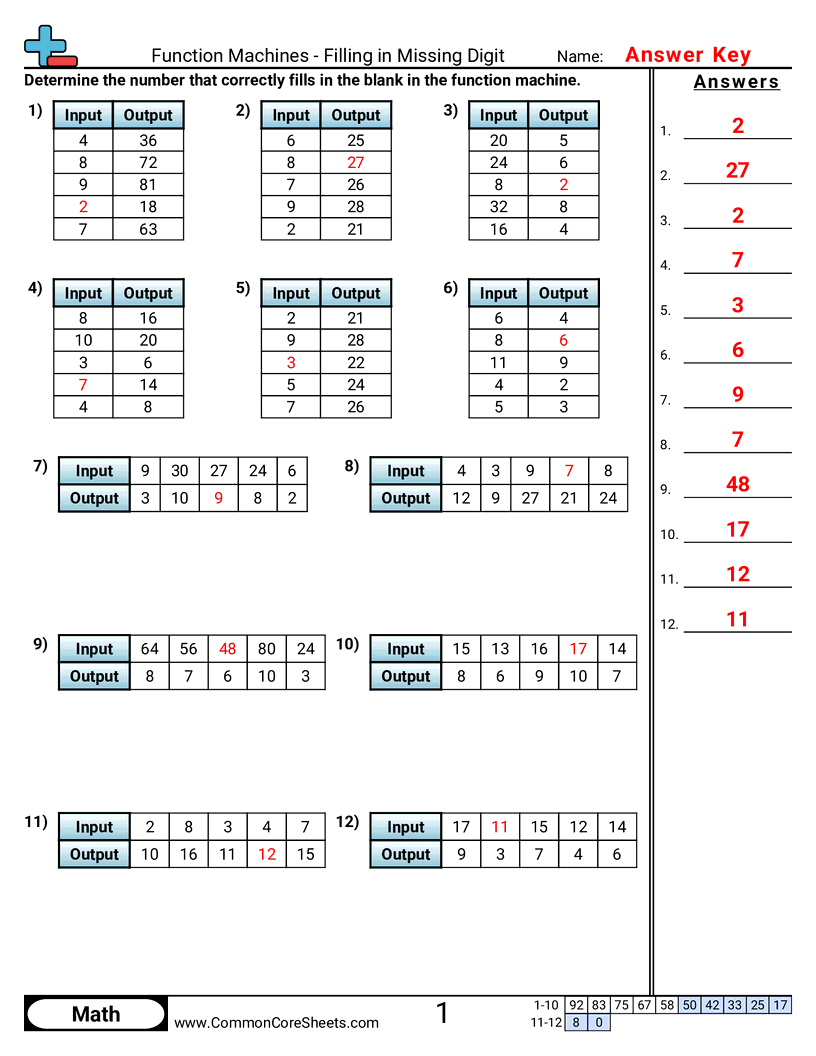
"This worksheet is designed to help children understand the concept of function machines in math by filling in the missing digit. With 12 interactive problems that involve subtraction, addition, multiplication, and division rules, it offers a dynamic way to foster computational skills. The customizable nature allows its use as flash cards or for distance learning, suiting individual learning styles and needs."
×Student Goals: Mastery in Basic Math OperationsChildren who complete this worksheet should display fluency in the four fundamental arithmetic operations, namely, addition, subtraction, multiplication, and division. They should be able to perform these operations without difficulty and apply them correctly in different scenarios, demonstrating foundational math knowledge and familiarity with number operations.Enhanced Problem-Solving SkillThe worksheet aims to push the students to utilize problems to challenge their thinking and foster their problem-solving abilities. After completing the sheet, students should be adept at solving mathematical problems and in identifying patterns. Their analytical thinking and logical reasoning abilities should be improved, equipping them with the necessary skills to tackle more complex math problems in the future.Understanding of Function Machines ConceptCompletion of the said worksheet should ensure the students' understanding of the Function Machines concept. They should be capable to recognize and apply the concept in a practical setting, grasp how the input and output correlates, and accurately identify the rule used in each function machine.Critical Thinking DevelopmentThe worksheet focuses on problem-solving exercises that encourage critical thinking. After completion, students should be adept at using judgment to decipher patterns in numbers, make mathematical predictions, and draw valid inferences. These tasks are aimed at improving their ability to think independently and flexibly, critical skills that will be beneficial for later academic and life challenges.Accuracy and Speed in ComputationThe worksheet provides ample practice to improve the accuracy and speed of computation. Students who complete the worksheet should be able to perform mathematical computation without errors, enhancing their computational accuracy. The repeated practice should also help increase their computational speed.
6rp3aOpen FolderOpen File×Description:
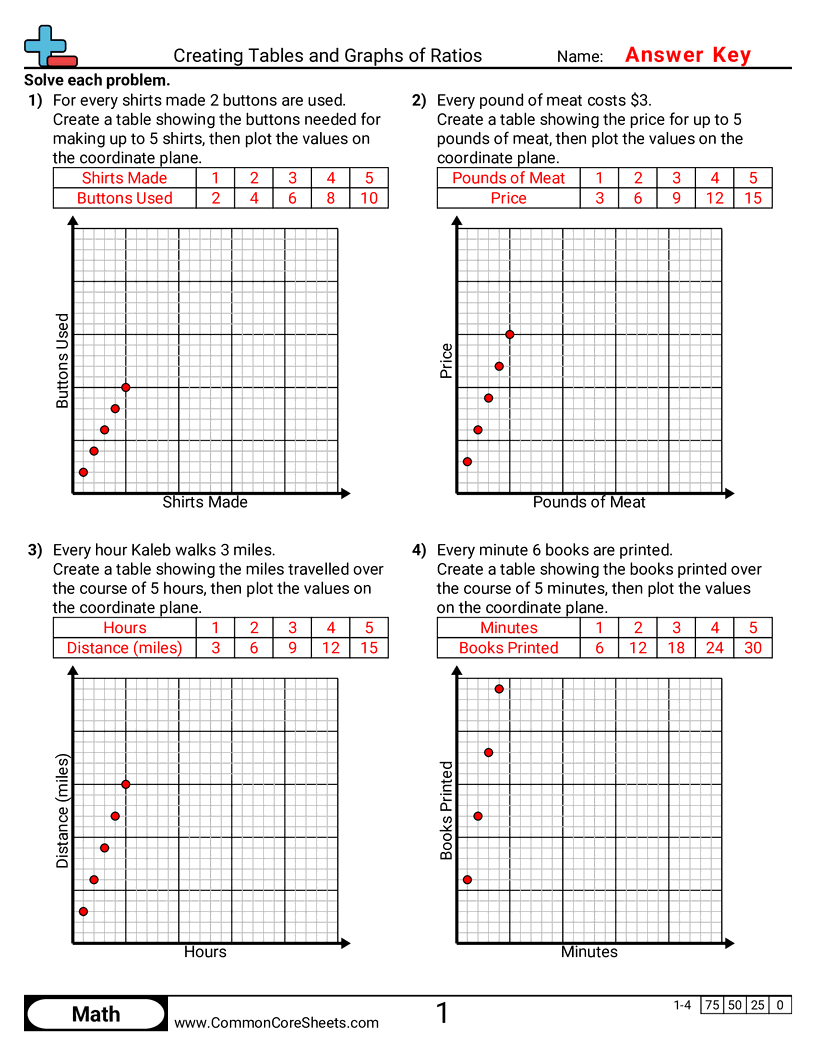
"This worksheet is designed to teach children the concept of ratios through practical problem-solving exercises. It contains four interactive math problems that require creating tables and graphs using provided real-life scenarios. The worksheet can be personalized to suit individual learning needs, used as flash cards for easy memorization, or incorporated into distance learning curriculum. It offers an engaging way to build fundamental math skills."
×Student Goals: Understanding RatiosUpon completing the worksheet, students should have a solid understanding of ratios and their practical application. They will have hands-on experience with creating ratio tables, allowing them to visually grasp the proportional relationship between a pair of numbers. This fundamental knowledge will make subsequent topics easier to understand, such as rates, fractions, and percentages.Plotting on Coordinate PlaneStudents should be proficient in plotting points on a coordinate plane, a vital skill they will continually need throughout their mathematical education. They will gain experience in transforming data from ratio tables into graphs. This will lay the foundation for future studies in graphing, data analysis, and spatial thinking.Real World ApplicationsStudents should have the ability to apply the concept of ratios to real-world scenarios. The worksheet provides practical examples related to everyday life, like shopping and gaming, making the abstract concept of ratios more tangible and relatable. This meet should lead students to realize the value of math in daily situations, ultimately instilling a more positive attitude towards the subject.Problem SolvingThe worksheet should enhance students’ problem-solving skills. By provided problems of varying complexity, it will challenge students to think critically and devise an effective approach to finding solutions. This experience should improve their capacity to tackle an array of mathematical problems.Conceptual UnderstandingFinally, students should develop a deep, conceptual understanding of the relationship between quantities. The process of creating ratio tables and graphs takes them beyond just memorizing procedures and moves towards understanding why those procedures work. This kind of understanding is crucial for learning higher-level math concepts in the future.