Ratios and Proportional Relationships Analyze proportional relationships and use them to solve real-world and mathematical problems.1Compute unit rates associated with ratios of fractions, including ratios of lengths, areas and other quantities measured in like or different units.
7rp1Open FolderOpen File×Description:
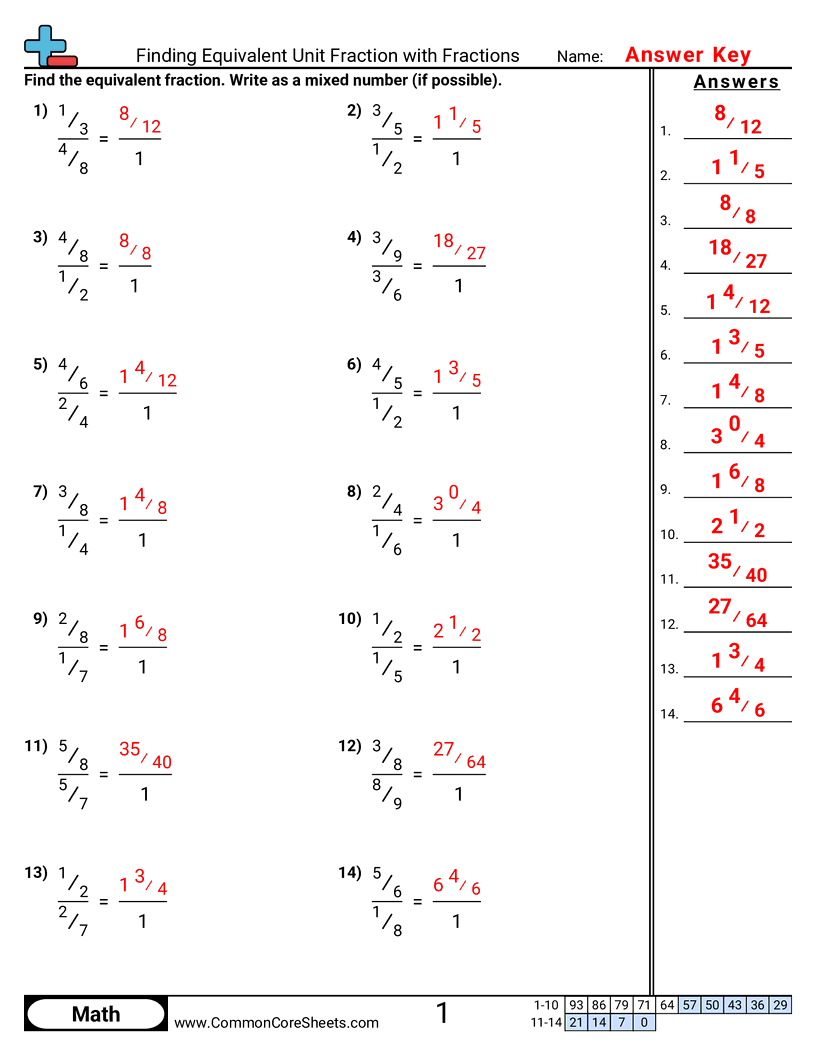
"This worksheet is designed to teach children about equivalent unit fractions in math. It contains 14 problems which introduce the concept of finding equivalent fractions and fosters critical thinking skills. Tailored for a customizable learning experience, this resource can be converted into flash cards for hands-on practice or utilized in distance learning settings. An essential tool for mastering fractions."
×Student Goals: Understanding Unit FractionsUpon completing the worksheet, students should have developed a grasp on the concept of unit fractions. Essentially, they should understand that a unit fraction is a fraction with a numerator of one. This foundational knowledge is critical in the study of more complex math topics as they advance in their studies.Recognizing Equivalent FractionsAnother achievement students should realize after successfully finishing this worksheet includes the ability to recognize equivalent fractions. This ability enhances numerical flexibility and allows students to manipulate numbers more effectively. Through the constant practice of such problems, students are expected to identify equivalent fractions with ease, thus improving mathematical agility.Discerning Non-Equivalent FractionsContrary to identifying equivalent fractions, students should also swiftly discern fractions that aren't equivalent after the completion of the worksheet. This proficiency in distinguishing non-equivalent fractions breeds confidence in dealing with mathematics problems that require quick and accurate identification of relationships between fractions.Solving Mathematical ProblemsAfter finishing the worksheet, students should be able to solve mathematical fraction problems more efficiently. They should be equipped with the problem-solving skills needed to approach math tasks and should be on their way to mastering the ability to apply these skills systematically in order to arrive at the most reasonable solution.Improving Mathematical Language UnderstandingCompleting the worksheet also improves students’ mathematical language understanding. They should be able to comprehend and apply mathematical terms, such as numerator, denominator, and equivalent, in a proper context. Hence, students are exposed to the necessary terminology that will likely be used throughout their mathematical education journey.Enhancing Numerical ReasoningFinally, students should be able to enhance their numerical reasoning skills after completing this worksheet. They should acquire the capability of thinking logically and analytically, making connections among mathematical ideas, and applying the appropriate strategies to solve fraction-related problems.
7rp1Open FolderOpen File×Description:
"This worksheet is designed to develop children's understanding of unit rates in a practical context. With 10 problems covering both everyday and academic scenarios, children are encouraged to analyze how changing one value affects another. Customizable and adaptable, this worksheet can be easily converted into flashcards or integrated into distance learning programs, making it a versatile tool for enhancing math education."
×Student Goals:
7rp1Open FolderOpen File×Description:
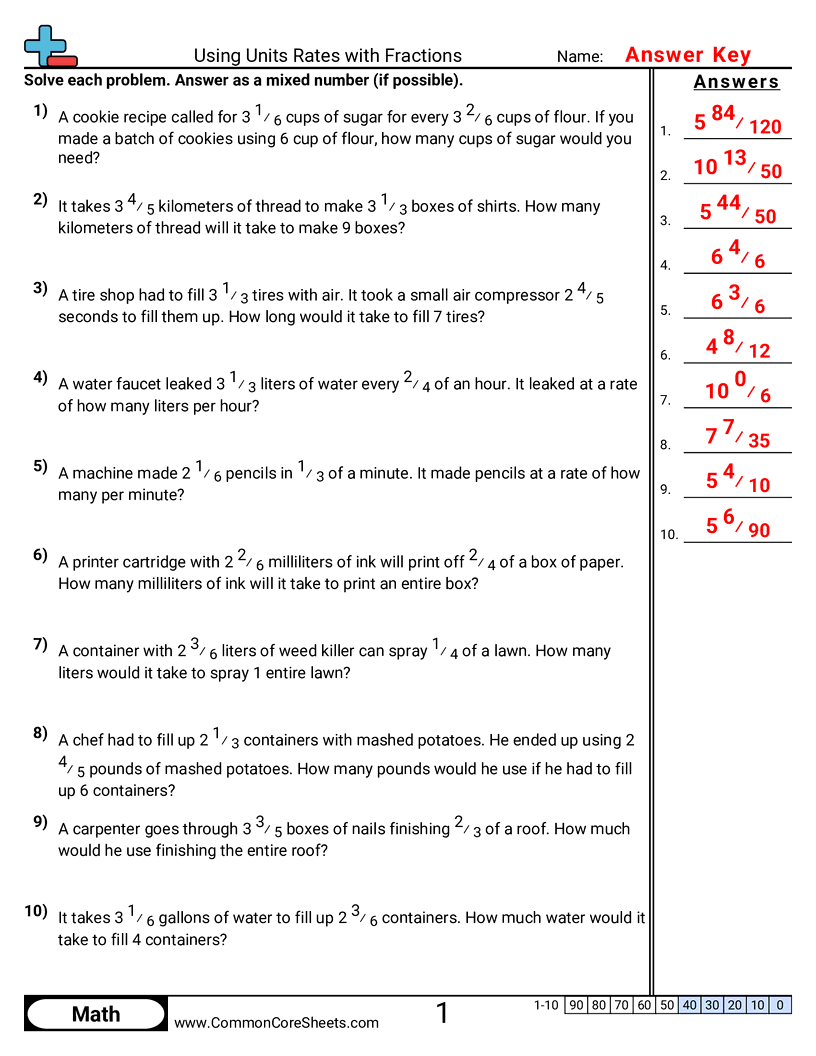
"This worksheet is designed to enhance children's proficiency in math, specifically in using unit rates with fractions. Comprising of 10 hands-on problems, it provides scenarios involving various practical applications, such as measuring time, volume, and distance. Customizable to meet individual learning requirements, it can also be converted into flash cards for engaging study sessions or adapted for distance learning to facilitate continuous education at home."
×Student Goals: Understanding of Fractions and Unit RatesAfter completing these worksheet exercises, students should have significantly developed their understanding of fractions and unit rates. This understanding is not just in theoretical terms but in practical, real-world application scenarios as presented in the problems. They will be able to interpret and manipulate fractions in different contexts, gaining knowledge that is vital in both further mathematical studies and in daily life.Problem Solving AbilitiesStudents will have sharpened their problem-solving abilities by working through each task. The problems provided will challenge students to think critically about the provided scenario and figure out how to solve for the unknown. This analytical approach fosters the skills necessary in numerous future encounters, both scholastically and professionally.Enhance Critical ThinkingThese exercises will enable children to enhance their critical thinking abilities. The situations presented in the questions require a thoughtful analysis to resolve. Therefore, the sheet will be a tool for expanding strategic contemplation abilities in real-world situations, as well as complex mathematics.Real-World Math ApplicationHaving gone through the ten problems, the students will have experienced fractional scenarios based on real-life instances. They should now be capable of taking the abstract principles learned in class and applying them accurately to situations that they might encounter in daily life. Such an ability is crucial as it bridges the gap between theory learned and its use in the outside world.Time Management SkillsBy working through the math problems in this worksheet, students also get to improve their time management skills. Each problem requires a certain level of concentration and time commitment, and being able to balance this is a skill that students will find helpful in their future academic endeavors.Increased Confidence with MathSuccessfully navigating through this challenging, relatable, yet educational worksheet will imbue the student with increased confidence in handling mathematics problems, particularly involving fractions and unit rate. This can boost their overall interest in the subject and motivate them to tackle more complex problems in future.