Functions Define, evaluate, and compare functions.3Interpret the equation y = mx + b as defining a linear function, whose graph is a straight line; give examples of functions that are not linear. For example, the function A = s 2 giving the area of a square as a function of its side length is not linear because its graph contains the points (1,1], (2,4) and (3,9], which are not on a straight line.
8f3Open FolderOpen File×Description:
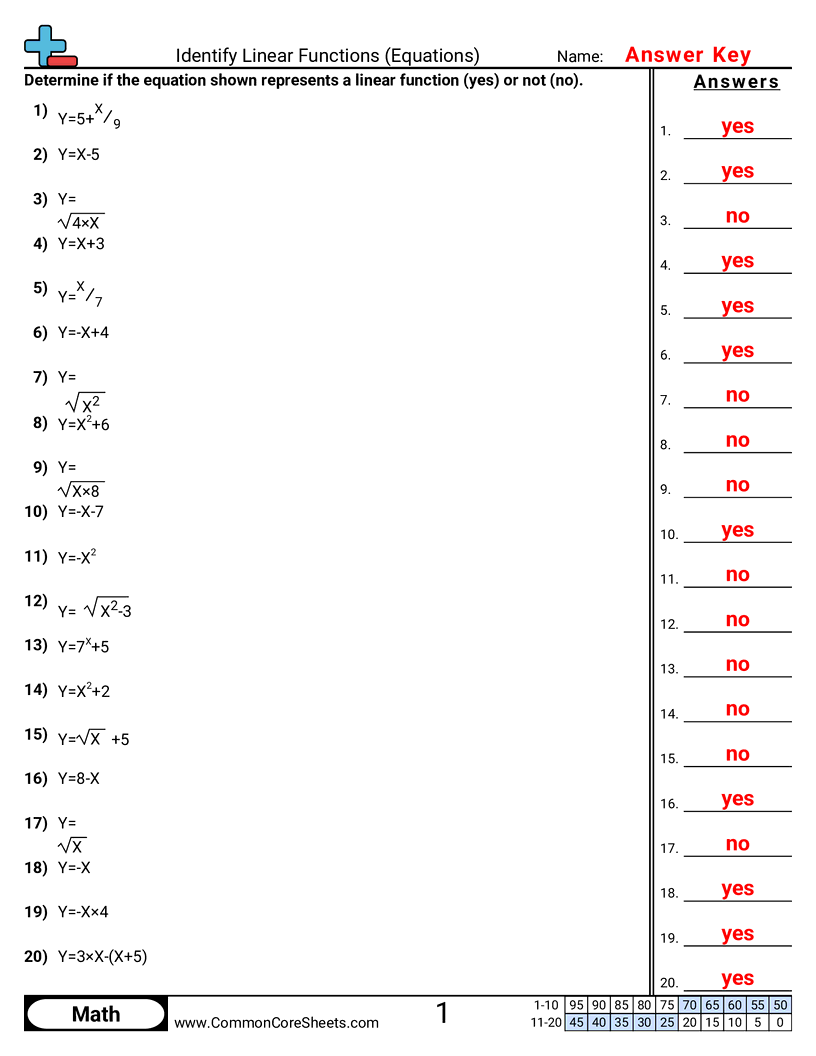
"This worksheet is designed to aid children in identifying linear functions. By solving 20 math problems, they build their understanding of linear equations and their components. In addition to in-person use, the worksheet can be customized for distance learning or converted into interactive flashcards for more engaging study sessions, fostering a dynamic and adaptable learning environment."
×Student Goals: Understanding Linear FunctionsAfter completing this worksheet, students should understand the concept of linear functions thoroughly. They should be able to interpret and simplify linear equations effectively. Identification of linear equations and distinction from other types of equations is another crucial skill acquired.Problem-Solving SkillsStudents will have enhanced their problem-solving skills based on linear equations, such as simplifying and solving functions. Engagement with diverse problems helps to improve their analytical thinking and logic application in solving mathematical problems.Conceptual ClarityThis learning tool aids in providing a clear understanding of functions and variables, critical concepts in learning algebra and advancing in more complex mathematical problems. Fundamental concepts like coefficients, constants, and their roles in shaping the graph of the function.Familiarity with Mathematical NotationStudents will become more familiar with mathematical notation used in algebraic equations, improving their ability to interpret and use these symbols correctly and intuitively in further studies.Real-World ApplicationsThe completion of the worksheet will help students understand the real-world application of linear functions. They will develop the skills to model and solve real-life problems using linear functions, contributing to their problem-solving skills outside the school environment.Preparation for Advanced TopicsThe learning outcomes from this worksheet will be beneficial for more advanced topics in math. An understanding of linear functions serves as a foundation for studying non-linear functions and other higher-level mathematics.Confidence BuildingSolving the problems in the worksheet aids in building confidence in the students. Mastering such topics fosters their interest in math, encourages continuous learning, and helps dispel any fears associated with the subject.
8f3Open FolderOpen File×Description:
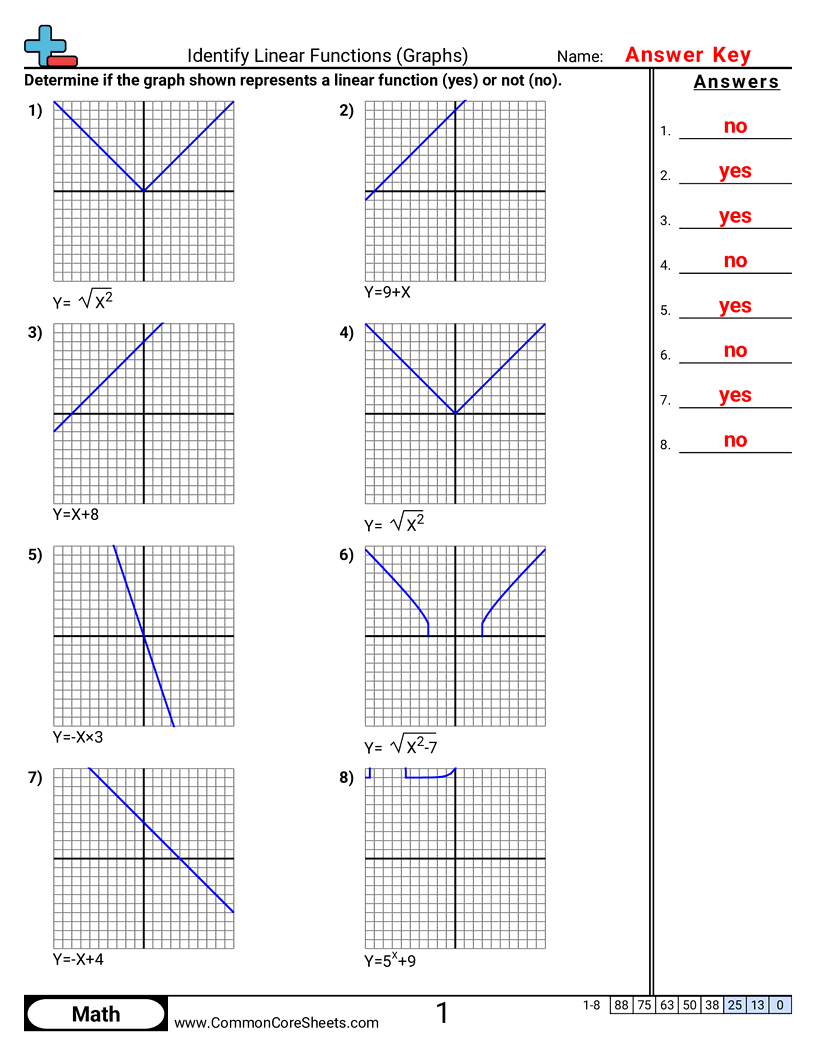
"This worksheet is designed to help children understand and identify linear functions through graphing in mathematics. Consisting of eight problems with varying equations, the worksheet conveys key concepts in a flexible format, which can be customized, transformed into flashcards, or incorporated into distance learning strategies to further aid comprehension and retention of the subject matter."
×Student Goals: Understand and Identify Linear FunctionsAfter completing the worksheet, students will have improved their knowledge of linear functions. They should be able to accurately identify linear functions from given equations. With continuous efforts on similar problems, children should get used to recognizing the general form of linear equations, Y=mx+c. They'll comprehend that 'm' is the slope or gradient and 'c' is the y-intercept.Enhance Problem-solving skillsThis worksheet will provide children with the opportunity to practice and enhance their problem-solving skills. They would be able to understand how changes in 'm' and 'c' can affect the curve of the equation. By working out the problems, they will express a linear function in different forms and translate among these representations.Develop Analytical SkillsStudents after finishing this worksheet would have developed their analytical skills. They will learn to break down complex problems into simpler understandable forms thereby making the learning process more efficient. Rather than just memorization, solving these problems requires a clear understanding of the basics.Improve Graphical Interpretation SkillsChildren will enhance skills of graphical interpretation of linear functions. They'll grasp how an equation forms a straight line graph, recognizing the correlation between the graph and its equation. This exercise should equip students with the ability to intuitively draft and interpret line graphs in future mathematical or real-life problems.Application of Linear FunctionsStudents can expect improved skills in practical applications of linear functions. They should be able to apply the foundation formed here to solve practical problems in science like physics, economics, computer graphics, etc. Mathematics is always around us, and this worksheet serves as a small step towards understanding the world in mathematical terms.Increase Proficiency in AlgebraPractice makes perfect. An expansion in practice of the linear functions will drive the students toward perfecting their algebra skills. It would help them in understanding more complex topics that are based on the knowledge and application of algebra, like calculus and other higher-level mathematics.Promote Logical ReasoningBy solving these progressively challenging problems, students can develop their logical reasoning with mathematical data. They’ll learn deductive reasoning to navigate through potential solutions, which is a valuable life skill extending beyond just mathematics.Boost ConfidenceSolving problems correctly and understanding the process boosts confidence greatly. As students work through the worksheet and gradually comprehend the questions, they will grow more confident in their mathematical ability. This will motivate them to take on more complex problems and challenges in the future.
8f3Open FolderOpen File×Description:
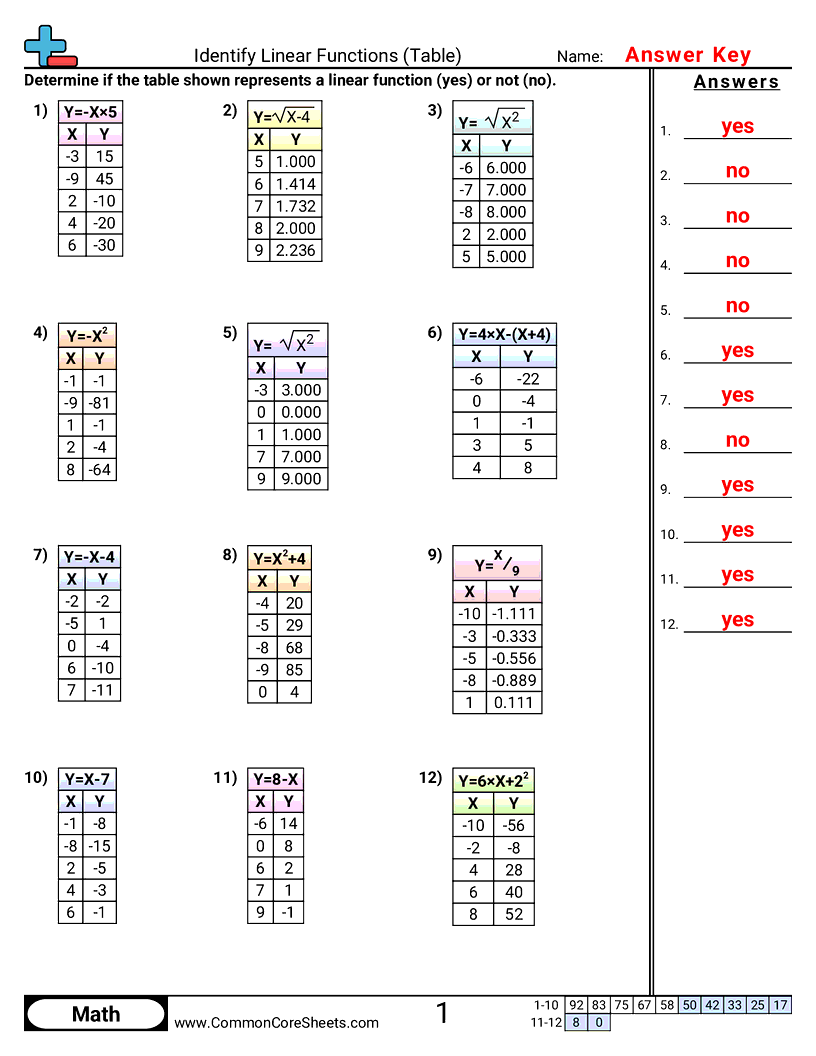
"This worksheet is designed to help children master identify linear functions. Comprising 12 math problems, it utilizes equations and tables format to illustrate concepts effectively. Examples range from simple arithmetic to more complex operations. The flexible format allows it to be customized, converted into flashcards, or adapted for distance learning environments, enhancing its utility in diverse educational settings."
×Student Goals: Understanding Linear FunctionsAfter completing the worksheet, students should have a solid understanding and foundation of identifying linear functions. They should be able to recognize a linear function in a mathematical equation and in table format without confusion. This skill allows students to view functional relationships in a table, deciphering if they follow a linear model.Problem Solving AbilitiesChildren should be able to solve math problems independently which involve linear functions. These problems include those that require both computation and interpretation. This built-up ability can enhance their problem-solving skills and proficiency in tackling mathematical challenges.Improving Analytical SkillsChildren should be able to analyze mathematical situations and apply the concept of linear functions in solving them. This not only emphasizes their insightful thinking, but also their critical evaluations. Such skills can be useful in other areas of studies and everyday life scenarios where analytical thinking is required.Inference and Prediction AbilitiesUpon completion, students should be able to infer information from tables and predict outcomes based on linear functions. For instance, they should be capable of interpreting what Y would be in response to X. Adapting prediction skills is vital in advanced studies and real-life scenarios.Strengthened Math VocabularyRecognizing the language of linear functions will strengthen the mathematical vocabulary of children. The correct use of terms instills confidence and allows the students to communicate mathematically with peers and educators.Preparation for Complex ConceptsThe worksheet prepares the students for more complex mathematical concepts. Understanding of linear functions creates a foundation for grasping intricate concepts such as quadratic functions, exponential functions, etc. This foundational knowledge can be beneficial in future study of algebra, calculus, and other higher math courses.