Algebraic Reasoning & Algebra (A)2.A.2 Use number sentences involving unknowns to represent and solve real-world and mathematical problems.2.A.2.3Apply the commutative property, identity property, and number sense to find values for unknowns that make addition and subtraction number sentences true or false.
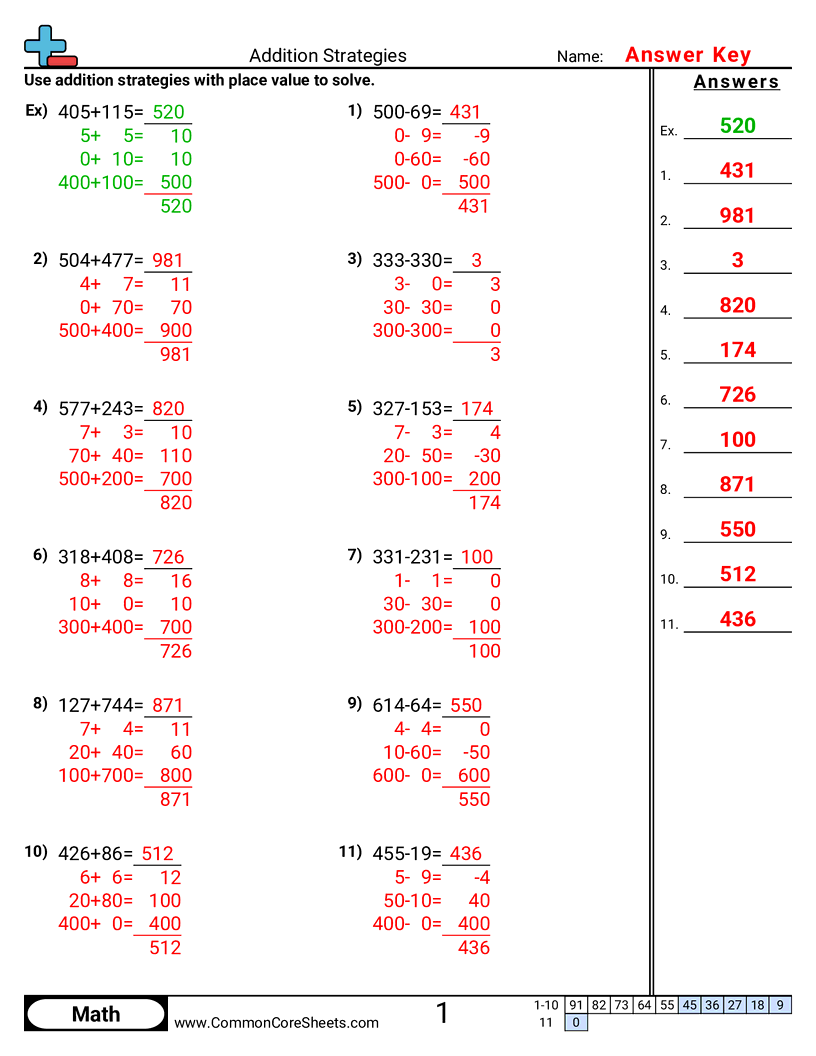
2nbt9Open FolderOpen File×Description:
"This worksheet is designed to enhance children's understanding of math, focusing on addition strategies. With 11 structured problems, it breaks down numerical additions into simpler steps, making it easier to grasp. The worksheet can be customized according to the child's learning speed and difficulty level. It's also convertible to flash cards for dynamic learning. Ideal for distance learning, it is a perfect tool to help children master the fundamentals of addition at their own pace."
×Student Goals: Master Basic Addition and SubtractionAfter completing this worksheet, students will have strengthened their foundational understanding of addition and subtraction. They will be capable of adding and subtracting numbers ranging from single to triple digits. This elementary understanding of arithmetic operations serves as a key building block for all future mathematical concepts.Understanding Number StructureStudents will learn to break down numbers into separate digits, reinforcing their understanding of place value. They will practice adding and subtracting ones, tens, and hundreds separately, underscoring the value of each digit within a larger number. This will aid them in comprehending and mentally visualizing the structure of numbers, an important concept in both mathematics and number sense.Development of Analytical SkillsBy working through the problems presented in this worksheet, students will further develop their problem-solving and analytical skills. They will learn to apply strategies for step-by-step arithmetic operations, thereby enhancing their ability to approach mathematical problems in a systematic and logical manner. This is a crucial developmental step for numerical cognition.Boost Confidence in MathematicsThis worksheet provides students ample practice to boost their confidence in performing addition and subtraction. By mastering these basic operations, they will be more secure in their mathematical abilities, fostering a positive attitude towards learning math. It's a robust step towards laying down a strong foundation for more complex mathematical topics in their future schooling.Promote Independent Learning and ThinkingThe worksheet promotes self-study and encourages students to work independently. The skills attained will allow them to perform math operations without aid and learn to verify their answers independently. The ability to learn independently and think critically are invaluable skills that cross academic boundaries and extend into every part of students' future learning and problem-solving scenarios.
1oa8Open FolderOpen File×Description:
"This worksheet is designed to enhance children's mathematical skills by solving mixed addition and subtraction problems. Comprising of 20 exclusive problems such as '4 + ? = 9', '14 = ? + 7', and '10 = 15 - ?', it provides a fun and engaging way to grasp basic arithmetic. Furthermore, this versatile worksheet can be customized for individual learning needs, converted into flashcards for interactive study, and effectively used for distance learning, promoting dynamic ways to master math."
×Student Goals:
2oa1Open FolderOpen File×Description:
"This worksheet is designed to strengthen children's math skills through engaging problems on word addition and subtraction within 100. Using real-life scenarios, the worksheet facilitates comprehension of basic arithmetic. With 12 problems, it offers ample practice for young learners. Customize it for different needs, convert into flashcards for revision, or incorporate it into distance learning for effective home-based education."
×Student Goals: Mathematical ProficiencyUpon completion of this worksheet, students will significantly enhance their mathematical proficiency, particularly in arithmetic operations within 100. They will have a better understanding of both addition and subtraction and be capable of executing these operations effectively.Real-Life Problem Solving SkillsThe students can apply their numerical skills in solving problems set within a real-life context. For instance, they will understand better how to use addition in daily activities such as exercising, shopping, attending events, and more. This practical application of math in everyday situations promotes their problem-solving capabilities.Number Sense DevelopmentThe worksheet helps students develop strong number sense. Students will develop an intuitive understanding of numbers, their magnitude, relationships, and how they are affected by operations. This can eventually aid them in making reasonable estimates and judgements about the results of computations.Critical Thinking and Analytical SkillsThe problems presented in this worksheet require not only basic addition and subtraction knowledge but also analytical thinking. Students will have to decode the problem's context, identify the correct operation to use, and apply it to find the solution, thus enhancing their critical thinking skills.Improved Mathematical VocabularyUpon completion, students will have a comprehensive understanding of common mathematical terminology used within word problems, leading to an improved mathematical vocabulary. This enhances their mathematical communication skills, which are vital for further studies in math and science subjects.Confidence and Enjoyment in MathPracticing with this worksheet and gradually mastering these problems will instil in students a sense of achievement and confidence in their numerical abilities. Students will find enjoyment in solving these problems, which can foster a positive attitude towards learning math and encourage them to take on even more challenging mathematical tasks in the future.
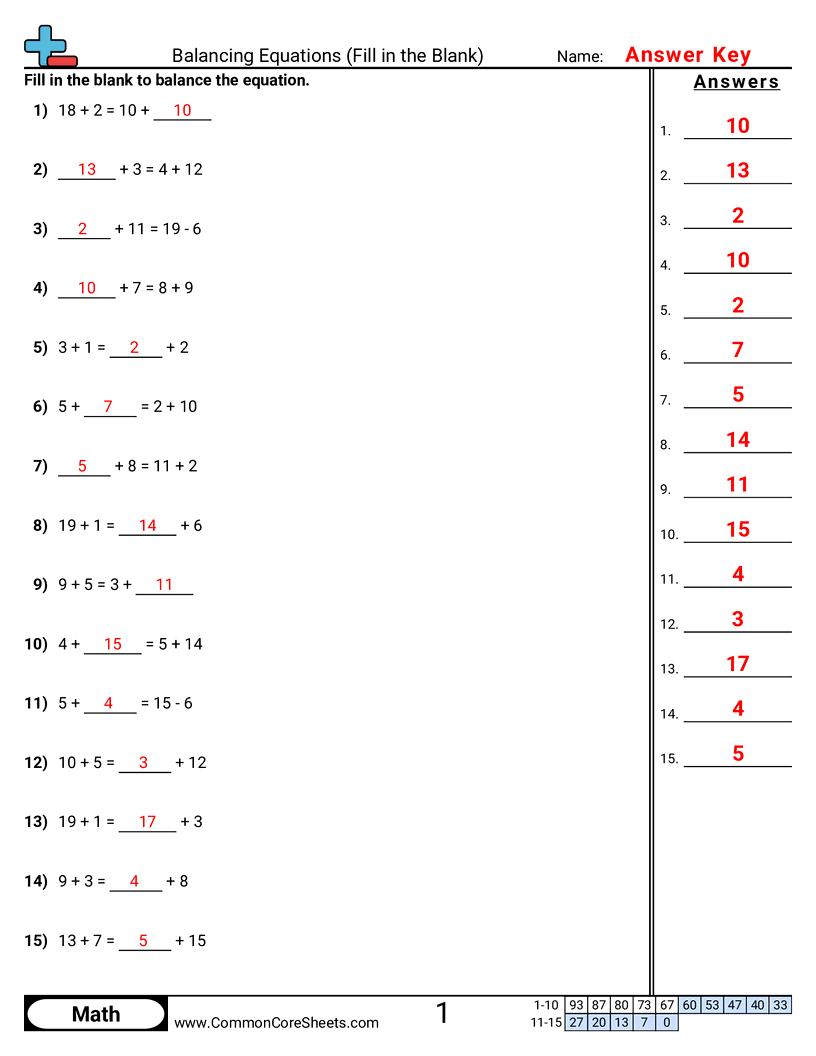
1oa7Open FolderOpen File×Description:
"This worksheet is designed to bolster children's mathematical prowess, delving into the intriguing concept of balancing equations. With 15 tailored problems encompassing addition and subtraction, children are motivated to fill in the blanks, nurturing their problem-solving skills. Apart from its flexibility in customization and feasibility for distance learning, the worksheet can also be effortlessly converted into engaging flash cards, aiding in an interactive and fun learning process."
×Student Goals: Improve Basic Math SkillsAfter successfully completing the worksheet, students should have enhanced their basic math skills, such as addition and subtraction. This worksheet aims to strengthen students’ fundamental understanding of simple math equations. They can learn to perform addition and subtraction more quickly and accurately, hence boosting their overall math proficiency.Developing Problem-Solving AbilitiesThe worksheet is not only about solving equations but also how to solve them. It encourages students to critically think about the problem and explore various ways to come to a solution. This process will result in improved problem-solving abilities and a sharper analytical mind.Understand the Concept of Balance in EquationsChildren will gain a better understanding of the concept of balance in equations. As the worksheet revolves around 'fill in the blanks' formula, students should be able to determine the necessary number that would balance the given equation on both sides. As a consequence, they should become proficient in recognizing patterns and develop the numeracy skills necessary in higher mathematics.Increased Confidence in MathematicsThis worksheet is a step towards becoming more confident in their mathematical abilities. Upon mastering the problems in this worksheet, students should feel more confident and less apprehensive about math. They will develop a positive mindset towards mathematical problems and view them as brain-training exercises rather than a chore.Better Preparation for Advanced TopicsBy enhancing their basic math skills, understanding balance in equations, and problem-solving abilities, students are setting a strong foundation for more advanced topics. As they move up to higher grades, having a firm grasp of these principles will be invaluable. They will be better equipped to handle more advanced equations and mathematical problems.
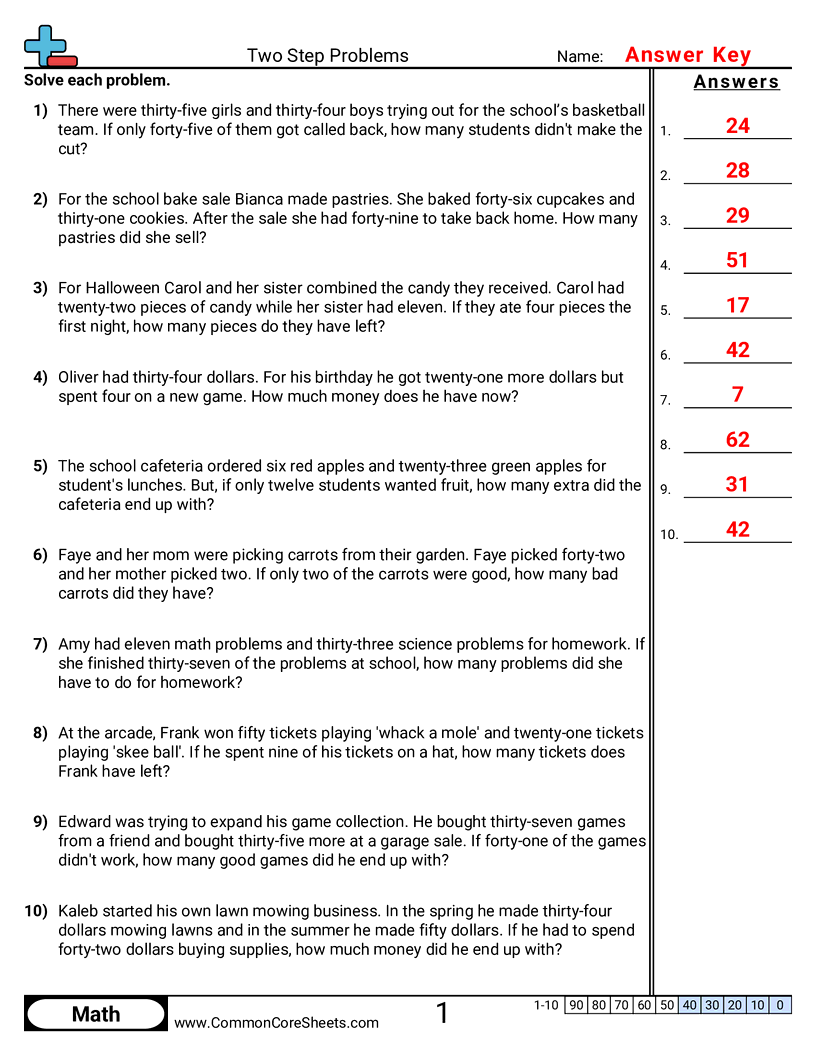
2oa1Open FolderOpen File×Description:
"This worksheet is designed to help students enhance their math skills by solving two-step problems. Covering topics from shopping totals to game collections, it includes 10 unique problems to solve and is perfect for reinforcing numeracy abilities. Easily customizable, this worksheet can be converted into flash cards or utilized in distance learning environments, making it a versatile resource for innovative math learning."
×Student Goals: Two-Step Problem SolvingAfter completing the worksheet, students should be able to solve two-step math problems efficiently. They will gain a strong understanding of the process involved, learning how to break down problems into manageable tasks and employing basic math operations (addition, subtraction, etc.) in a sequential manner.Critical Thinking SkillsThe complexity of these two-step problems encourages the development of critical thinking. Students will learn how to approach a problem, decide which steps to follow, and how to execute them correctly. This skill is essential not only in math but also in everyday situations where problem-solving is required.Number SenseThe tasks in this worksheet enhance students’ number sensing abilities. By calculating the sums or differences, they will be more familiar with numbers and their relationships, which aids in improving mathematical fluency.Real-World ApplicationPost completion of this worksheet, students will acquire skills to solve problems that depict real-world scenarios. They will learn to apply their mathematical knowledge to situations they might encounter in daily life, thus understanding the relevance and utility of math in a real-world context.Confidence BuildingHaving addressed these problems, students will gain confidence in their ability to tackle complex tasks. This worksheet equips them with the capacity to deal with difficulty levels that increase gradually. As the pupil realizes that they can solve these problems, their confidence in their mathematical abilities will bolster.Mathematical VocabularyBy working through problems, students will be exposed to mathematical terms and language, which can enhance their mathematical vocabulary. They will become more comfortable with using and understanding these terms, supporting better performance in math and related disciplines.
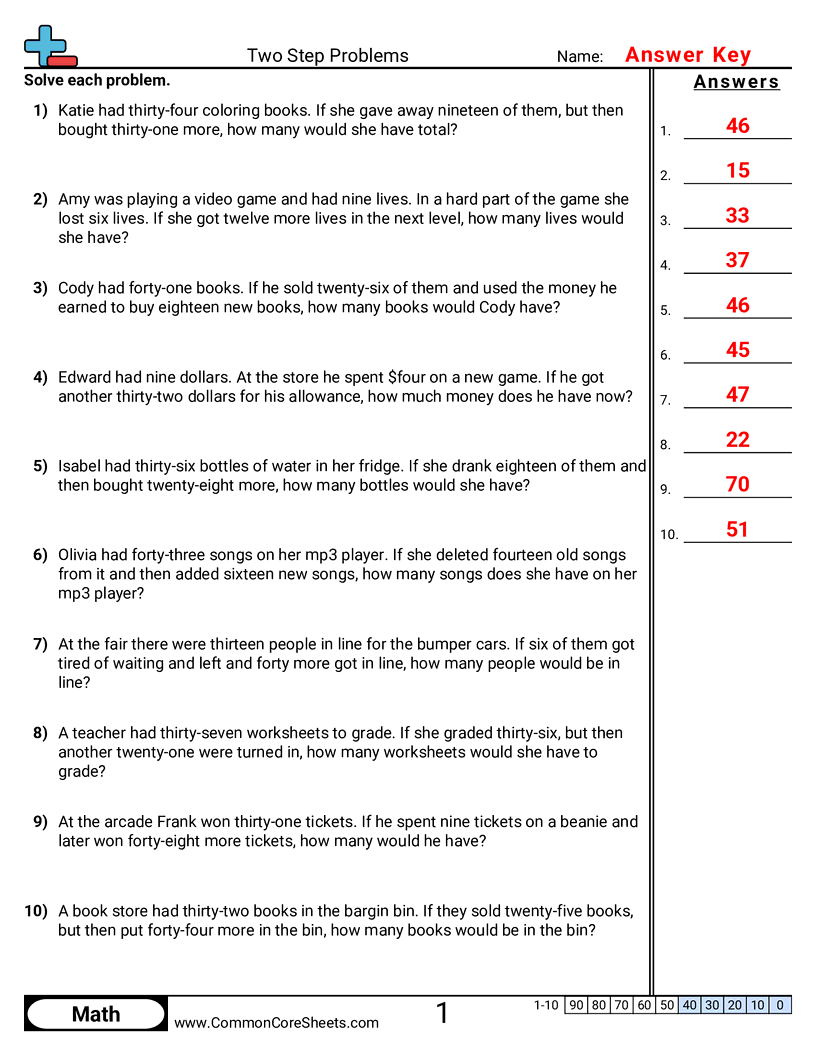
2oa1Open FolderOpen File×Description:
"This worksheet is designed to enhance children's math skills through two-step problem-solving exercises, focusing on real-life scenarios involving addition and subtraction. It is an adaptable tool, perfect for traditional or distance learning environments. Concepts captured can easily be customized or transformed into flash cards, providing variability in teaching modalities. It contains 10 engaging problems aimed at making learning maths enjoyable and practical."
×Student Goals: Enhanced Mathematical SkillsAfter completing the worksheet, students should have significantly improved their mathematical skills. Specifically, they should be able to perform addition and subtraction operations effortlessly. These basic operations are utilized throughout the questions in this worksheet, allowing students to practice and reinforce these core maths skills.Problem-Solving AbilityWorking on these problems is expected to enhance the students’ ability to evaluate, analyze, and solve complex problems. The two-step word problems presented in the worksheet require students to first process the problem, break it down into simpler parts, and then apply suitable operations to find the solution. This ability to decipher complex problems into manageable tasks is valuable not only in mathematics but also in daily life.Logical Reasoning SkillsBy dealing with the two-tier problems in the worksheet, the students will be able to improve their logical reasoning skills. They will learn to connect multiple facts together in a logical order to reach a reliable conclusion. This skill will enable them to tackle more complex equations in future, making them ready for advanced levels of mathematics.Attention to DetailWorking through these problems will encourage students to pay greater attention to details. These two-level problems require students to read carefully, identify variables, understand the relationship between different variables, and apply the correct mathematical operations to solve them. Gaining this skill will allow them to approach future mathematical problems with greater precision and thoroughness.Increased ConfidenceSuccessfully completing the worksheet should increase the students' confidence in handling mathematical problems. They will gain self-assurance from knowing they are capable of solving relatively complex two-step problems. Having the confidence to overcome mathematical challenges will serve them well as they progress in their educational journey.Grasp of Practical Application of MathLast but not least, the practical nature of the problems in the worksheet, representing real-life situations, allows the students to understand the practical application of mathematical concepts. They will have a clearer perception of how these principles can be utilized in their daily experiences, thereby promoting a more profound understanding and interest of the subject.
2oa1Open FolderOpen File×Description:
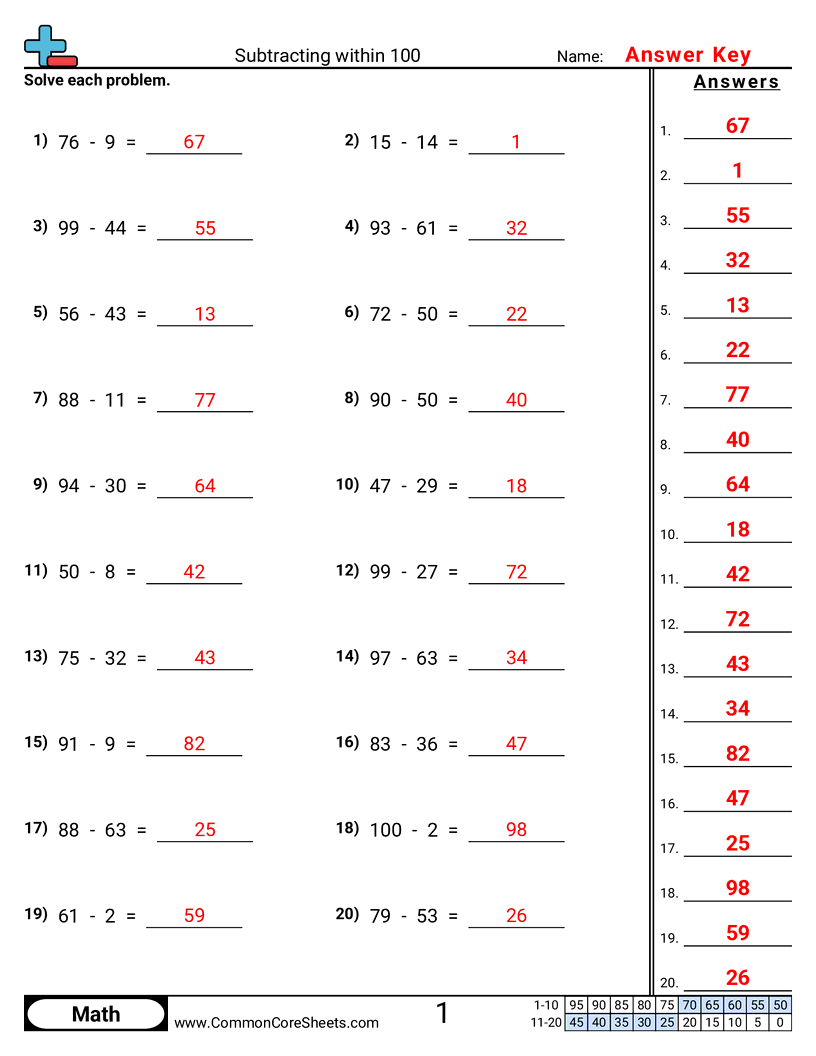
"This worksheet is designed to strengthen children's subtraction skills within the 100 range, providing 20 examples of varied complexity. It covers essential math topics, while offering flexibility for customization or conversion into flashcards. Its digital format also makes it accessible for distance learning, promoting continual mathematical learning beyond the traditional classroom setting."
×Student Goals: Understanding Subtraction ConceptAfter completing the worksheet, students should have a stronger grasp of the concept of subtraction. They should be able to define subtraction as taking away from a group or decreasing the amount and identify the related symbols and terminology.Subtracting within 100Students should be able to accurately subtract two numbers within 100. This includes understanding and applying the process of regrouping if necessary. They should understand the sequence of numbers up to 100, enabling them to perform subtraction operations accurately.Applying Subtraction in Real-Life SituationsStudents should be able to apply their subtraction skills to real-world situations. They can use subtraction to solve problems involving loss, comparison, and difference scenarios. They can also compare and order objects based on their numbers and perform calculations involving monetary transactions.Developing Fluency with SubtractionUpon completion of the worksheet, students should be well on their way to achieving fluency with subtraction. They should be able to subtract rapidly and accurately, which is a necessary skill for solving more complex mathematical problems.Improving Problem-Solving SkillsThis worksheet will exercise students' problem-solving skills. They should be able to follow a mathematical process to reach a correct answer, verify their answers through reverse operations or use of a number line, and apply their mathematical knowledge to solve subtraction problems.Building Confidence in MathematicsA significant accomplishment should be an increase in students' confidence in their math capabilities. After successful completion of the worksheet, they should feel more comfortable with subtraction problems, enhance their math vocabulary, and be prepared for more complex arithmetic operations.
2oa1Open FolderOpen File×Description:
This worksheet is designed to help children master the concept of subtraction within 100 through twelve engaging math problems. The problems vary from simple subtraction to 'start unknown' and 'change unknown' scenarios, enhancing children's problem-solving skills. The worksheet is versatile and customizable; it can be converted into flashcards or incorporated in distance learning as a teaching resource, making learning subtraction within 100 a fun and interactive experience.
×Student Goals: Enhance Numeracy SkillsUpon completing the worksheet, students should have significantly improved their basic numeracy skills. They should be able to comfortably and accurately perform subtraction operations within the range of 100, enhancing their mental arithmetic abilities and providing a solid foundation for more complex math problems.Problem-Solving AbilitiesStudents should exhibit a strong grasp on problem-solving strategies by successfully completing the problems provided on the worksheet. They should be adept at implementing crucial steps such as interpreting the problem, planning a solution, carrying out that plan, and checking their work to ensure accuracy.Comprehension and ApplicationThe real-world scenarios given in the worksheet demonstrate how mathematical principles can be applied to daily life. After working through these scenarios, students should have a better understanding of how subtraction functions in practical contexts, thereby enhancing their ability to apply mathematical knowledge outside of academic settings.Fluency in Mathematical LanguageWith subtraction terms like 'Take From (Result Unknown)', 'Add To (Result Unknown)', and 'Take From (Change Unknown)', students should develop fluency in the specialized language of mathematics. They should be comfortable using these terms and understanding their relevance to different problem contexts.Progress TrackingFinally, the completion of the worksheet serves as an effective means of tracking students' progress. By evaluating the number of correct responses, students and educators can gauge the improvement in skills over time, identify areas of strength and weakness, and adjust learning strategies accordingly.
1oa7Open FolderOpen File×Description:
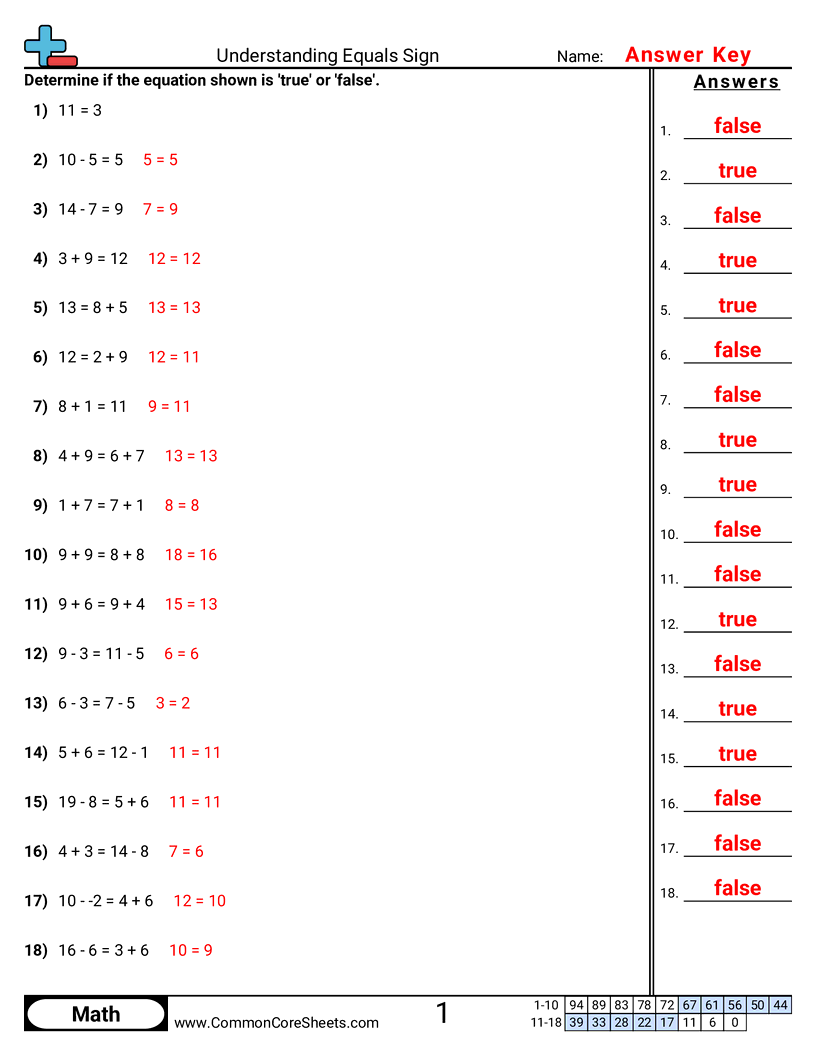
"This worksheet is designed to teach children the principles of math, focusing on the understanding of the equals sign. The 18 engaging problems will challenge students to grasp equivalent equations. Ideal for distance learning and adaptable to flashcards, this versatile worksheet can be tailored to individual learners. Enhance your child's math skills with these stimulating exercises."
×Student Goals: Understanding the Equals SignUpon completion of the worksheet, students will have a comprehensive understanding of the equals sign and how it is used in basic mathematics. They will be aware that the equals sign symbolizes equivalence or equality, meaning what is on the left side of the equals sign will always be the same as what is on the right side.Developing Problem-Solving SkillsStudents will improve their problem-solving skills by determining mathematical correctness in equations. This would involve deductive reasoning skills to identify the right values on either side of the equals sign. As problem-solving is fundamental in all areas of life, this skill is a valuable learning outcome.Arithmetic ProficiencyThe worksheet will also help students in gaining proficiency in basic arithmetic including addition and subtraction. Students will be able to accurately perform these operations and understand their relationship with the equals sign.Mental Math SkillsCompletion of the worksheet will enhance students' mental math skills. They will be able to perform basic addition and subtraction calculations mentally, promoting quicker mathematical thinking, which is not only useful for their educational pursuits but also for daily life scenarios.Preparation for Advanced MathematicsOnce students have achieved a solid understanding of the equals sign and its application in basic arithmetic, they are preparing themselves for more advanced mathematical concepts. This foundational knowledge will serve as a building block for future mathematical explorations, setting the stage for more complex challenges.Boost Confidence in MathematicsWhen students successfully complete the worksheet, they will gain more confidence in their abilities to perform mathematics. This increase in confidence can lead to improved performance in the subject, as well as a greater willingness to take on more complex math problems in the future.