Data & Probability (D)2.D.1 Collect, organize, and interpret data.2.D.1.1Explain that the length of a bar in a bar graph and the number of objects in a pictograph represents the number of data points for a given category.
2md10Open FolderOpen File×Description:
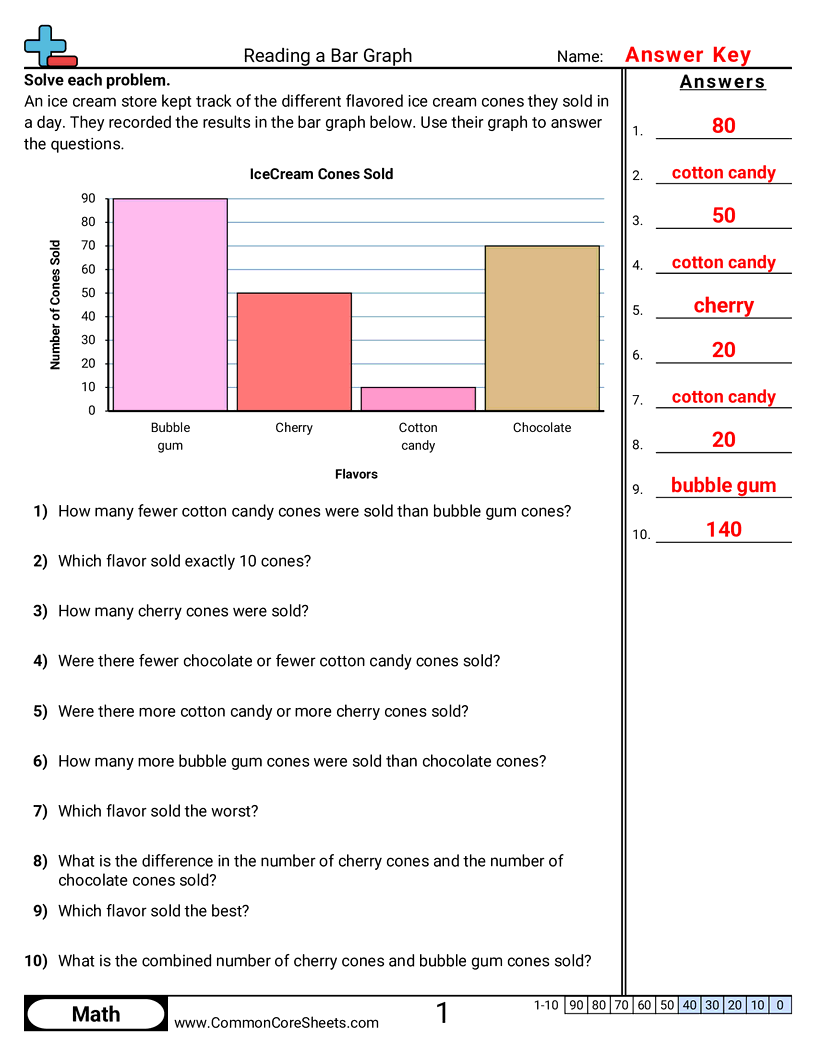
"This worksheet is designed to teach children the fundamentals of interpreting bar graphs in an engaging way. The focus is on reading graphs to understand and compare monetary savings data. With 10 problems, children can engage with real-world applications of math. The worksheet is flexible and can be customised to your child's needs, even converted into flashcards for convenient learning. It also serves as an excellent resource for distance learning, making math education accessible and fun."
×Student Goals: Understanding GraphsStudents should have a good command over reading and interpreting bar graphs. They should be able to distinguish the different segments, their sizes and accurately identify and compare the quantities represented by these segments on the bar graph. Grasping the concept of graphical representation of data will equip these young learners with the aptitude to navigate through the increasingly data-centric world.Problem-solving skillsThe worksheet is also designed to improve students' problem-solving skills. They should be able to decipher the problem in each question, apply the right approach to find the solution and understand the logic behind each solution. This enhances their analytical thinking and improves their ability to solve real-life problems.Basic mathematical conceptsStudents should be able to grasp basic mathematical facets like understanding quantities, differences, comparisons and totals. They should be equipped to identify who has saved the most or the least amount of money, what the difference is between two amounts, and what the total sum of money saved is. This understanding will lay a solid foundation for dealing with numbers and calculations in their future academic journey.Comparison skillsA crucial accomplishment is the enhancement of the children's ability to compare and contrast quantities. They will be enabled to tell who saved more or less money, thereby building the rudimentary concepts of comparison into their cognitive skill set. This will allow them to better interact with their environment, making them more competent in distinguishing between various quantities and scales.Applied learningUsing real life context such as savings, this worksheet thereby introduces young learners to the concept of applied learning. After completing the worksheet, they should be able to apply the mathematical concept of 'saving' in their real life, enhancing their arithmetical competence and equipping them with the knowledge to manage finances at an elementary level.
2md10Open FolderOpen File×Description:
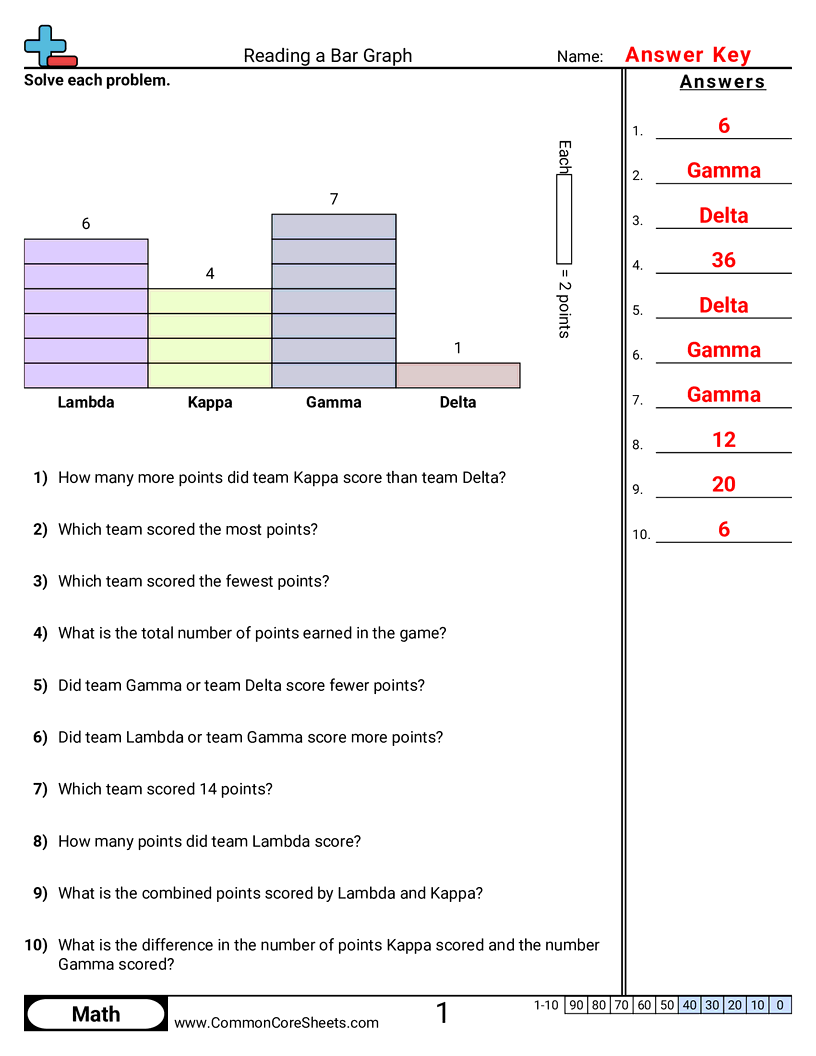
"This worksheet is designed to enhance children's mathematical skills specifically in reading and interpreting bar graphs. Featuring 10 problems, it presents questions about point comparisons among teams, highest and lowest scores. The customizable content can easily be converted into flash cards for interactive learning or utilized in distance learning settings, fostering independent comprehension of this critical aspect of math education."
×Student Goals: Understanding the Concept of Bar GraphsThe completion of this worksheet should enable children to understand and interpret the information presented via bar graphs. They should be able to analyze the relative heights of different bars, distinguishing between longer and shorter ones and understanding what that difference signifies in the context of the data being presented. This skill is crucial for data interpretation not only in math, but in science, and social studies as well.Application of Mathematical OperationsAfter completing the worksheet, the students should be more competent in applying basic mathematical operations such as addition, subtraction, and comparison when interpreting data from bar graphs. This means they can determine more or fewer scored points, the team with most or fewest points, the total points scored, and the points scored by a particular team or teams. These abilities reinforce the practical use of math in real-world situations.Critical Thinking and Analytical SkillsStudents will develop their critical thinking and analytical skills. They will be able to identify trends, make comparisons, and interpret data in context, skills which are transferable to many other areas of study and everyday life. For instance, the ability to discern which team scored 20 points means they can spot specific data in a larger set.Problem Solving AbilitiesStudents should demonstrate improved problem-solving abilities by drawing logical conclusions from the data represented. By discerning differences in points scored between teams, they are fostering an understanding of the application of mathematics in problem-solving.Incremental Learning and Confidence BuildingLastly, completing the worksheet successfully should result in students building their confidence in understanding and using bar graphs. This confidence can stimulate interest and curiosity in further learning about more complex data interpretation involving other forms of graphs and charts. Incremental learning like this forms a strong foundation for more advanced topics in future mathematical studies.
2md10Open FolderOpen File×Description:
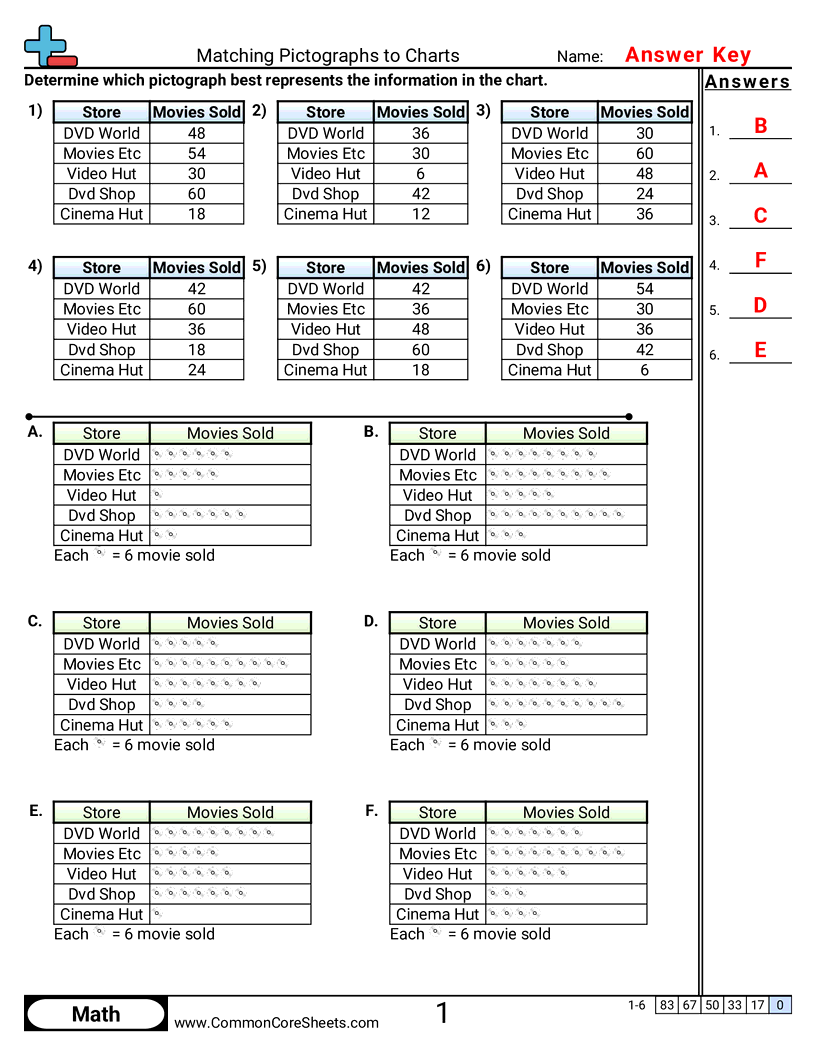
"This worksheet is designed to enhance children's mathematical skills by matching pictographs to charts. The exercise involves six problems where kids correlate the number of fish caught on different days. The worksheet introduces them to key concepts in data interpretation and number patterns. Easily customizable, it can be converted into flash cards, or adapted for distance learning, offering a versatile educational tool to boost mathematical comprehension."
×Student Goals: Understanding Pictographs and ChartsAfter completing this worksheet, students should have a deeper understanding of pictographs and charts. They will be able to identify and read different types of pictographs, understanding how different symbols and icons represent different quantities. Furthermore, students will be able to comprehend the conversions between pictographs and charts, enhancing their analytical skills in the process.Handling Numerical DataThe exercise aids students in honing their skills in handling and interpreting numerical data. They will learn to analyse the relationships between different sets of data and what they signify, bolstering their ability to make deductions based on numerical information. This will serve as a stepping stone towards more complex numerical computations and analysis in future mathematical concepts.Correlating Days and ValuesThe worksheet also provides a contextual understanding of correlating certain values with certain days, promoting their skill in data logging and tracking. This foundational understanding of data correlation will enhance their capabilities in various everyday activities, like keeping track of personal habits or observing trends over time.Boost Critical Thinking and Problem Solving SkillsWorking through this worksheet promotes development of critical thinking and problem-solving skills. It requires students to match relevant information from different sources, a skill that is important in many real-life situations. In addition, the process of matching pictographs to charts improves their cognitive skills, pattern recognition and logical thinking.Growth in Confidence and Competence in MathThis worksheet aims to increase students' confidence and competence in math. It provides students the opportunity to apply their theoretical understanding of pictographs and charts to practical examples. By successfully completing the exercise, the students will achieve a sense of accomplishment and a growth in their confidence in working with numerical data, which is critical for their future mathematical learning.
2md10Open FolderOpen File×Description:
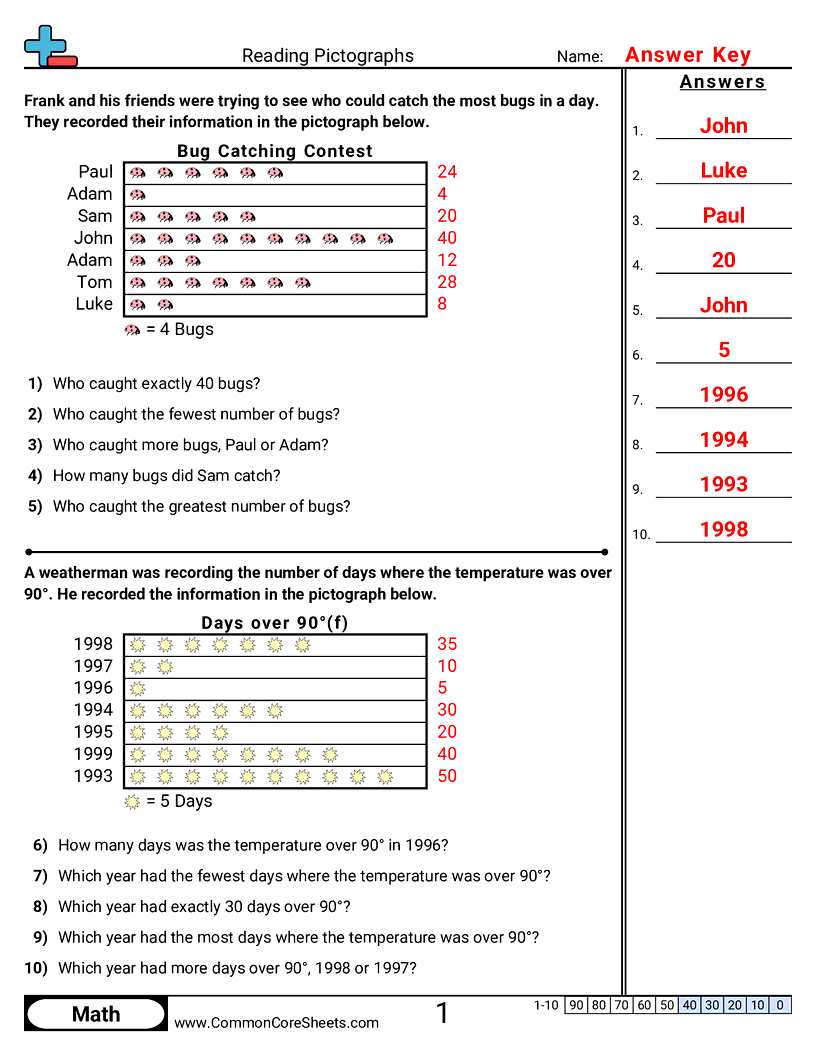
This worksheet is designed to enhance children's analytical skills in math by reading pictographs. With ten diverse problems to solve, it explores concepts like comparing quantities, identifying specific data points, and weather pattern analysis. A versatile tool, it can be customized to cater to individual learning needs, converted into flash cards for interactive learning, or used in distance learning environments. This makes it ideal for multi-purpose educational use.
×Student Goals: