Numbers & Operations (N)4.N.3 Represent and compare fractions and decimals in real-world and mathematical situations; use place value to understand decimal quantities.4.N.3.1Represent and rename equivalent fractions using fraction models (e.g., parts of a set, area models, fraction strips, number lines).
4nf1Open FolderOpen File×Description:
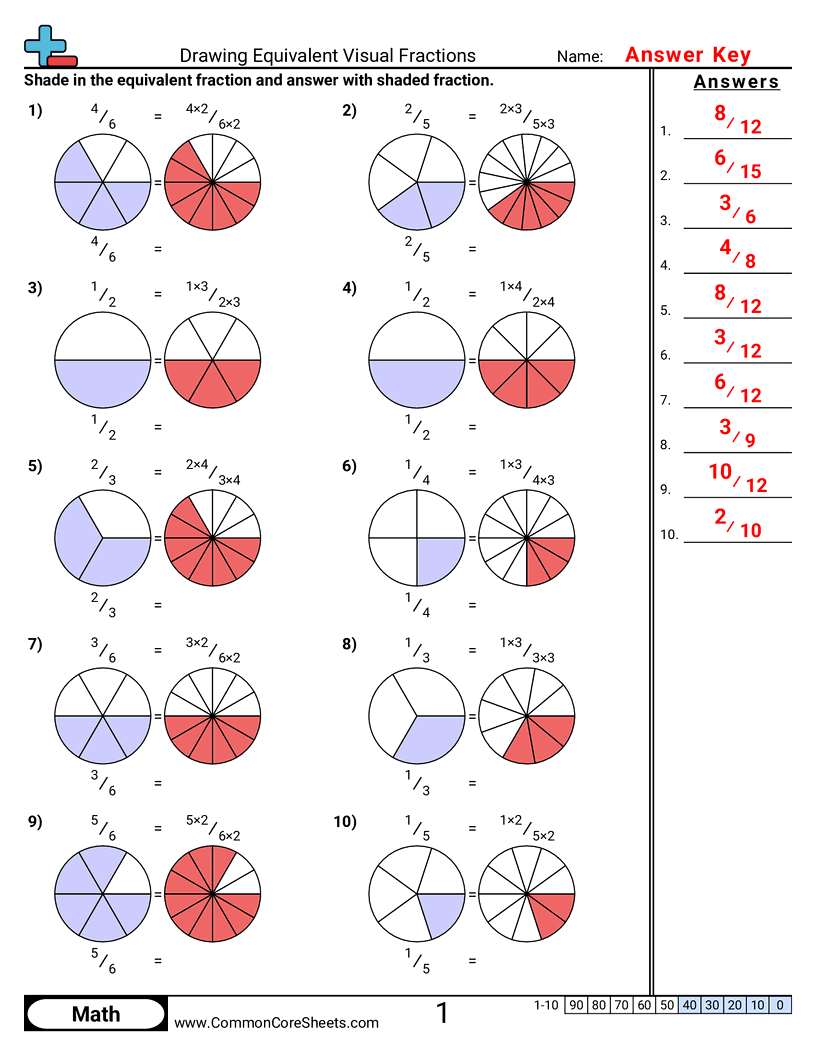
"This worksheet is designed to teach children fundamental math concepts, focusing specifically on visualizing equivalent fractions. The customizable, child-friendly format includes 10 unique problems, each creatively illustrated to enhance understanding. The worksheet's dynamic nature allows it to be easily converted into flashcards for versatile learning, or used effectively for distance learning. It is an innovative tool for making fractions easy and fun for kids to learn."
×Student Goals: Understanding of Equivalent FractionsAfter completing the worksheet, students should have a strong, foundational understanding of equivalent fractions. This fundamental math concept is integral to grasping more complex mathematical ideas down the road. The completed worksheet should provide tangible proof of their ability to interpret and manipulate fractions, proving they understand that different fractions can represent the same value.Mastery of Fraction MultiplicationThe worksheet is designed to test and reinforce a student's ability to multiply fractions. Upon completion, students should be comfortable with multiplying fractions, both in terms of the mathematical mechanics and understanding the implications of the operation. They should be able to multiply any given fractions, reducing them to their simplest form when necessary.Visual Representation of FractionsThe exercises included in the worksheet will also require students to draw visual representations of the fractions they're working on. Completing these problems should result in the student's ability to visualize fractions, which is extremely valuable in breaking down more complex problems. The visualization skill also makes it easier for students to understand and remember the concepts.Problem Solving and Critical ThinkingWorking through the equivalent fractions worksheet requires logical thinking and the application of problem-solving skills. Upon finishing the worksheet, students should have more confidence in their ability to approach math problems critically and strategically. This boosts their overall mathematical reasoning skills and prepares them for tackling diverse problems in the future.Mathematical Vocabulary ExpansionThis worksheet involves exposure to, and use of, specific mathematical vocabulary. As students solve the problems, they will need to use correct mathematical language, terms, and symbols. Therefore, upon completion, they should have broadened their mathematical lexicon, which is essential for eventual mathematical literacy.
4nf1Open FolderOpen File×Description:
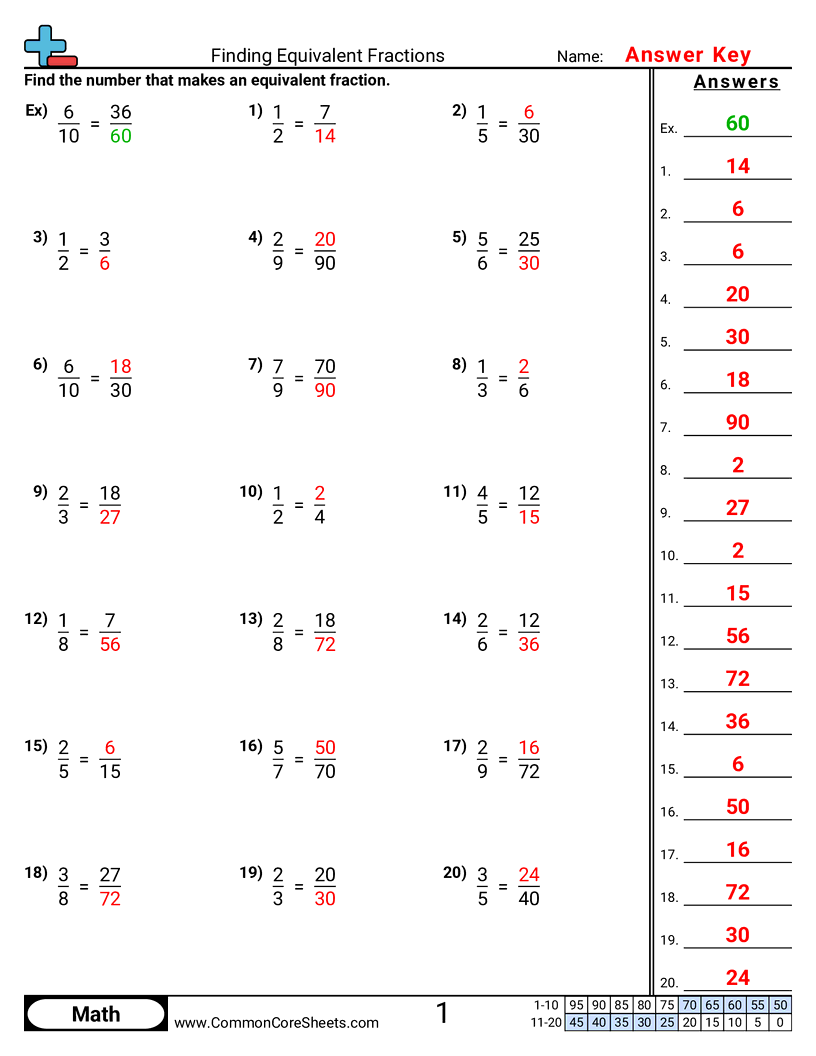
"This worksheet is designed to help children grasp the concept of equivalent fractions in math. It features 20 interactive problems, with examples such as 1/6 equals 2/12, 7/9 equals 28/36, and 3/6 equals 30/60. Perfect for distance learning, the worksheet can be customized for individual needs and even converted into flashcards to further facilitate understanding. Enhance your child's math skills through this engaging and adaptable tool."
×Student Goals: Understanding Equivalent FractionsAfter completing this worksheet, students should have a strong understanding of equivalent fractions. This fundamental concept in mathematics is critical as it underpins many more complex areas of study within the subject. By practicing to find equivalent fractions, students improve their problem-solving abilities and enhance their mathematical reasoning.Enhancing Calculation SkillsWorking through the worksheet will also help students to refine their calculation skills, especially their division and multiplication abilities. By repeatedly identifying equivalent fractions, students will become more fluent and confident in performing these calculations, helping them to improve their overall math competency.Improving Number SenseThe worksheet encourages the development of a strong number sense, which is the understanding of what numbers mean and their relationship to one another. By finding equivalent fractions, students will actively explore the relationships between numbers, leading to a deeper comprehension of mathematics.Developing Pattern RecognitionAs students work through the problems in the worksheet, they will also have opportunities to recognize and predict patterns. This is an important mathematical skill that will support them in diverse areas of study, such as algebra and geometry.Applying Mathematical ConceptsAt the completion of the worksheet, students will not only have bolstered their understanding of equivalent fractions but will also have enhanced their ability to apply this knowledge. Whether solving more complex mathematical problems or using these skills in real-world situations, they will be equipped with a crucial knowledge base, helping them excel in future learning endeavors.Building ConfidenceFinally, with each problem they successfully solve, students are building their confidence in solving mathematical problems. Overcoming challenges faced in this worksheet can foster perseverance and resilience, which are beneficial not just for math but for every aspect of their learning journey.
4nf1Open FolderOpen File×Description:
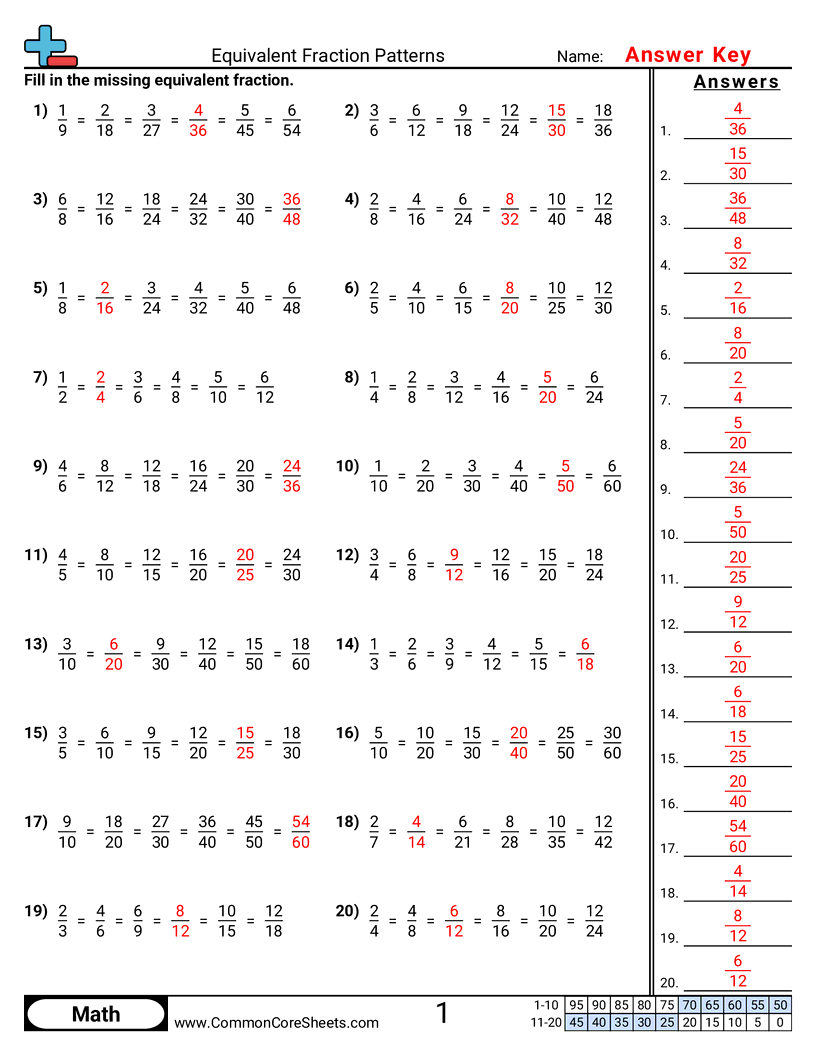
"This worksheet is designed to teach children about equivalent fractions through pattern recognition in math. It features 20 unique problems, where fraction equivalencies are visually represented in table format. The interactive nature of the content allows for customization, including the capacity to convert the worksheet into flash cards. This feature extends its usability, making it an excellent tool for distance learning and homeschooling environments."
×Student Goals: Understand Equivalent FractionsWith successful completion of this worksheet, students should develop a solid understanding of equivalent fractions. They should be able to recognize that different fractions can represent the same part of a whole, enhancing their numerical flexibility. This forms the basis for strong mathematical reasoning, feeding into other areas of number theory and arithmetic.Develop Problem-Solving SkillsThese carefully designed fraction problems should help students strengthen their problem-solving skills. By unraveling patterns and deducing the correct numerical value for each equivalent fraction, students exercise both inductive and deductive reasoning, preparing them for advanced math hurdles. This process refines their decision-making skills, teaching them to strategize and choose the most efficient route to a solution.Enhance Mental ArithmeticBeing repeatedly exposed to and working on these fraction problems will enhance students' mental arithmetic. They will be more comfortable and quicker at processing numbers mentally, which will be fruitful not just in mathematics, but across all subjects and day-to-day applications, increasing their number sense.Grasp Number PropertiesCompletion of this worksheet should aid students in grasping the properties of numbers, and how they interact in the context of fractions. They will have gained an understanding of the important mathematical concepts of ratio and proportion, thus extending their knowledge of numbers and paving the way for future mathematical learning.Application to Real-life SituationsThe learning attained from this worksheet extends beyond the classroom. It enables students to apply their knowledge to real-life situations. As fractions are ubiquitous in daily life scenarios, for instance, during cooking, shopping or time allocation in daily activities, comprehension of equivalent fractions can enhance practical problem-solving skills, empowering students to make accurate and efficient calculations.Builds a Foundation for Advanced MathUnderstanding fractions and equivalences, a subject matter of this worksheet, represents an essential mathematical concept that underlies more advanced topics. Successful completion will provide a solid foundation for future learning in fractions, decimals, pecentage calculations, algebra and even calculus. This core mathematical competency plays a crucial role in preparing students for advanced mathematical concepts and procedures.
4nf1Open FolderOpen File×Description:
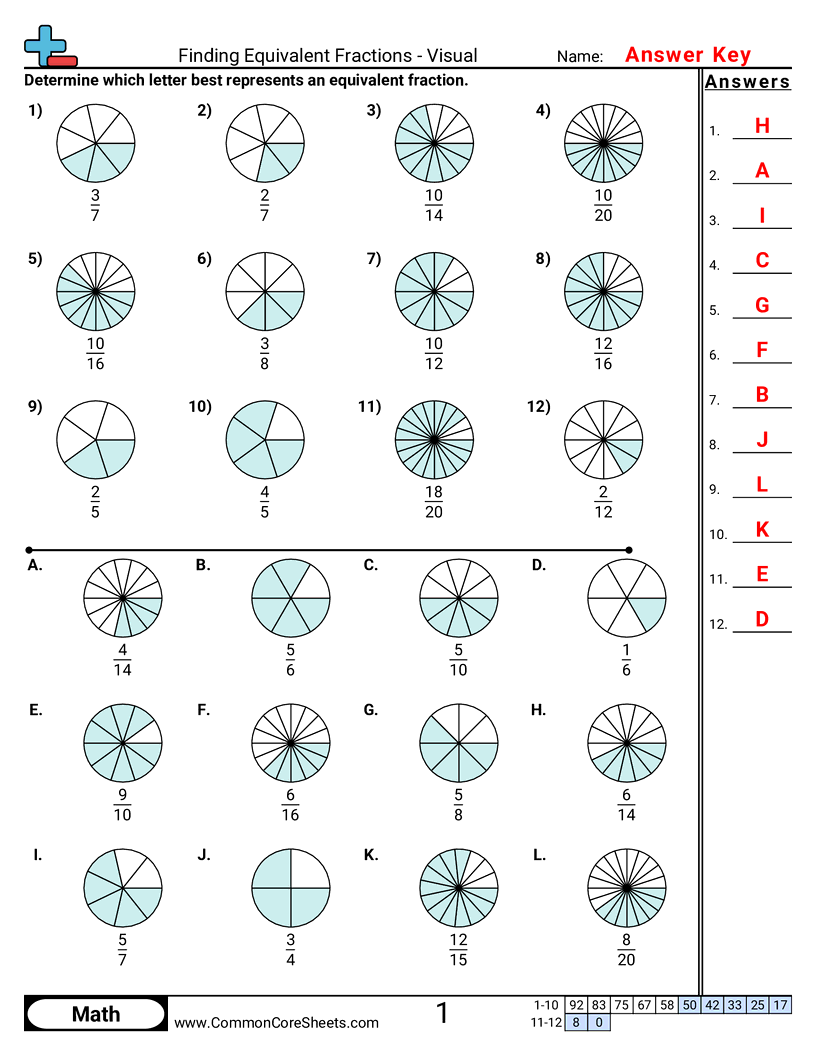
"This worksheet is designed to help children visually understand the concept of equivalent fractions in math. It provides 12 problems using vibrant diagrams to represent fractions and engage the student's interest. The flexible format allows it to be customized according to individual needs, converted into flashcards for easy review, or used in a distance learning setup to provide interactive math learning from home."
×Student Goals: Mastering Equivalent Fractions ConceptAfter successfully completing this worksheet, students should be able to confidently understand and demonstrate their knowledge of equivalent fractions. They will have gained much practice in finding equivalent fractions through visual aids which would significantly improve their skills. This worksheet is designed to aid them in visualizing what equivalent fractions look like, and how different fractions can represent the same value.Developing Problem-Solving AbilitiesSolving the problems presented in this worksheet would require students to engage their problem-solving skills. They will need to evaluate, analyze, and identify equivalent fractions. This worksheet will help enhance their cognitive development, fostering growth in analytical thinking and ability to recognize patterns. Over time, this will enhance the student's proficiency in working with other complex math problems.Boosting Confidence in MathMath can seem daunting to many students. However, having the ability to comfortably work through problems and see improvements serves as a confidence booster. As students find more success in dealing with these fraction problems, their confidence in their math skills is likely to increase. This, in turn, may foster a positive attitude towards learning and mastering other math topics.Application of Learned SkillsAfter completing the worksheet, students should be able to apply the skills they have learned to practical situations. The understanding of equivalent fractions can be used to simplify fractions or compare them. Moreover, they could apply these concepts when dealing with problems involving ratios, proportions, or probability, which they will encounter in more advanced math subjects.Fostering Self-Reliance and IndependenceThis worksheet is designed to promote self-reliance and independence. Students will find that they can work through the problems at their own pace, enhancing their ability to learn independently. This is a crucial lifelong learning skill that is applicable in many aspects of life beyond the classroom.
4nf1Open FolderOpen File×Description:
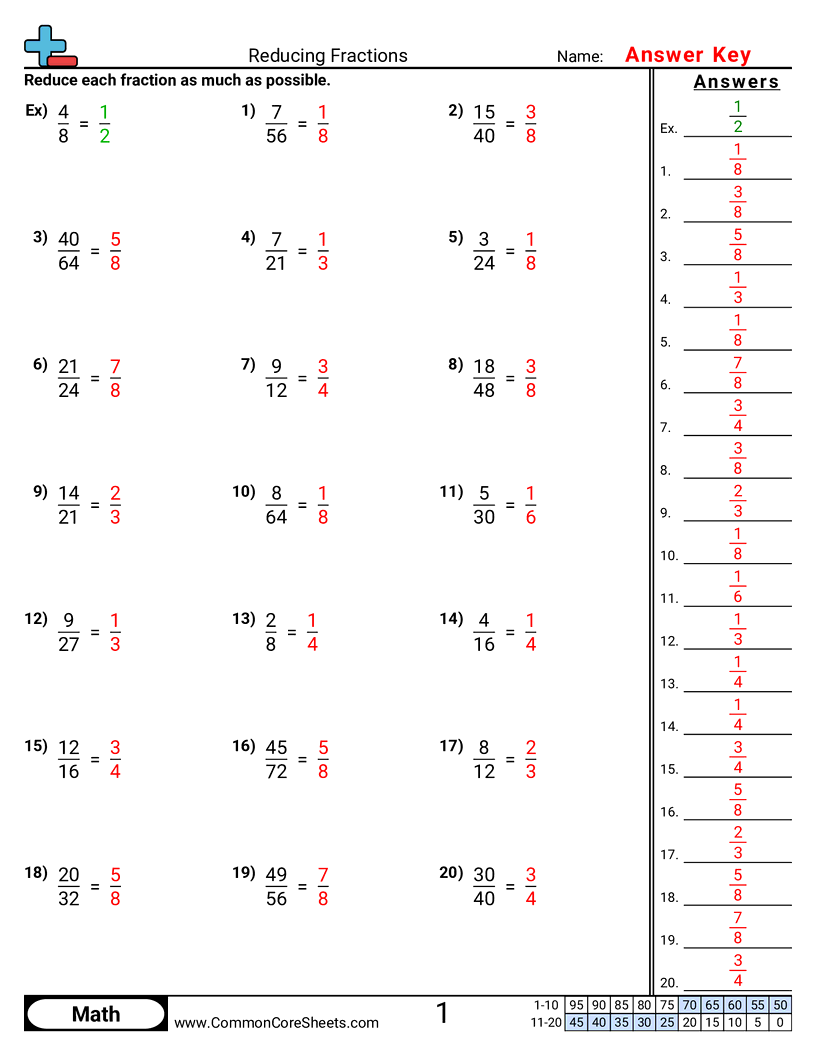
"This worksheet is designed to strengthen children's understanding of reducing fractions in math. It contains 20 problems that teach students to simplify fractions by finding their lowest terms. Customizable for varied learning needs, it can be converted into flashcards or utilized in distance learning platforms for enhanced flexibility. A valuable resource for homeschooling, tutoring, or in-class learning."
×Student Goals: