Numbers & Operations (N)4.N.3 Represent and compare fractions and decimals in real-world and mathematical situations; use place value to understand decimal quantities.4.N.3.2Use benchmark fractions (e.g., 0, 1/2, 1/3, 1/4, 3/4, 2/3, 1) to locate additional fractions with denominators up to twelfths on a number line.
4nf2Open FolderOpen File×Description:
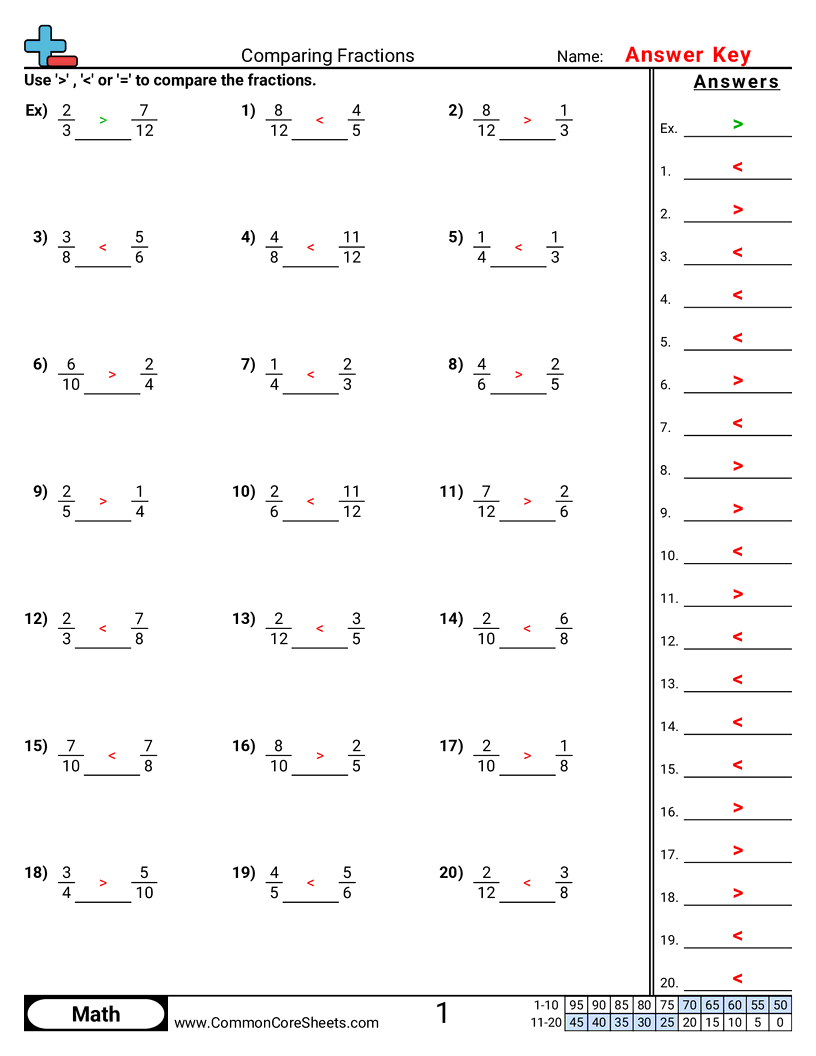
"This worksheet is designed to strengthen children's understanding of comparing fractions in math. It contains 20 distinct problems, where children will decide if one fraction is greater than, less than, or equal to another. Dynamic and engaging, this material can be customized based on learner's needs. It also has the capacity to be converted into flashcards for a more visual approach and is adaptable for distance learning, maximizing instruction during remote education sessions."
×Student Goals: Understanding of FractionsUpon completion of the worksheet, students should have an improved understanding of fractions. They should be able to identify the numerator as the number that represents a part of the whole and the denominator as the total number of parts in that whole. Recognizing these aspects of fractions is fundamental to further mathematical learning.Comparing FractionsStudents should have mastered how to compare fractions effectively. They should be able to determine if a fraction is less than, equal to, or greater than another and justify their reasoning. The comparison of fractions is a fundamental skill that students will utilize in various aspects of their lives, from simple daily activities to complex problem solving in future mathematics studies.Proportional ReasoningThis worksheet should provide students with a clear understanding of proportional reasoning concepts. Through comparing fractions, students should begin to grasp the reciprocal relationship between the numbers in a fraction and the principled way in which they interact. This essential comprehension will assist them in solving more sophisticated mathematical problems down the line.Augmented Problem-Solving AbilitiesBy completing this worksheet, students should significantly improve their problem-solving abilities. They will enhance not only their critical thinking skills but also their ability to apply mathematical principles to solve problems systematically. This improvement will definitely provide a solid foundation for more complex mathematical tasks that they will encounter through their educational journey.Familiarity with Fractional NotationHaving worked with a variety of fractions on this worksheet, students should develop a familiarity with fractional notation. They should understand the differences between proper and improper fractions and be able to recognize equivalent fractions. This understanding of fractional notation will greatly assist them when they progress to additional math subjects such as algebra and calculus.Build ConfidenceCompletion of the worksheet should instill a sense of mathematical confidence in the students. Familiarity and understanding of the topic should reduce math anxiety and encourage students to take on more challenging mathematical concepts. Handling complex problems with ease will boost their confidence and enhance their overall academic performance.
4nf2Open FolderOpen File×Description:
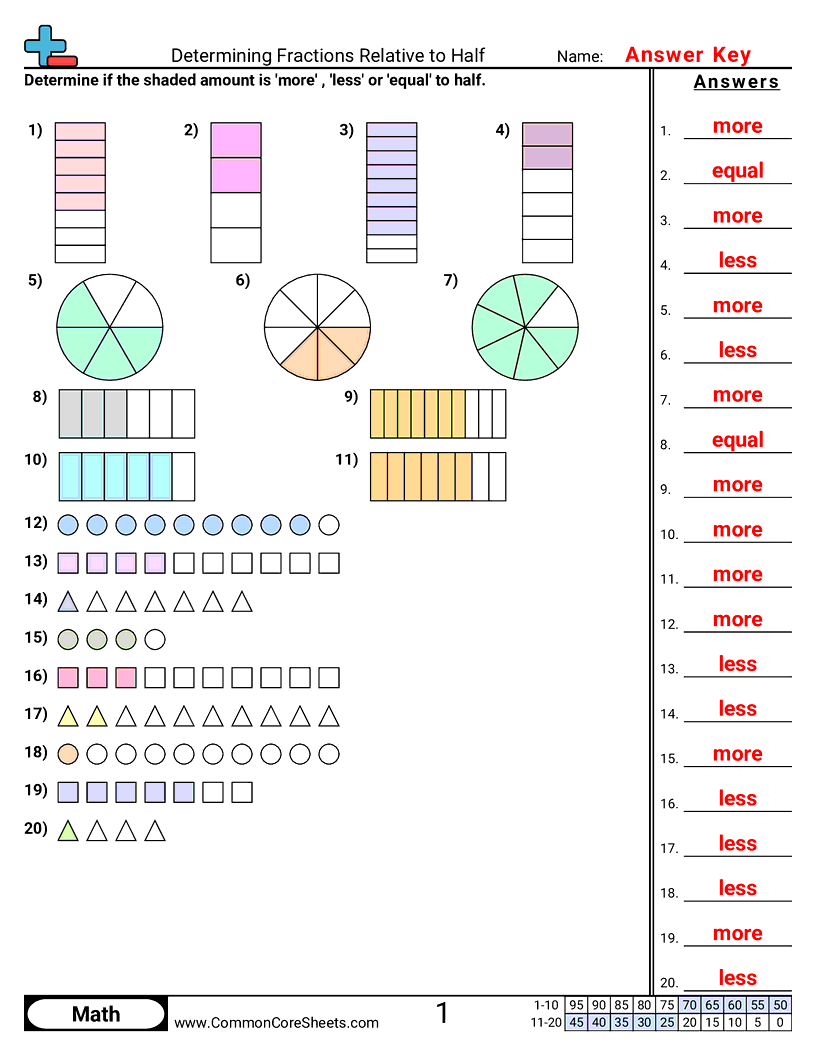
"This worksheet is designed to educate children on the concept of fractions and their relation to half. Through 20 math problems, kids will enhance their numeracy skills and develop a better understanding of fractions. The worksheet can be customized according to individual learning needs, converted into flashcards for interactive study or used for distance learning, thereby offering a flexible, educational tool for children's mathematical development."
×Student Goals: Understanding Basics of FractionsAfter completing this worksheet, students should have a firm understanding of the basic principles of fractions, particularly in relation to halves. They will understand that a fraction represents a part of a whole and they will improve their ability to visualize this concept, enhancing their essential fraction comprehension. The exercises will improve their speed, efficiency, and accuracy in identifying and working with fractions.Comparing and Classifying FractionsThe worksheet will enable students to develop advanced skills in comparing and classifying fractions. Through their work with the problems, students will learn to differentiate between fractions that are more than, less than, or equal to half. This fundamental but important skill helps children appreciate the relative size of fractions, which is invaluable in advanced mathematical comprehension.Fraction Arithmetic SkillsAfter completing the worksheet, students should acquire hands-on practice in performing basic fractional arithmetic. Through the problems presented in the worksheet, students will fine-tune their ability to perform different mathematical operations with fractions, including addition, subtraction, multiplication, and division.Application of Fraction KnowledgeThe worksheet will also help students understand the applicability of fractions in real-life scenarios. After engaging with this worksheet, students will gain insight into how fractional knowledge can be transferred to everyday activities like cooking, shopping or sharing. Thus, making fractions less theoretical and more practical for students.Problem-Solving and Critical Thinking SkillsBy working on the problems in the worksheet, students will improve their problem-solving and critical thinking skills. Each problem will push them to think critically, strategize, and apply their fractional knowledge to find the best solution. These skills extend beyond mathematics, contributing to the overall intellectual development of the students.Foundation for Advanced MathematicsLast but not least, by mastering fractions in relation to halves, students will build a solid foundation for more advanced mathematical concepts. Fractions serve as a stepping stone to decimals, percentages, ratios, and algebra. With a firm grasp of fractional understanding, students will be well-equipped to tackle these advanced topics when they encounter them in higher grades.
4nf2Open FolderOpen File×Description:
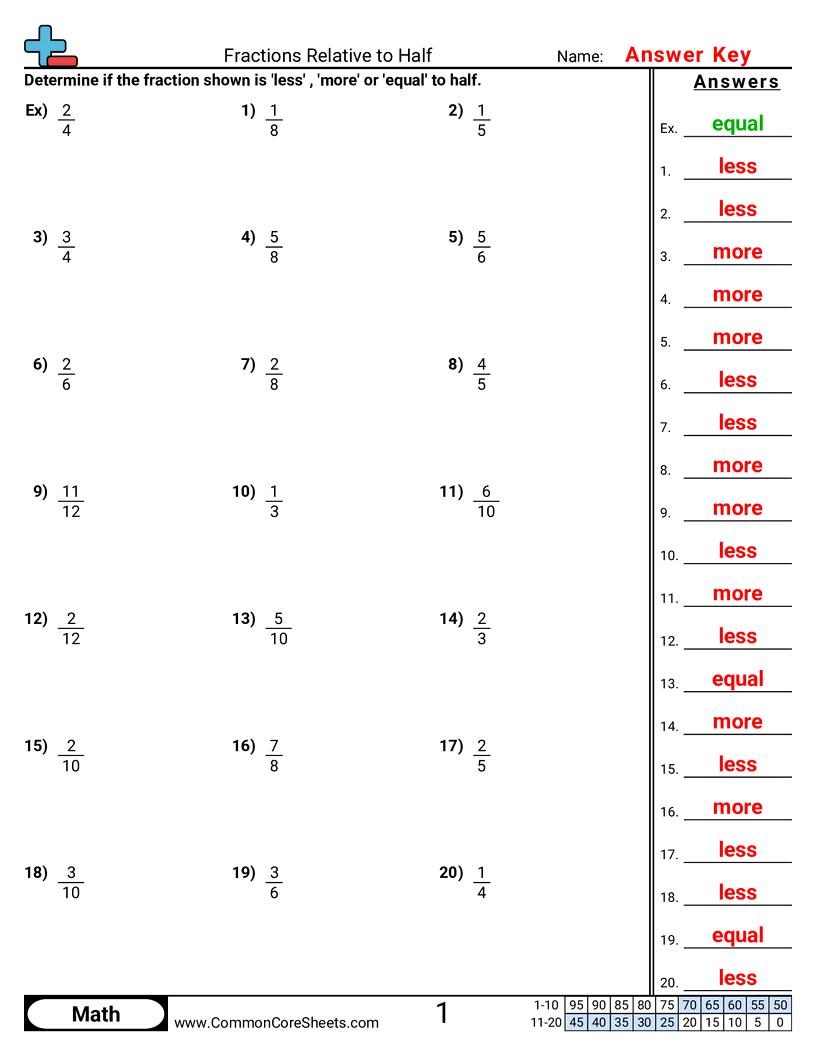
"This worksheet is designed to educate children on the concept of fractions relative to half in a math context. It encompasses 20 distinctive problems, ranging from basics such as 3/6 to more challenging instances like 5/8. Perfect for distance learning, the worksheet is flexible, allowing for user customization and a seamless conversion into flashcards to enhance comprehension and memory retention. Ideal for instilling a strong foundation in fractions."
×Student Goals: Understanding of FractionsAfter completing the worksheet, students should have a deeper understanding of fractions. They should be able to identify numerators and denominators and what they represent in the context of a whole. They should understand how fractions are used to represent portions of a whole, and how different fractions can express the same value.Conversion SkillsStudents should be able to convert fractions to their simplest form. For example, they should know that 2/4 is the same as 1/2. They should also be able to convert improper fractions to mixed numbers, and vice versa. Their ability to compare and order fractions should also be enhanced.Relating Fractions to HalfAn important learning outcome is for students to understand fractions relative to the value of one half. They should appreciate how different fractions are smaller or larger than one half. They should be able to make estimations about the value of fractions based on their relation to one half.Problem Solving SkillsCompletion of the worksheet should also bolster students' problem-solving skills. Not only will students answer specific problems, but they will also apply concepts and strategies learned to solve new, unfamiliar fractional problems. This applies their understanding in a practical and meaningful way.Math Language and TermsThe worksheet should arm students with the correct mathematical language and terms. They should be able to use the proper terminology and symbols when representing and discussing fractions. This helps them to effectively communicate their mathematical thoughts and understandings.Confidence in MathematicsLastly, successfully working out fraction problems can boost students' confidence in their math abilities. They should feel encouraged to further explore and learn more complex fraction concepts and other areas of mathematics. Overall, the enhanced confidence could foster a positive attitude towards learning mathematics.