Geometry & Measurement (GM)5.GM.2 Determine volume using the object’s dimensions. Compare and analyze rectangular prisms with equivalent volume to recognize their different dimensions.5.GM.2.1Determine the volume of rectangular prisms by the number of unit cubes (n) used to construct the shape and by the product of the dimensions of the prism a · b · c = n. Understand rectangular prisms of different dimensions (p, q, and r) can have the same volume if a · b · c = p · q · r = n.
5md5cOpen FolderOpen File×Description:
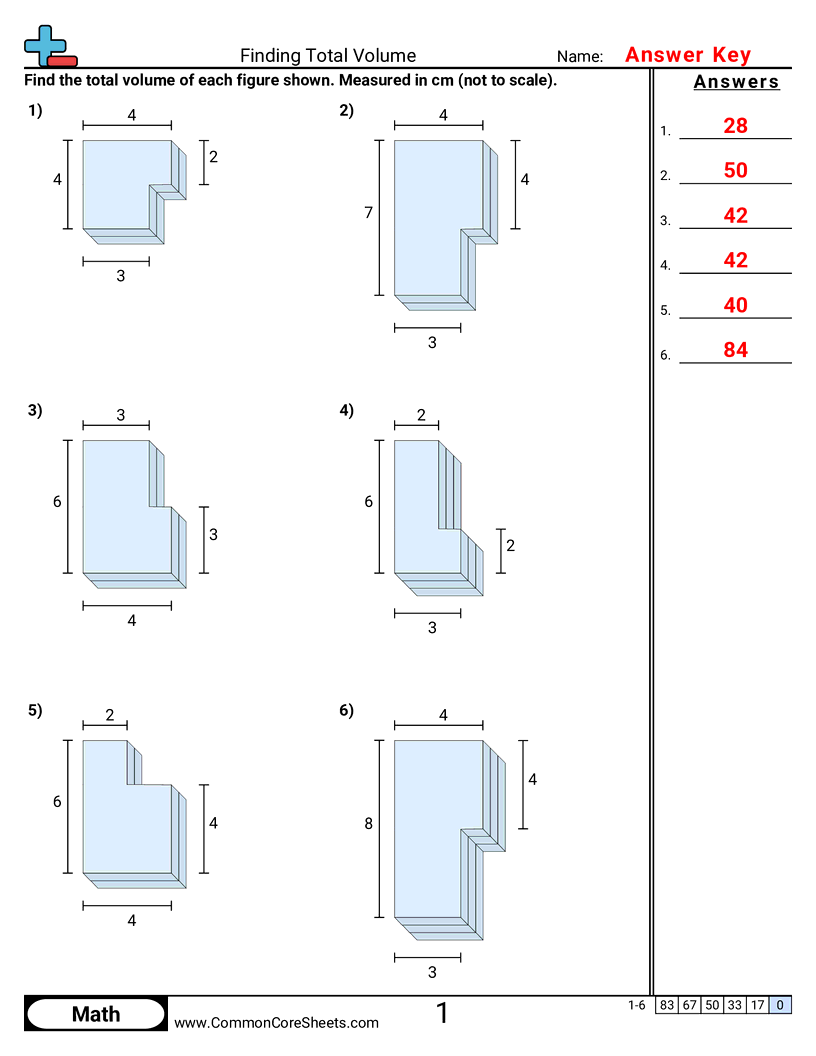
"This worksheet is designed to teach math learners the concept of finding total volume. It contains 6 carefully designed problems, with dimensions given for the length, width, and height. Users can customize the problems according to their learning level, convert them into flashcards for easy repetition, or use them for distance learning. An excellent resource to deepen understanding and boost mathematical skills."
×Student Goals: Enhanced Analytical SkillsAfter completing the worksheet, students will refine their analytical skills. They will learn how to dissect a problem and identify the required steps to reach a solution. Examining the problems in the worksheet aids in developing the students' abilities to decipher and employ problem-solving tactics effectively.Understanding of Volume ConceptsThe worksheet focusses on the concept of volume, which will afford students the ability to comprehend the principles of volume in mathematics. It will educate them on how the measurements of length, width, and height collectively inform the volume of an object. Grasping these concepts will enable them to tackle more complex volume-related problems in the future.Improved Mathematical FluencyWorking through the worksheet will improve the student's mathematical fluency. By frequently practicing with these problems, students can fine-tune their calculation skills. This recurring practice will foster a deeper understanding of mathematical operations and concepts, consequently boosting their mathematical performance and confidence.Enhanced Problem-Solving SkillsThe completion of this worksheet enables students to improve their problem-solving skills. Each problem can be considered as an investigation that students need to solve, which in turn, strengthens their ability to analyze and solve mathematical problems efficiently.Sequencing PracticeThis worksheet helps students practice effective sequencing. They are not only focused on finding the solution but also have to follow the correct sequence of steps to achieve it. This process assists in structuring their thought processes and enforcing logical reasoning, crucial skills for success in various life scenarios.Real-World ApplicationsOnce finished with the volume worksheet, students will understand how mathematical applications extend beyond the classroom. A robust understanding of volume can help students apply their learnings in a range of practical scenarios - whether it be to determine the amount a container can hold or to calculate space for storage purposes.
5md5bOpen FolderOpen File×Description:
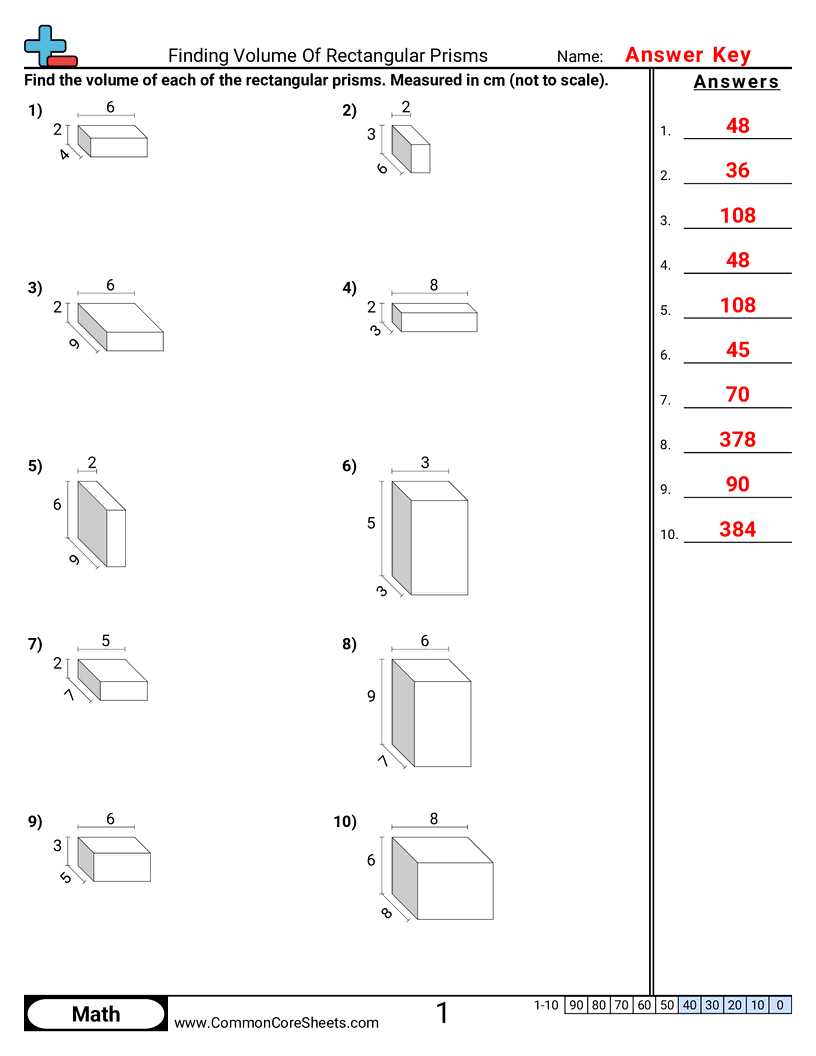
"This worksheet is designed to develop and strengthen children's knowledge in finding the volume of rectangular prisms in math. It includes 10 engaging problems that incorporate measurements in three dimensions - left-right, up-down, and angle. Versatile in nature, it can be personalized according to the student's skill level, transformed into interactive flashcards, or used effectively in distance learning environments."
×Student Goals: Mathematical Skill DevelopmentUpon completion of this worksheet, students should have improved in essential mathematical skills. Finding the volume of rectangular prisms is a fundamental concept that not only helps them grasp volume measurements but also assists in strengthening their three-dimensional spatial awareness. These tasks promote students' abilities to visualize dimensions, measure spaces and understand the interactions between length, width, and height.Critical Thinking and Problem-Solving SkillsThe worksheet is designed to encourage critical thinking and problem-solving abilities in learners. It presents various problems related to the calculation of volume, which requires learners to apply their knowledge and analytical skills. The process of identifying the correct method to calculate volume tests their comprehension and their ability to apply theoretical knowledge practically. This approach ensures that they can rely on their understanding of the subject matter, thereby boosting their confidence in tackling similar problems in the future.Application of GeometryAfter working through this worksheet, students will enhance their expertise in the practical application of geometry. In everyday life, they will be able to understand and relate to the various scenarios where knowledge of geometry, particularly volume calculation, is required. This acquaintance with perceptions of shapes, spaces, and quantities enables learners to make relevant connections to real-world contexts.Precision and AccuracyAs students progressively work their way through this worksheet, they get to practice the accuracy and precision of their calculations. Given the repetitive but varied nature of the tasks, pupils can understand better and rectify any mistakes, leading to more accurate results over time. This, in turn, improves their ability to deliver accurate answers more consistently.Mastery and ConfidenceLastly, successful completion of the worksheet will help students achieve a degree of mastery over the topic of finding volumes of rectangular prisms. Regular and prompt completion of the problems can result in a gradual boost of confidence, enabling students to approach math problems with a positive mindset. The more they practice, the more fluent they become in navigating these problems, supporting their overall mathematical proficiency.
5md4Open FolderOpen File×Description:
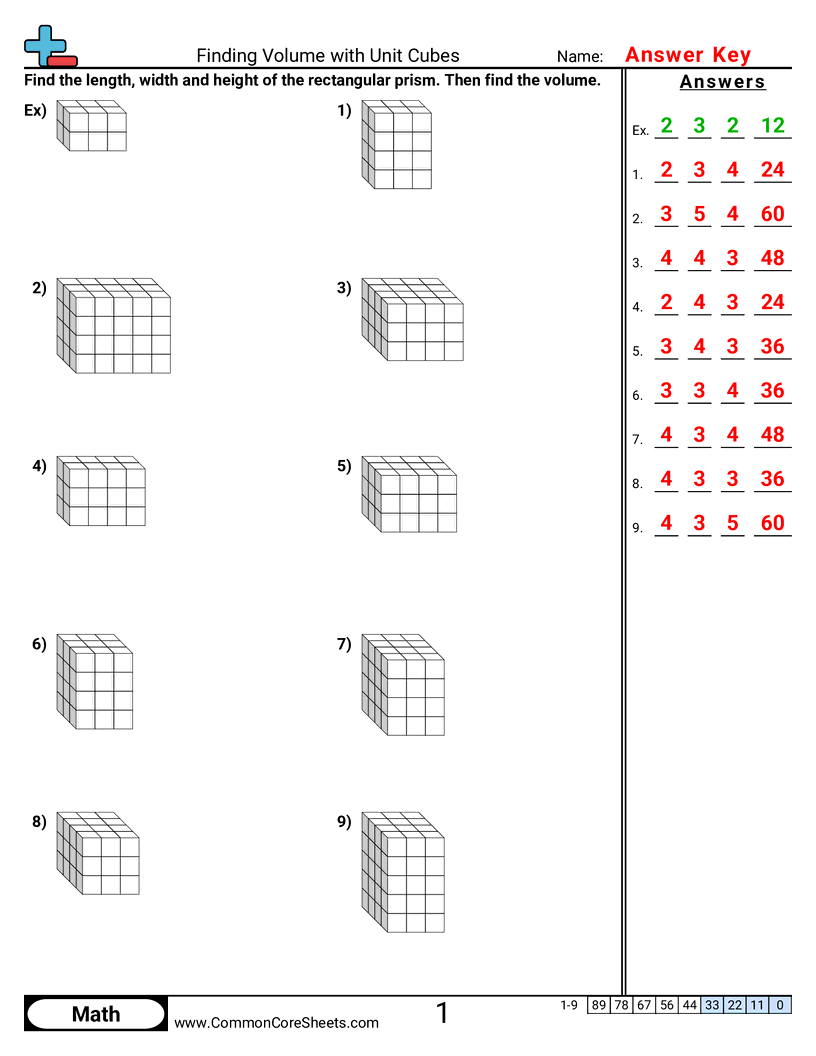
"This worksheet is designed to help children grasp the concept of volume using unit cubes. It offers nine engaging problems to make learning interactive and enjoyable. The worksheet is easily customizable, allowing for use as flashcards or as a tool in distance learning environments. The aim is to simplify comprehension of mathematical volume and foster confidence in young learners."
×Student Goals: Understand the Concept of VolumeAfter completing this worksheet, students should have a foundational understanding of the concept of volume, a critical concept in geometry. They will grasp the principle that volume measures the space that an object occupies, typically in cubic units.Ability to Calculate Volume Using Unit CubesStudents will learn how to calculate the volume of various shapes using unit cubes. Through problem-solving, they will gain practical experience in determining the volume, enhancing their calculation skills and numerical comprehension.Develop Spatial ReasoningWorking with unit cubes to calculate volume will help students improve their spatial reasoning skills. They will learn to visualize shapes in three dimensions and understand the spatial relationships between these shapes.Improve Problem-Solving SkillsThe worksheet contains problems that challenge students to apply their understanding of volume and the use of unit cubes. This will not only test their comprehension but also enhance their problem-solving skills, which are crucial in math and other fields of study.Application in Real World ContextsThrough this worksheet, students will also get to understand how to apply the principles of volume in real-life situations. Understanding volume becomes relevant in a myriad of real-life applications such as figuring out how much a container can hold or how much space an object will occupy.Enhance Mathematical Language SkillsAfter completing this worksheet, students will be familiar with terms and concepts related to volume like unit cubes. This contributes to growing their mathematical vocabulary, facilitating their ability to communicate mathematically and enhancing overall math literacy.Confidence in Further Mathematical StudiesUltimately, the ability to understand and calculate volume builds a firm foundation for the student's further studies in more complex mathematical topics. This understanding thus builds their confidence in tackling other related mathematical topics in the future.