Geometry & Measurement (GM)5.GM.3 Understand angle, length, weight, and capacity as measurable attributes of real-world and mathematical objects, using various tools to measure them. Solve real-world problems of length.5.GM.3.2Measure the length of an object to the nearest whole centimeter or up to 1/16 inch using an appropriate instrument.
4md1Open FolderOpen File×Description:
This worksheet is designed to familiarize children with the concept of estimating capacity, utilizing US customary units. It includes engaging visuals and math problems based around items like measuring cups, barrels, and tea cups. This customized worksheet can be converted into flash cards or adapted for distance learning, providing a versatile tool for both teachers and parents in making learning about capacities fun and interactive.
×Student Goals: Conceptual UnderstandingAfter completing the worksheet, students should have deepened their understanding of American capacity measurements, including cups, pints, quarts, gallons, and liters. They should also be able to associate these units of measurement with everyday objects and substances, reinforcing the practical application of these concepts.Problem-solving SkillsThe worksheet exercises a range of problem-solving skills. Students should be able to make reasonable estimations of the capacity of everyday items using different units of measure. Through this practice, they will have developed the ability to approach problems logically and apply their knowledge and understanding effectively to find solutions.Critical Thinking SkillsProgressing through the problems should sharpen students' critical thinking skills. They should be able to make estimations based on their understanding of capacity units, comparing different units and choosing the appropriate one for each item or scenario. This requires reflecting on the properties of each unit and their real-world implications, thereby stimulating and enhancing critical thought processes.Real-world ApplicationSuccessfully completing the worksheet ensures students have learned to apply their knowledge of capacity measurement units to realistic, everyday situations. They should be able to estimate the capacities of various household objects or substances in different units of measures, such as understanding how much soda a can holds or the capacity of an ice chest, which makes their learning relevant and practical.Performance EvaluationThis worksheet also serves to evaluate student performance in the field of measurement estimation. Based on the completion of this worksheet, students will be able to identify their strengths and areas for improvement in understanding American capacity units. This can guide their subsequent learning and study strategies in mathematics, particularly in the area of measurement and estimation.
4md1Open FolderOpen File×Description:
"This worksheet is designed to help children understand and estimate capacity using American units through practical examples in 15 Math problems. Subjects range from determining the volume of common items such as a packet of ketchup to larger volumes such as a swimming pool. Tailored to suit individual learning needs, the worksheet can be customized, converted into flashcards, or utilized in a distance learning setting, promoting versatile and engaging education."
×Student Goals:
4md1Open FolderOpen File×Description:
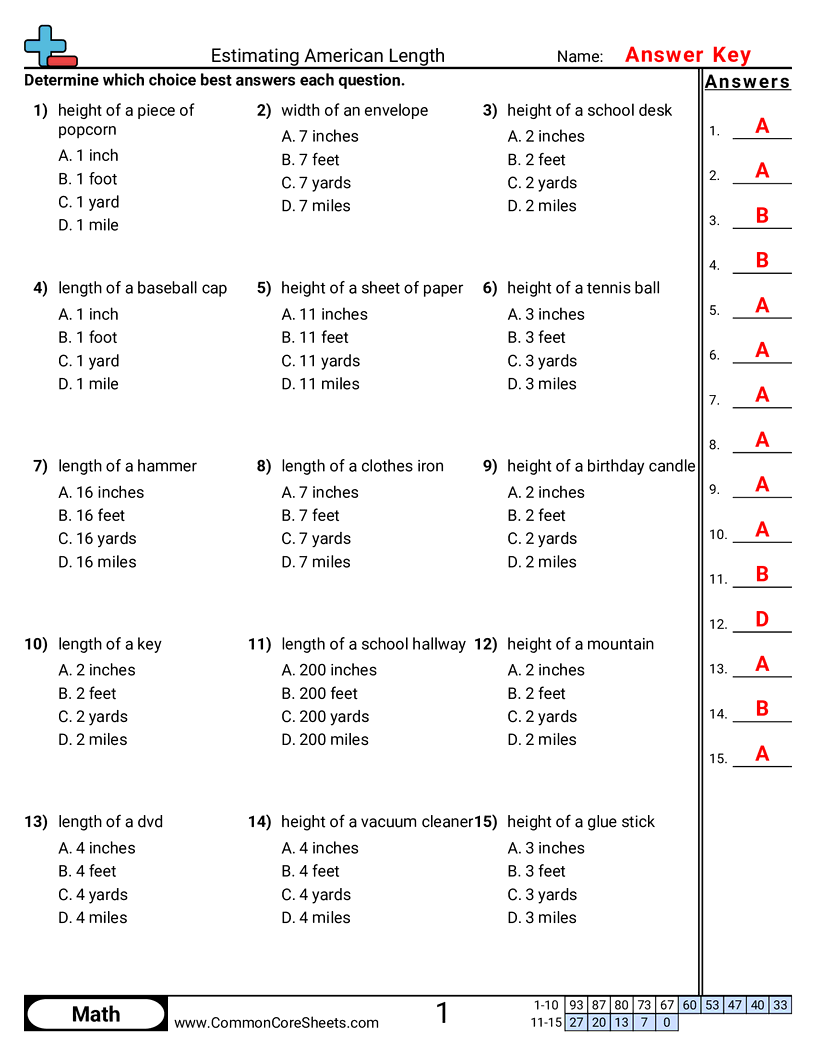
"This worksheet is designed to teach math through the concept of estimating American lengths. From social objects to natural wonders, the tasks encourage children to familiarize themselves with measurements like inches, feet, yards, and miles. It features 15 problems and can be easily customized, converted into flashcards, or used for distance learning, making it versatile for various teaching methods and environments."
×Student Goals: Measurement UnderstandingUpon successful completion of this worksheet, students will develop a solid understanding of the American length measurement units including inches, feet, yards, and miles, and the relative differences between them. They will gain insight into making educated estimations on the lengths and heights of everyday objects and elements of the natural world.Estimation SkillsStudents will develop valuable estimation skills which are critical not only in the subject of math, but throughout various aspects of life. They will become comfortable with making an educated guess or estimate, which can be a valuable problem-solving tool when precise information is unavailable.Real-World ApplicationsThe completion of this worksheet will enable students to apply their learning into real-world contexts. By relating the problems to everyday items like a can of soda or a skateboard, they will be able to visualize and grasp the concept of length estimation better. This understanding will transfer to their ability to approximate and compare distances in real-life situations.Critical ThinkingThis worksheet fosters critical thinking by encouraging students to use their knowledge of measurement units to evaluate and choose the most reasonable answer out of multiple choices. This skill of critically evaluating multiple potential solutions will benefit them in future mathematical problems as well as in wider life situations.Builds ConfidenceBy systematically developing an understanding and honing their estimation skills, students will gain confidence in handling problems related to length measurement. They will become capable of making quick estimations in their head and develop a sense of achievement in their mathematical abilities.Promotes Active LearningFinally, since the learning is couched within the framework of practical, real-life objects and situations, students are motivated to actively engage with the content. This active involvement in their own learning process can lead to a deeper understanding of the subject and improved academic performance in the long run.
4md1Open FolderOpen File×Description:
"This worksheet is designed to improve children's estimation of distances in a fun and interactive manner. Covering a wide range of objects, from skateboards to frogs, the activities engage learners through nine diverse math problems. Customizable to different learning needs, this worksheet can be converted into flash cards or suitably adapted for distance learning, ensuring flexibility in teaching methods while solidifying essential mathematical concepts."
×Student Goals: Understanding of MeasurementsUpon completion of the 'Estimating Distance' worksheet, students should have a developed understanding of the various units of measurement used in the American system. These include inches, feet, yards, and miles, and students will become familiar with their relative lengths and everyday uses.Estimation SkillsThe worksheet is designed to improve the practical estimation skills of students. Faced with objects and distances of various sizes, students should learn how to make quick yet accurate approximate evaluations of distances and sizes using known benchmarks. Thus, sharpening their mental estimation skills.Real-World ApplicationsAfter completing this worksheet, learners should have a clearer understanding of how these units of measurement are applied in real-world contexts. By relating commonly known objects in their estimation exercises, students gain insights into real-world applications of measurements.Critical ThinkingStudents will also enhance their critical thinking skills through the course of completing the worksheet. With every problem, students are required to consider the size and scale of the objects and distances involved, and to select the most appropriate unit of measurement. This encourages concept analysis and strategic thinking.Confidence BuildingFinally, successfully completing the worksheet should boost the students' confidence in their mathematical abilities. Not only will they have a stronger grasp of American measurement units, but they will also have refined their estimation and reasoning abilities. This increased confidence can inspire a more positive attitude towards learning math and related subjects.
4md1Open FolderOpen File×Description:
"This worksheet is designed to enhance children's math skills, focusing on the method of converting tables. Comprising 20 problems ranging from base to complex numbers, it reinforces the fundamentals of number conversion. Each problem can be customized, transformed into flashcards for hands-on learning or incorporated into distance education modules. A brilliant tool to make learning fun and effective!"
×Student Goals: Enhance Mathematical SkillsUpon completion of the 'Converting Tables' worksheet, students should have significantly improved their mathematical skills. Complex concepts are simplified into understandable chunks, allowing young learners to grasp them easily. This foundational comprehension can make subsequent topics easier to understand.Improve Problem-Solving AbilitiesThis math worksheet is designed to enhance problem-solving abilities in children. The various problems provided prompt students to apply conventionally learned strategies in order to find solutions, developing their ability to think critically and independently.Develop Analytical SkillsUsing this worksheet, students should be able to cultivate their analytical skills. They learn how to examine a problem, analyze the information provided, plan a solving strategy, and critically review their results. This development is crucial not only in tackling math problems but also in everyday scenarios.Boost Confidence & ResilienceThe process of tackling and successfully finishing the worksheet tasks can boost a student's confidence in their own abilities. Additionally, they learn that it is okay to make mistakes, as they are a part of learning—a concept that builds resilience.Enhance Cognitive SkillsChildren's cognitive skills are improved as they manipulate numbers, apply formulas, and uncover patterns through these worksheets. They will not only understand the 'how' but also the 'why' behind solving these questions, which promotes higher-level thinking.Promote the Love for NumbersThis worksheet paves the way for students to develop a lifelong love and appreciation for numbers. By gradually solving these problems and understanding core concepts, maths becomes less intimidating and more appealing.Prepare for Advanced TopicsThe completion of this worksheet implies the foundation necessary for more advanced mathematical concepts has been set. It prepares the students for future topics, both in terms of concepts and the confidence to tackle difficult problems.
4md1Open FolderOpen File×Description:
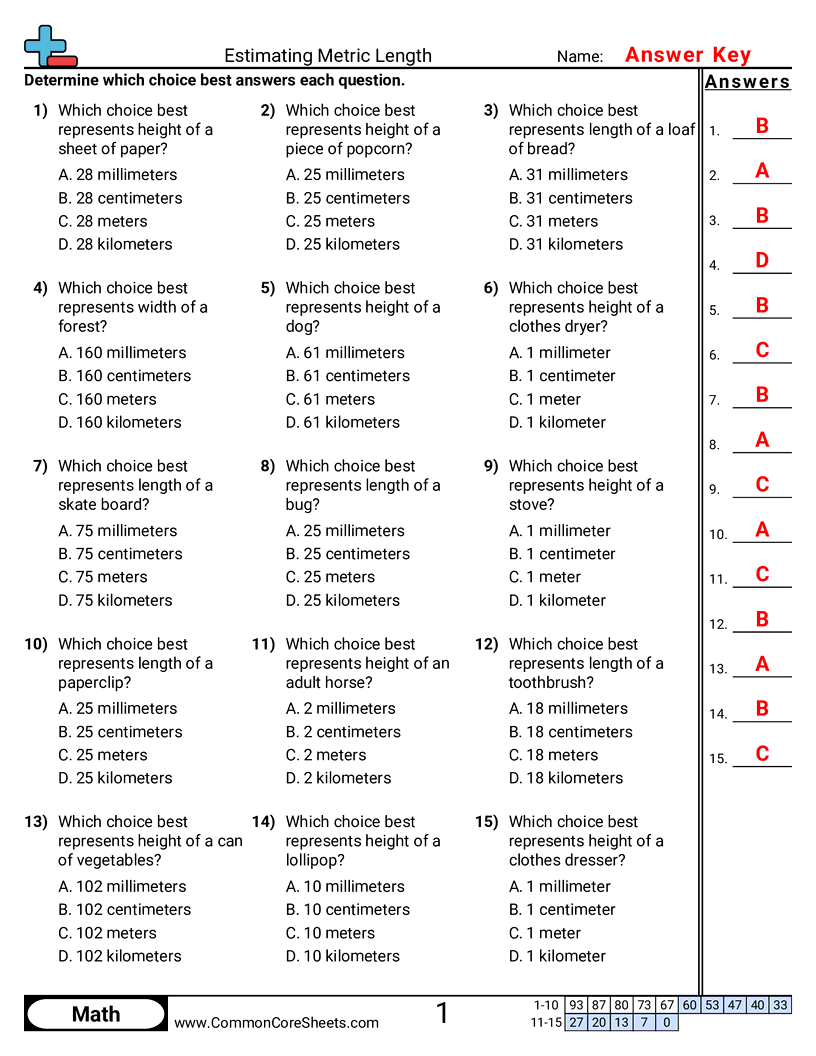
"This worksheet is designed to help children practice estimation of metric lengths. It offers 15 mathematical problems dealing with real-world objects, varying from daily household items to larger landscapes, to improve the grasp of metric units. This versatile aid can be customized based on a learner's level, transformed into flashcards for revision, or incorporated into distance learning curriculums to effectively and engagingly teach metric length estimation."
×Student Goals: Understanding of Metric UnitsAfter completing the worksheet, students should have gained a clear understanding of various metric units of length such as millimeters, centimeters, meters, and kilometers. They will also comprehend how these units relate to real-world objects, enhancing their understanding of metric scales.Problem Solving SkillsThe worksheet aims to enhance critical thinking and problem-solving skills in a student. As they navigate through the problems, they are encouraged to make logical decisions on what metric units best represent the given objects—thus, equipping them with fundamental problem-solving abilities.Practical Application of Math ConceptsPost worksheet completion, students should be able to apply the mathematical concepts learned in practical scenarios. They will be equipped to estimate and measure lengths of various objects around them accurately using the correct metric units.Conceptual KnowledgeStudents will also assimilate conceptual knowledge about the size and scale of everyday items, which will be beneficial not only in their mathematical journey but also in general cognitive development. They will understand the typical length of objects, their comparison, and get a sense of spatial awareness.Improved Estimation SkillsThe worksheet is designed to help students significantly improve their estimation skills. By solving problems that involve estimating the length of various items, students will develop a better sense of judgment. They will learn to make accurate estimates, a skill that is essential in many areas of life beyond math.Strengthens Logical ReasoningUpon completion, students should exhibit improved mental agility and logical reasoning. Probing the metric length of everyday objects and comparing choices demands regular practice for cognitive development, which in turn strengthens their logical reasoning skills.Confidence in Handling MeasurementsStudents will attain familiarity and confidence in dealing with measurements in their day-to-day encounter. By linking realistic objects to measurements, theoretical concepts of metrics and measurements become more approachable and less abstract.
4md1Open FolderOpen File×Description:
"This worksheet is designed to help children master the concept of metric length in math. Offering 10 customizable problems, it provides practice in key areas of measurement. The user-friendly approach allows it to be adapted for flashcards or distance learning, making it versatile for various methods of instruction. Ideal for home or classroom use."
×Student Goals:
4md1Open FolderOpen File×Description:
"This worksheet is designed to enhance children's mathematical skill in estimating distances using the metric system. Comprising nine problem sets, it employs everyday items, from shovels to envelopes, to facilitate comprehension. Perfect for distance learning, these problems can be converted into customizable flashcards for effective learning and easy recall."
×Student Goals: Understand Distance MeasurementAfter successfully completing this worksheet, students should attain a comprehensive mastery of distance measurements in metric units. They should be able to recognize and differentiate between millimeters, centimeters, meters, and kilometers, understanding how they relate to each other and how they are used to represent lengths and distances in the real world.Estimating TechniquesFurthermore, students will develop the skill to make accurate estimations. They will be able to gauge the distances of various everyday items without employing measuring instruments, based on their understanding of the comparative lengths of different metric units. Hence, they will understand the application of these units in day-to-day scenarios.Critical Thinking and Problem SolvingWith the knowledge obtained from the worksheet, students should be equipped with better problem-solving and critical thinking abilities. They will be capable of making smart choices from provided options in estimating the length or distance of things. This will be especially useful in instances where precision measuring tools are not readily accessible.Application to Real-life ContextsFinally, students should be able to apply the skills learned in practical real-world contexts. They will understand that the same methods used in estimating the length of a glue stick, or the distance covered in a trip, can be used to solve more complex mathematical problems.Relevance in Other Subject AreasThis knowledge will be useful in overcoming challenges not only in Math but also in other subjects that require measurements such as Science and Geography. For instance, having a good grasp of distances could aid in the study of habitats or geographical features.Build ConfidenceCompletion of the worksheet can build confidence in students, as they would be able to see that mathematics and measurements are concepts that they can grasp and use in their everyday lives. This could lead to a deeper interest in math and other related subjects, encouraging them to explore these further.
4md1Open FolderOpen File×Description:
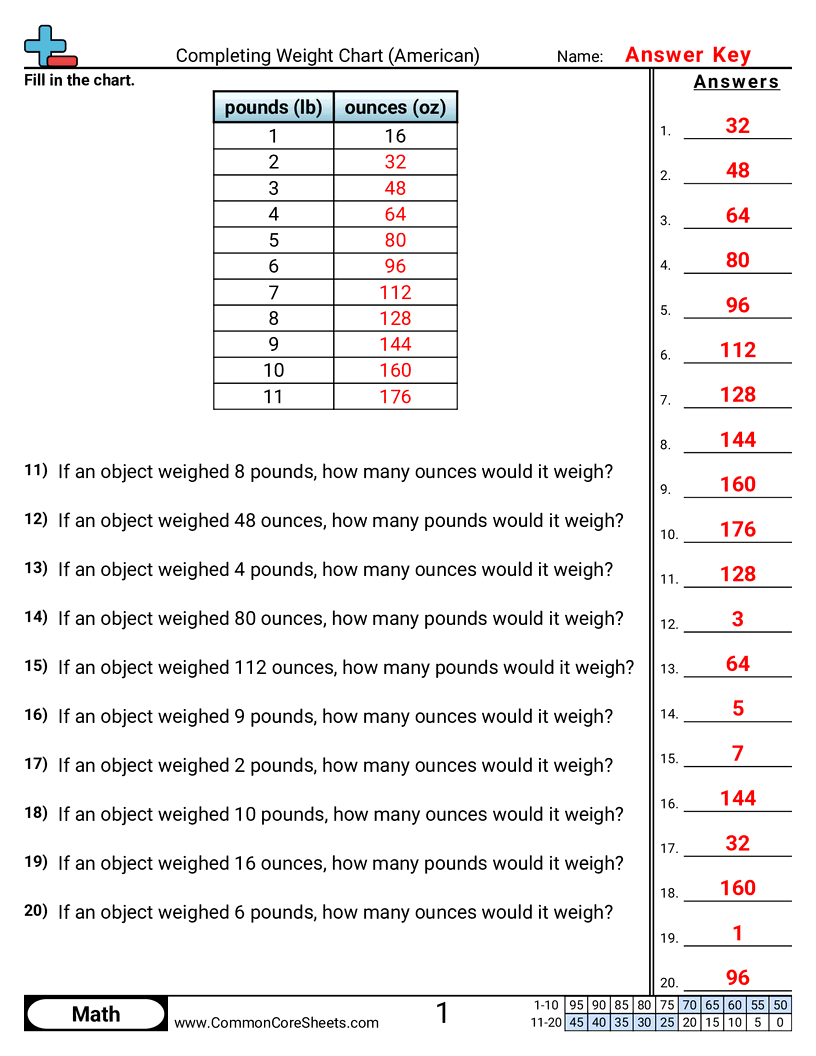
"This worksheet is designed to enhance children's mathematical skills in completing American weight charts. Incorporating 20 problems, learners improve understanding of the relationship between pounds and ounces through practical examples. The worksheet's flexibility allows for customization, flash card conversion, or incorporation into distance learning platforms, catering to various educational requirements and learning styles."
×Student Goals: Understanding of ConversionAfter completing the worksheet, students should have a clear understanding of the conversion between pounds (lb) and ounces (oz). They will learn that one pound is equivalent to 16 ounces, gaining knowledge that will be vital in numeracy skills and real-world applications requiring weight conversion.Mastery in CalculationsThis worksheet offers repeated practise in integrating two different systems of measurement, enhancing the students' calculation skills. They will need to perform multiplication and division to convert the units. With regular practise of these problems, it will accentuate their competency in fast and accurate calculations, an integral part of every mathematical operation.Critical Thinking StimulationBy engaging in the worksheet, students will be involved in problem-solving that encourages critical thinking. They will find patterns, make predictions, and confirm their hunches, contributing to their critical and logical thinking skills. Over consistent engagement, students can detect the conversion pattern and apply it to more complex mathematical problems.Real-world ApplicationThe exercise fortifies practical knowledge needed for real-world scenarios. Understanding the conversion between ounces to pounds is a skill they would use in daily life, especially in situations involving grocery shopping, cooking, or other areas where weight estimation is required. This learning will enhance student’s lifting, flavouring, and monetary value judgment skills.Mathematical FluencyStudying and comprehending weight conversion will help students gain mathematical fluency. As students solve each problem, they become better at recognizing the relationship between different units of measurement, thus assisting them in being more fluent in their math skills. This skill becomes essential as they advance in their educational journey where they encounter more intricate mathematical concepts.Improved Numerical LiteracyUnderstanding units of scale, specifically the relation between pounds and ounces, will lead to improved numerical literacy. This worksheet will develop their comprehension about weight, quantity, and capacity, foundational concepts in our numeracy. This understanding lays the groundwork for more complex maths problems later in their academic career.
4md1Open FolderOpen File×Description:
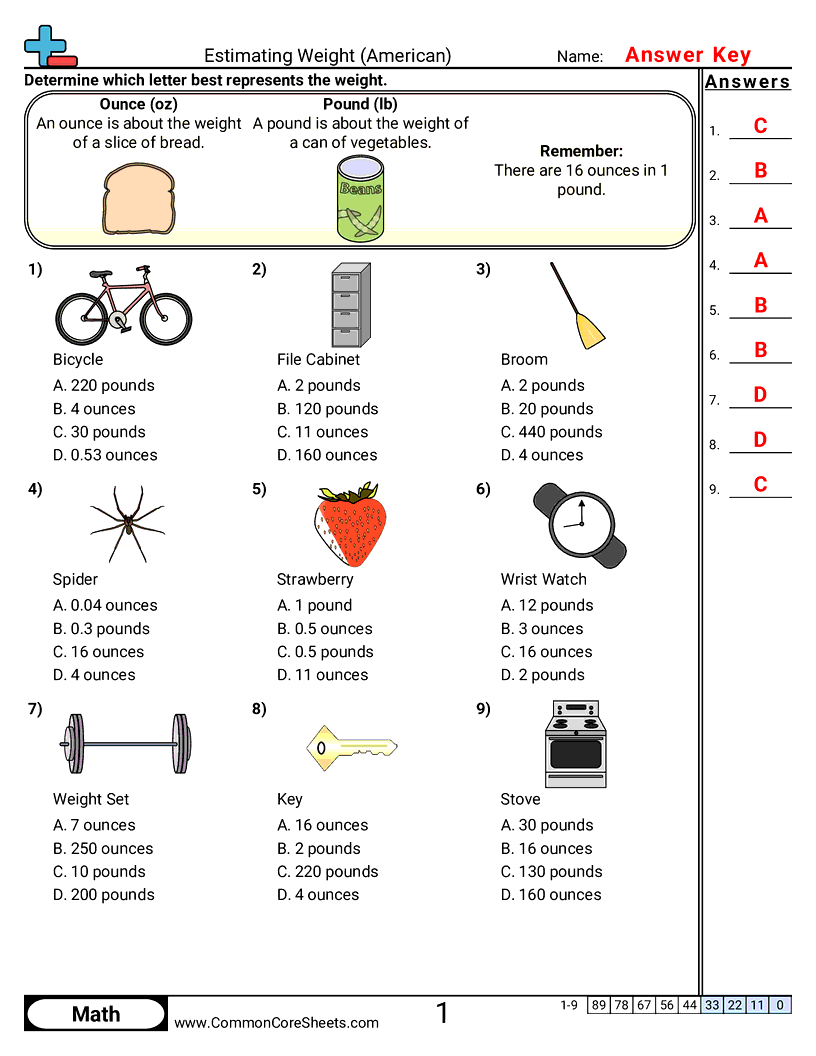
"This worksheet is designed to strengthen children's understanding of weight estimation in a fun, educational format. Titled 'Estimating Weight (American)', it provides 9 diverse math problems, each asking kids to estimate the weight of common items from cans of soda to stove. An ideal and customizable tool for honing practical math skills, this worksheet is also adaptable for use as flashcards or in distance learning platforms, enhancing flexibility in the learning approach."
×Student Goals: Enhanced Estimation SkillsUpon completion of the worksheet, students will demonstrate advanced estimation capabilities. They will be better equipped to make educated guesses about the weight of different objects, using commonly used units of weight in the American system (ounces and pounds). This skill is not only vital in mathematics but also in practical situations encountered in everyday life.Improved Understanding of Weight UnitsStudents will develop a thorough understanding and working knowledge of weight measurements used in the American system. They will deepen their comprehension of how much an ounce and a pound represent, and refine their ability to switch from one unit of measurement to another seamlessly.Advanced Problem-Solving AbilitiesThe worksheet will enhance students' problem-solving skills, as they must select the most plausible estimate from multiple choices. Students will learn to quickly discard vastly overestimated or underestimated options, fostering decisive decision-making skills.Real-World Application of Math SkillsStudents will become adept at applying their mathematical knowledge to real-world scenarios. They will gain an inherent sense of the weight of diverse objects, ranging from household items to everyday groceries. This practical understanding of weight will instill in them the utility and application of math in daily life.Improved Critical ThinkingWorking through the problems in the worksheet, students will have to employ critical thinking. They will not only recall information about units of measurement but also apply logic and reasoning to make the best choice. This process will enhance their cognitive development, particularly their critical thinking skills.
4md1Open FolderOpen File×Description:
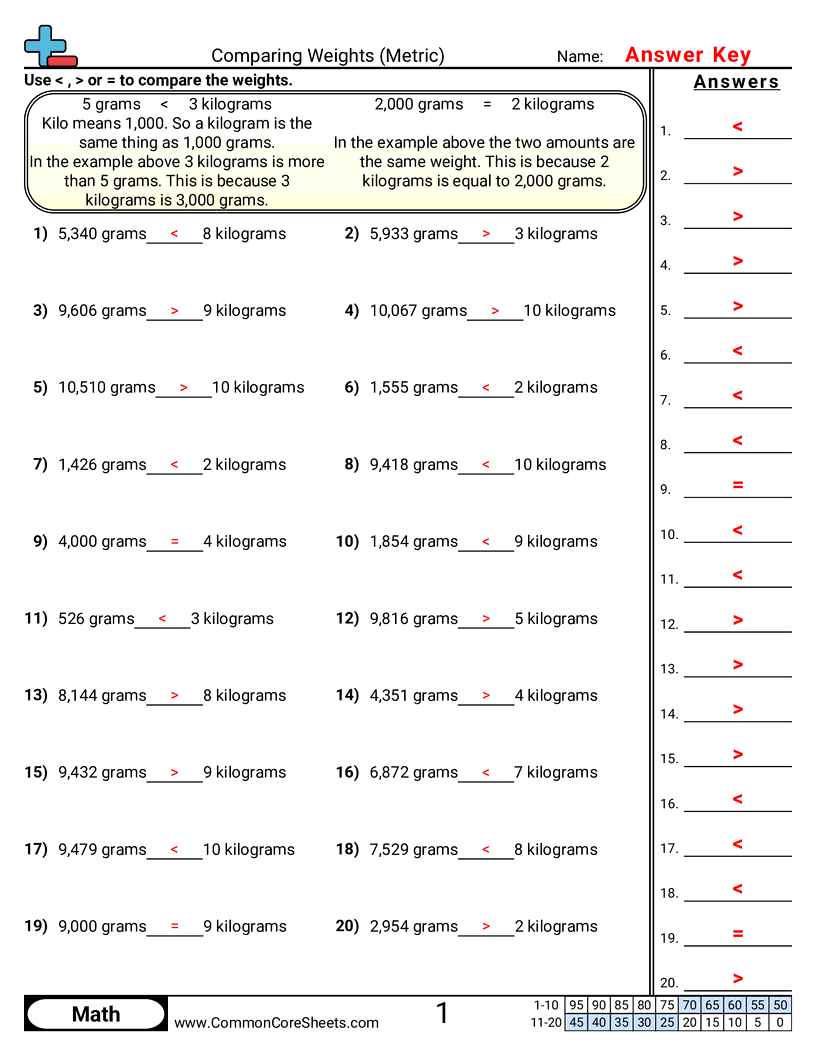
"This worksheet is designed to enhance children's understanding of metric weights. It includes 20 math problems that encourage students to compare and contrast different measurements in grams and kilograms. Its adaptable format allows it to be customized to individual learning needs, converted into flashcards, or utilized effectively in distance learning. A valuable tool for building crucial math skills in a fun and engaging way."
×Student Goals: Understanding Metric WeightsAfter completing this worksheet, students should have a solid understanding of metric weights, primarily grams and kilograms. They should be capable of converting from grams to kilograms and vice versa, understanding the relationship between these two units of measurement. They should recognize that 1 kilogram equals 1,000 grams.Comparison SkillsStudents should develop strong comparison skills. The ability to compare and evaluate different metric weights is crucial in many mathematical and real-world scenarios. They should be able to analyze and compare the weights of different objects, determine which is heavier or lighter, and make logical conclusions based on their comparisons.Mental ArithmeticThis worksheet should enhance students' mental arithmetic skills, particularly in relation to measurement units. They will need to convert between units and compare different quantities, improving their ability to perform calculations in their head. This skill is essential for quick decision-making and problem-solving in everyday situations.Problem-Solving SkillsWorking through the problems should improve students' problem-solving abilities. As they navigate the metric system and solve comparison puzzles, they learn to approach problems from different angles and devise various strategies for resolution. This experience will boost their confidence in confronting and resolving future mathematical problems, laying a solid foundation for more complex problems.Knowledge ApplicationsStudents should be able to apply the knowledge gained from this worksheet in various practical situations. Understanding weights and measures is fundamental in many everyday tasks, such as cooking, shopping, or estimating weight or size of objects. The acquired skills will allow students to make practical estimations and decisions, enhancing their credibility in real-world applications.Conceptual UnderstandingFinally, students completing this worksheet should gain a deep conceptual understanding of the metric system, rather than just rote memorization of facts. This deeper level of understanding will enable them to apply their learning in new contexts and assist in the recall of information, thereby enhancing their long-term learning achievements.
4md1Open FolderOpen File×Description:
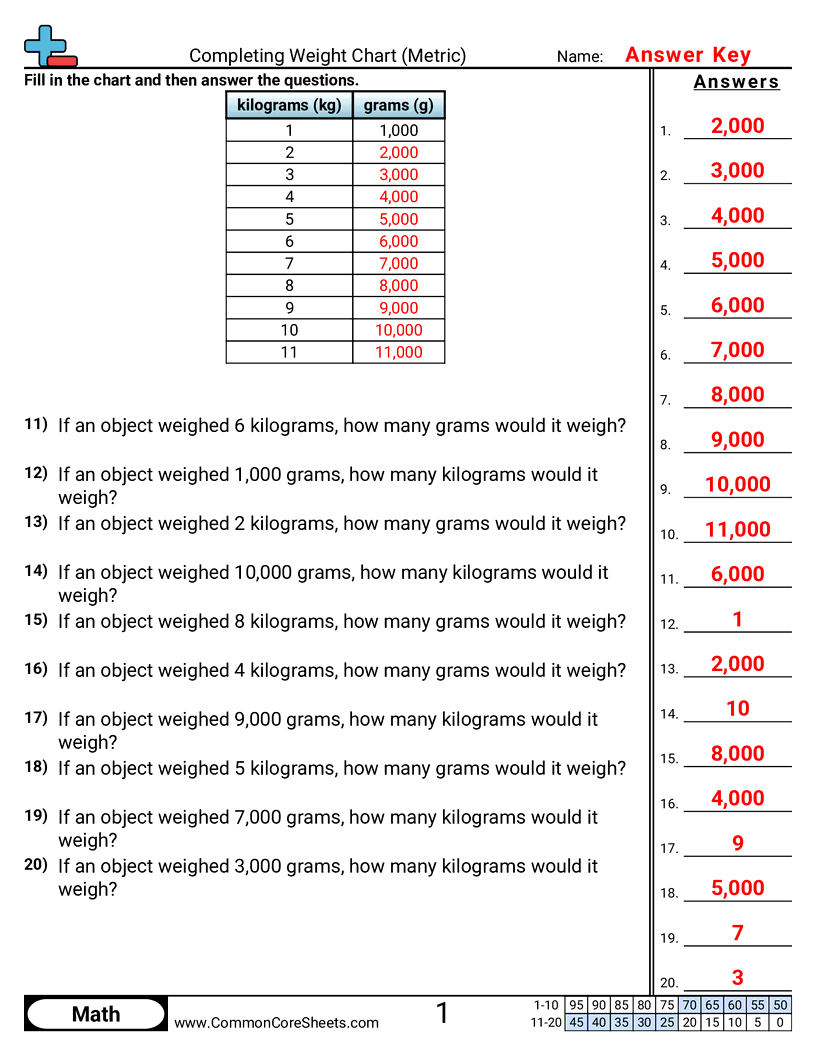
"This worksheet is designed to enhance math skills through the metric weight system for children. The 'Completing Weight Chart (Metric)' worksheet features 20 problems where students convert weight between pounds and ounces. Customizable for individual learning needs, it is suitable for conversion to flash cards, making it a versatile tool for distance learning. A practical approach to build and reinforce fundamental weight conversion concepts."
×Student Goals: