Numbers & Operations (N)5.N.1 Read, write, represent, and compare fractions and decimals; recognize and write equivalent fractions; convert between fractions and decimals; use fractions and decimals in real-world and mathematical situations.5.N.1.3Compare and order decimals and fractions, including mixed numbers and fractions less than one, and locate on a number line.
4nf2Open FolderOpen File×Description:
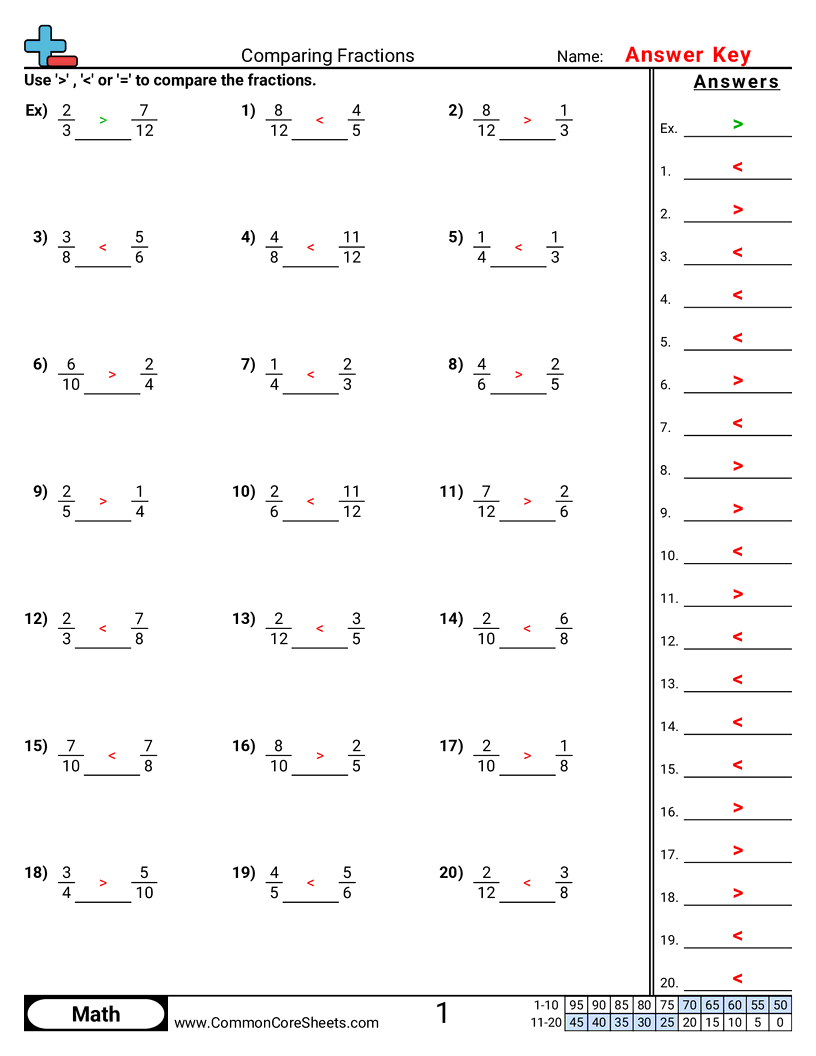
"This worksheet is designed to strengthen children's understanding of comparing fractions in math. It contains 20 distinct problems, where children will decide if one fraction is greater than, less than, or equal to another. Dynamic and engaging, this material can be customized based on learner's needs. It also has the capacity to be converted into flashcards for a more visual approach and is adaptable for distance learning, maximizing instruction during remote education sessions."
×Student Goals: Understanding of FractionsUpon completion of the worksheet, students should have an improved understanding of fractions. They should be able to identify the numerator as the number that represents a part of the whole and the denominator as the total number of parts in that whole. Recognizing these aspects of fractions is fundamental to further mathematical learning.Comparing FractionsStudents should have mastered how to compare fractions effectively. They should be able to determine if a fraction is less than, equal to, or greater than another and justify their reasoning. The comparison of fractions is a fundamental skill that students will utilize in various aspects of their lives, from simple daily activities to complex problem solving in future mathematics studies.Proportional ReasoningThis worksheet should provide students with a clear understanding of proportional reasoning concepts. Through comparing fractions, students should begin to grasp the reciprocal relationship between the numbers in a fraction and the principled way in which they interact. This essential comprehension will assist them in solving more sophisticated mathematical problems down the line.Augmented Problem-Solving AbilitiesBy completing this worksheet, students should significantly improve their problem-solving abilities. They will enhance not only their critical thinking skills but also their ability to apply mathematical principles to solve problems systematically. This improvement will definitely provide a solid foundation for more complex mathematical tasks that they will encounter through their educational journey.Familiarity with Fractional NotationHaving worked with a variety of fractions on this worksheet, students should develop a familiarity with fractional notation. They should understand the differences between proper and improper fractions and be able to recognize equivalent fractions. This understanding of fractional notation will greatly assist them when they progress to additional math subjects such as algebra and calculus.Build ConfidenceCompletion of the worksheet should instill a sense of mathematical confidence in the students. Familiarity and understanding of the topic should reduce math anxiety and encourage students to take on more challenging mathematical concepts. Handling complex problems with ease will boost their confidence and enhance their overall academic performance.
3nf2bOpen FolderOpen File×Description:
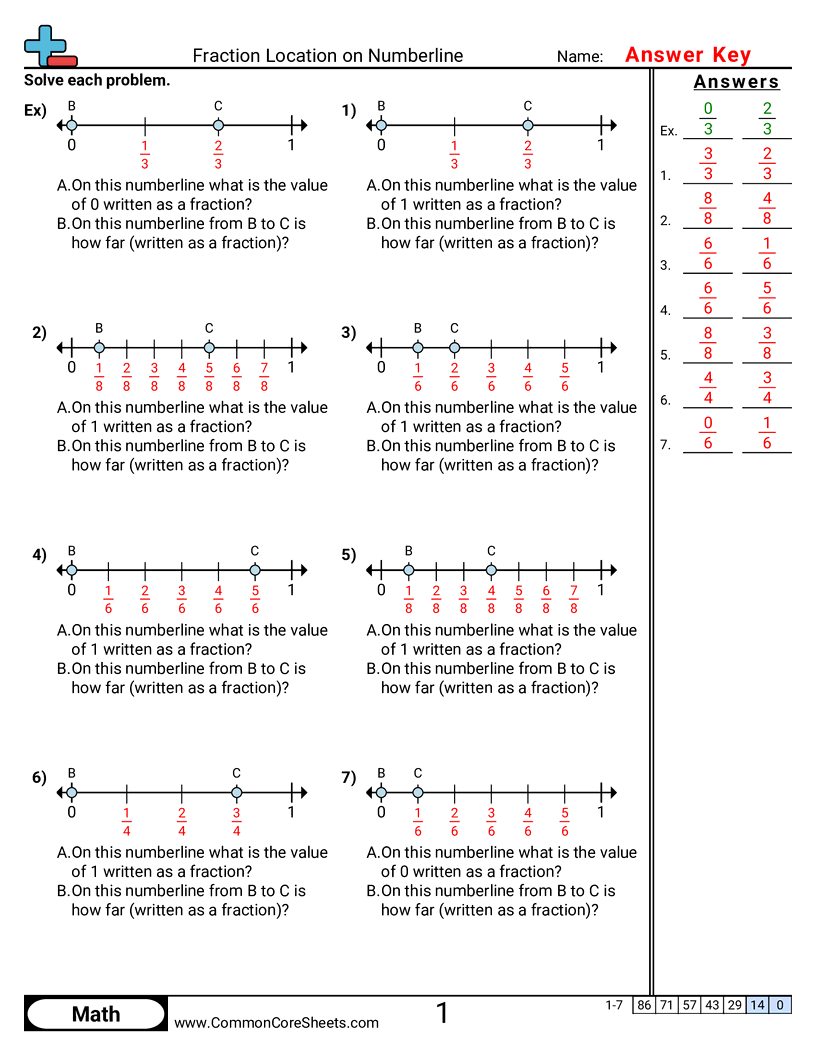
"This worksheet is designed to enhance children's understanding of fractions on a number line. Comprised of seven detailed math problems, it walks students through various aspects of fractions, including values and locations. The problems challenge students to identify fractional values and distances between points on various number lines. Adjustable for different learning levels, the worksheet can be customized, used as flashcards, or incorporated into distance learning curriculums to adapt to learning preferences and needs."
×Student Goals: Develop Numeracy SkillsAfter completing the worksheet, students will have greatly developed their numeracy skills. They will be capable of interpreting and locating fractions on a number line, a crucial concept in elementary mathematics. This understanding will be beneficial in the advancement of more intricate mathematical ideas and proficiencies in the future.Understand Division of Unit LengthsThe children will demonstrate an understanding that a number line is divided into unit lengths, and that different fractions or decimal points denote these divisions. Recognizing this foundational principle will enhance their skills in deeper mathematical categories like algebra, geometry, and more advanced categories of arithmetic.Knowledge of Real World ConnectionsThrough the worksheet, students will gain an understanding of how fractions and their location on a number line relate to real world situations. This could be in measuring distances, cooking, or understanding timelines, reinforcing the notion that math is not merely a theoretical subject, but has practical, everyday applications.Enhancement of Critical ThinkingThis worksheet encourages critical thinking and problem-solving abilities. From figuring out the value of points on a number line to comparing distances, students are challenged to think, analyze, and solve which fosters a much-required mindset for future mathematical and scientific learning.Effective CommunicationBy describing the location of various points on the number line as fractions, students will be developing their ability to communicate mathematical ideas and arguments effectively. This skill is vital not only in the scope of mathematics but also across different subjects and learning areas since clear communication is key in academic success and future professional pursuits.Improve AccuracyThrough repeatedly answering the problems provided, the children will improve their mathematical accuracy. This practice will lessen the probability of committing errors in calculations, which is a valuable skill in many areas of life requiring financial or statistical analysis.
3nf2aOpen FolderOpen File×Description:
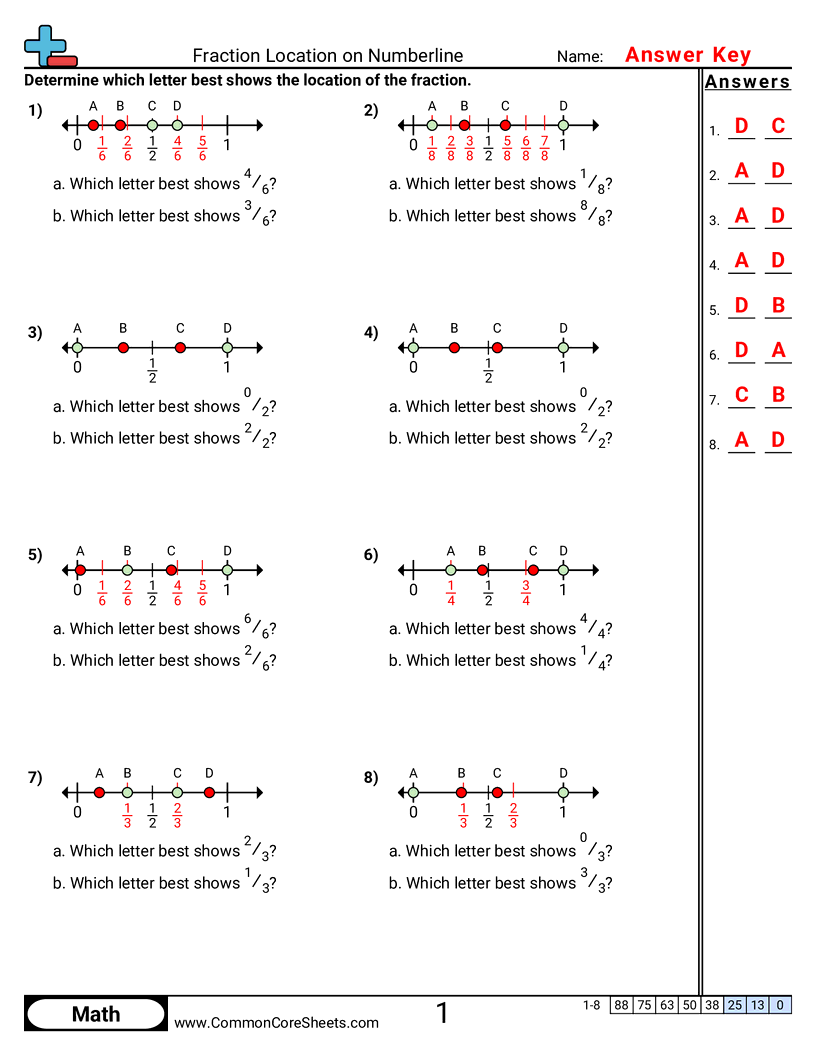
"This worksheet is designed to help children master the concept of fraction location on a number line. Offering 8 diverse problem sets, kids identify the correct placement of specific fractions. The worksheet is highly customizable to suit different learning requirements. It can be easily converted into flashcards for more interactive learning or utilized in distance learning platforms to facilitate math education beyond traditional classroom settings."
×Student Goals: Understand FractionsBy completing the worksheet, students should gain a solid understanding of fractions. This foundation will be crucial for them to grasp more complex numerical concepts in the future. They'll learn about number numerators and denominators, as well as how these components influence a fraction's value. The task demands students to visualize fractions on a number line, which helps them appreciate the relative sizes of different fractions and their relation to whole numbers. This understanding can then be applied in various real-life scenarios, such as measuring ingredients for cooking or calculating distances.Develop Problem-solving SkillsThe worksheet serves as an excellent tool for enhancing students' problem-solving abilities. Each problem poses a unique challenge that requires students to apply their knowledge and analytical skills to find the required fraction on the number line. Through this process, they learn to approach problems methodically, improve their critical thinking skills, and, most importantly, do not fear facing mathematical tasks. These problem-solving abilities are not only relevant to their math lessons but are also applicable to other subjects and real-world situations.Enhance Numerical LiteracyCompletion of this worksheet means that the students have enhanced their numerical literacy. This implies that they've been exposed to the skills necessary to interpret and work with numbers in all aspects of life, from budgeting to measuring and beyond. They'd understand how fractions fit into the broader picture of numerical literacy, appreciating their prevalence and relevance in daily undertakings. Importantly, this stage of numerical literacy is a stepping stone towards more difficult concepts, such as percentages and ratio calculations.Improve Visual-spatial UnderstandingWith a focus on mapping fractions on a number line. This worksheet promotes visual-spatial understanding. It trains students to mentally arrange and manipulate numbers and fractions within a defined space. It also challenges them to identify the relative positions of different fractions on the number line. Consequently, this understanding aids in the honing of spatial awareness which is beneficial in other areas of education such as geometry, engineering, physical sciences, and even day-to-day tasks that require spatial judgement.Boost Confidence in MathematicsLastly, upon completion of the worksheet, students should feel a lot more confident in their mathematical abilities. By mastering these foundational fraction-related tasks, they will realize that they are fully capable of understanding and conquering mathematical challenges. This new-found confidence can have a profound effect on their overall attitude towards learning and education, encouraging them to tackle more complex mathematical problems and concepts without hesitation.
3nf2aOpen FolderOpen File×Description:
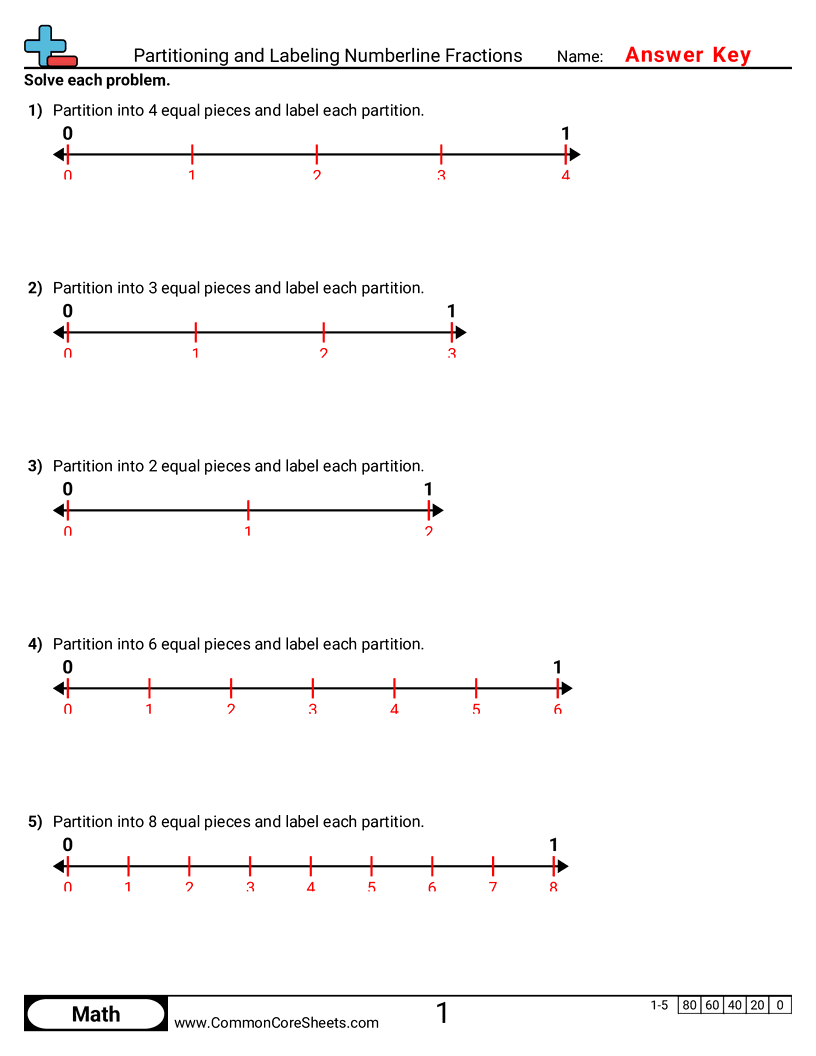
"This worksheet is designed to help children grasp and master the concept of partitioning and labeling on number lines, demonstrating understanding of fractions. Comprised of five unique questions, students will partition number lines into 2, 3, 4, 6 and 8 equal pieces. It offers customizability for individual learning and can easily be converted into flashcards for an interactive experience. Moreover, it's perfectly suitable for distance learning. This worksheet illuminates math concepts, making them approachable and comprehensible."
×Student Goals: Understanding of Fractional ConceptsUpon completing this worksheet, students should have a solid understanding of basic fractional concepts. They will learn that a fraction represents a part of a whole and that different fractions can represent the same value (for example, 2/4 and 1/2). Understanding fractions is crucial as it lays the foundation for more complex mathematical concepts in the future.Proficiency in Partitioning NumberlinesThe worksheet also equips students with the skill to accurately partition number lines into equal segments. This ability allows them to visually represent fractions and better understand their underlying principles. Partitioning is a critical skill for understanding interval scale and shapes the students' ability to deal with both ratio and proportion.Improved Numerical Labeling SkillsAfter finishing the worksheet, students will have improved proficiency in labeling each partition on the number line with corresponding fractional values. This enhances their number sense, links fractions to linear measurement, and cultivates their understanding of the relative nature of number size. This skill directly feeds into the ability to interpolate in missing number sequences and handle data interpretation in graphical forms such as bar and line graphs.Enhanced Comparison SkillsChildren will develop the ability to compare fractional values by analyzing number lines. This can be a practical way for them to understand that with fractions, a bigger denominator does not necessarily mean a larger value – an essential principle that students often struggle with in early fractions work.Introduction to Equivalent FractionsThough it is not explicitly mentioned in the worksheet, students will begin to develop intuition for the concept of equivalent fractions. They may notice, for example, that partitioning a number line into 4 pieces and shading in 2 will visually look the same as partitioning into 2 pieces and shading in 1 (i.e., that 2/4 = 1/2). This preps them for later math instruction where equivalent fractions are formally introduced.Building a Foundation for More Advanced Fractional ConceptsFinally, this worksheet provides a strong foundation for the learning of more advanced fractional concepts in the future. When they understand where fractions come from and how they work on a number line, they will find it much easier to grasp operations with fractions like addition, subtraction, multiplication, and division.
4nf2Open FolderOpen File×Description:
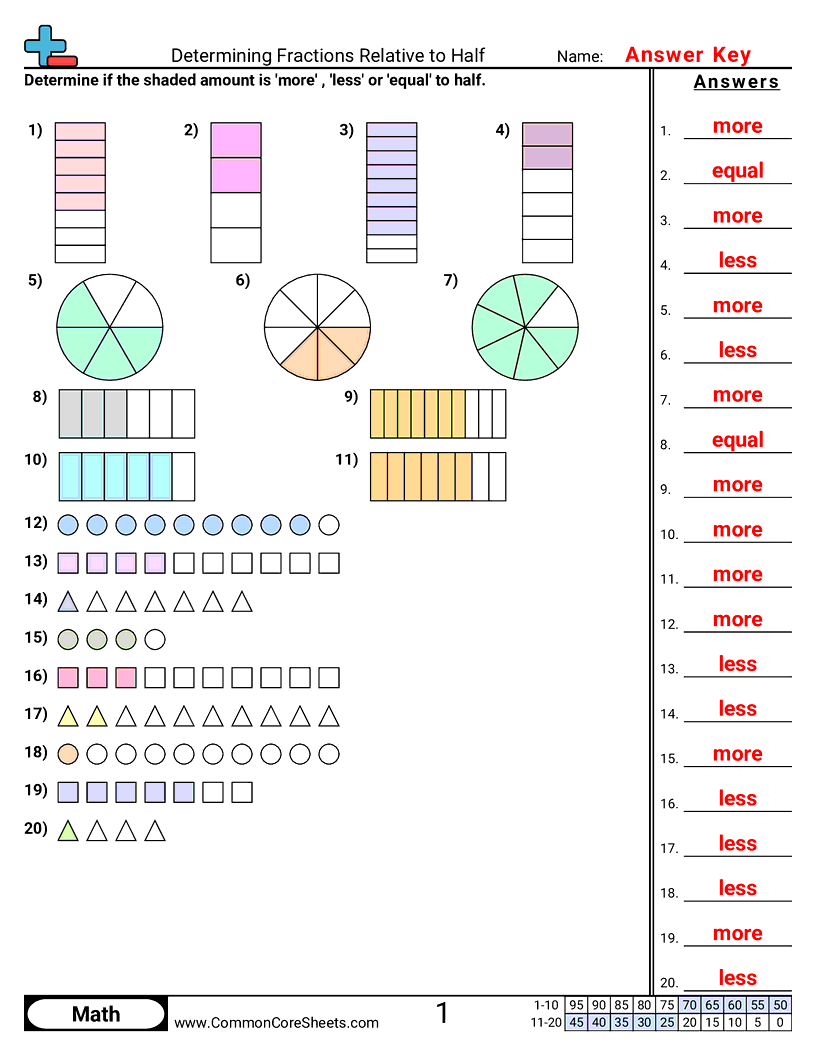
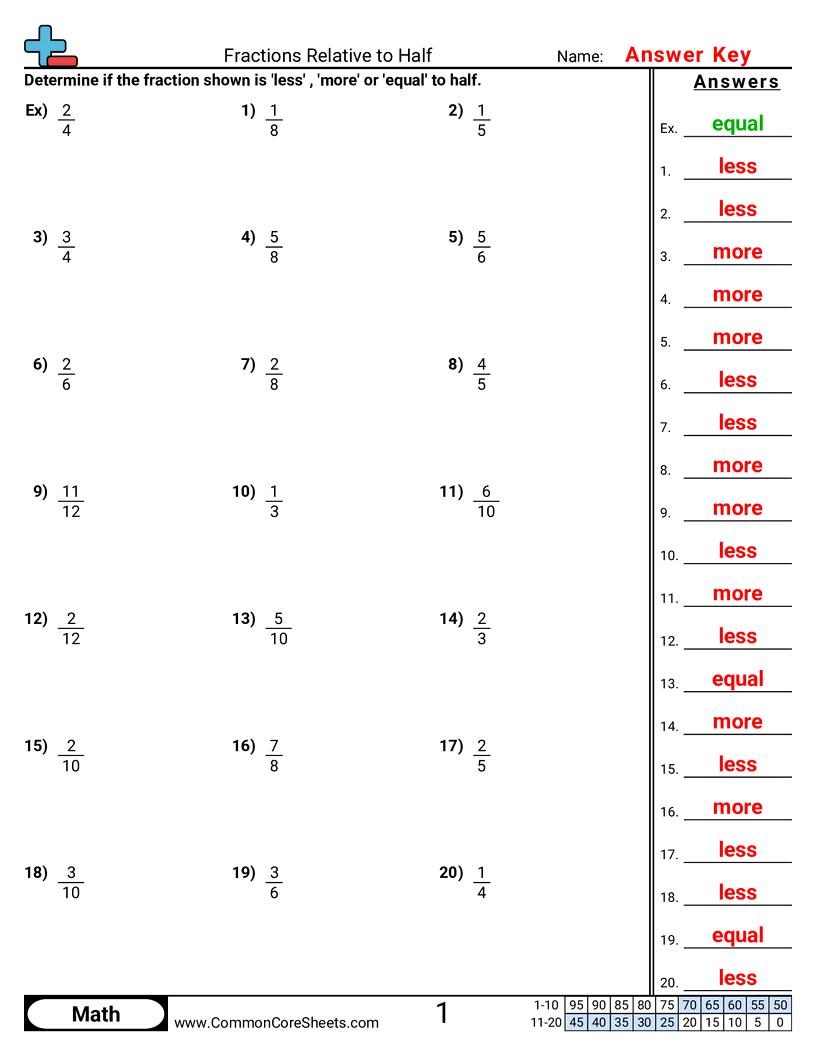
"This worksheet is designed to educate children on the concept of fractions and their relation to half. Through 20 math problems, kids will enhance their numeracy skills and develop a better understanding of fractions. The worksheet can be customized according to individual learning needs, converted into flashcards for interactive study or used for distance learning, thereby offering a flexible, educational tool for children's mathematical development."
×Student Goals: Understanding Basics of FractionsAfter completing this worksheet, students should have a firm understanding of the basic principles of fractions, particularly in relation to halves. They will understand that a fraction represents a part of a whole and they will improve their ability to visualize this concept, enhancing their essential fraction comprehension. The exercises will improve their speed, efficiency, and accuracy in identifying and working with fractions.Comparing and Classifying FractionsThe worksheet will enable students to develop advanced skills in comparing and classifying fractions. Through their work with the problems, students will learn to differentiate between fractions that are more than, less than, or equal to half. This fundamental but important skill helps children appreciate the relative size of fractions, which is invaluable in advanced mathematical comprehension.Fraction Arithmetic SkillsAfter completing the worksheet, students should acquire hands-on practice in performing basic fractional arithmetic. Through the problems presented in the worksheet, students will fine-tune their ability to perform different mathematical operations with fractions, including addition, subtraction, multiplication, and division.Application of Fraction KnowledgeThe worksheet will also help students understand the applicability of fractions in real-life scenarios. After engaging with this worksheet, students will gain insight into how fractional knowledge can be transferred to everyday activities like cooking, shopping or sharing. Thus, making fractions less theoretical and more practical for students.Problem-Solving and Critical Thinking SkillsBy working on the problems in the worksheet, students will improve their problem-solving and critical thinking skills. Each problem will push them to think critically, strategize, and apply their fractional knowledge to find the best solution. These skills extend beyond mathematics, contributing to the overall intellectual development of the students.Foundation for Advanced MathematicsLast but not least, by mastering fractions in relation to halves, students will build a solid foundation for more advanced mathematical concepts. Fractions serve as a stepping stone to decimals, percentages, ratios, and algebra. With a firm grasp of fractional understanding, students will be well-equipped to tackle these advanced topics when they encounter them in higher grades.
4nf2Open FolderOpen File×Description:
"This worksheet is designed to educate children on the concept of fractions relative to half in a math context. It encompasses 20 distinctive problems, ranging from basics such as 3/6 to more challenging instances like 5/8. Perfect for distance learning, the worksheet is flexible, allowing for user customization and a seamless conversion into flashcards to enhance comprehension and memory retention. Ideal for instilling a strong foundation in fractions."
×Student Goals: Understanding of FractionsAfter completing the worksheet, students should have a deeper understanding of fractions. They should be able to identify numerators and denominators and what they represent in the context of a whole. They should understand how fractions are used to represent portions of a whole, and how different fractions can express the same value.Conversion SkillsStudents should be able to convert fractions to their simplest form. For example, they should know that 2/4 is the same as 1/2. They should also be able to convert improper fractions to mixed numbers, and vice versa. Their ability to compare and order fractions should also be enhanced.Relating Fractions to HalfAn important learning outcome is for students to understand fractions relative to the value of one half. They should appreciate how different fractions are smaller or larger than one half. They should be able to make estimations about the value of fractions based on their relation to one half.Problem Solving SkillsCompletion of the worksheet should also bolster students' problem-solving skills. Not only will students answer specific problems, but they will also apply concepts and strategies learned to solve new, unfamiliar fractional problems. This applies their understanding in a practical and meaningful way.Math Language and TermsThe worksheet should arm students with the correct mathematical language and terms. They should be able to use the proper terminology and symbols when representing and discussing fractions. This helps them to effectively communicate their mathematical thoughts and understandings.Confidence in MathematicsLastly, successfully working out fraction problems can boost students' confidence in their math abilities. They should feel encouraged to further explore and learn more complex fraction concepts and other areas of mathematics. Overall, the enhanced confidence could foster a positive attitude towards learning mathematics.