Geometry & Measurement (GM)7.GM.1 Develop and understand surface area and volume of rectangular prisms with rational edge lengths.7.GM.1.3Model volume by counting same-size unit cubes that fill a prism without gaps/overlaps; use appropriate cubic units (e.g., cm³).
6g2Open FolderOpen File×Description:
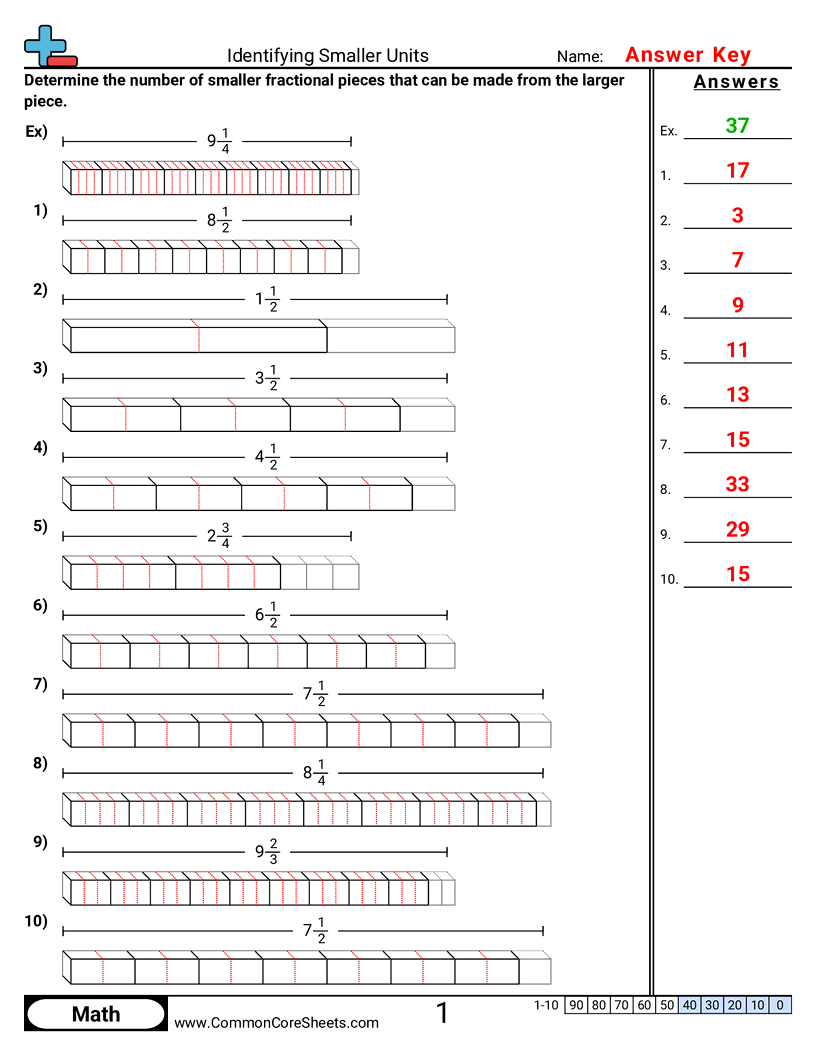
"This worksheet is designed to improve children's math skills by identifying smaller units. Featuring 10 interactive problems, kids discern from options to choose the lower value. This customizable tool can easily be converted into flashcards or integrated in distance learning programs. Ideal for enriching mathematical understanding in a fun, engaging way."
×Student Goals: Enhanced Numerical ProficiencyBy coming to the end of this worksheet, students solidify their understanding and fluency of basic numerical skills. They will be able to efficiently and accurately determine smaller numbers among others, a crucial aspect of practical arithmetic. This improvement in their numerical proficiency will lay a solid groundwork for ensuing complex tasks in advanced math.Improved Critical ThinkingCompletion of the worksheet results in sharpening of the child's critical thinking abilities. The exercises help students in problem-solving by analyzing different elements to identify smaller units. This competence goes beyond mathematics to other areas of learning and life requirements.Boosted ConfidenceAccomplishing the tasks on the worksheet will boost the students' confidence in their mathematical abilities. By overcoming the challenges on the sheet, students are motivated and gain the assurance to take on more intricate problems in mathematics.Mathematical Vocabulary ExpansionBy completing this worksheet, students will inevitably come across different mathematical terms and notations used to communicate mathematical practices. Therefore, it assists in augmenting their mathematical vocabulary, aiding successful communication in the subject.Enhanced Pattern RecognitionPattern recognition is one primary outcome for learners upon completion of the worksheet. Determining smaller units among a series of numbers reinforces the ability to recognize and analyze patterns, which is a vital skill in mathematics and scientific evaluation.Developed Speed and AccuracyThe practice of identifying smaller units swiftly and accurately cultivates a sense of quick judgment in students. This ability not only benefits them in timed tests or exams but also in real-life scenarios where quick decision-making is necessary.
6g2Open FolderOpen File×Description:
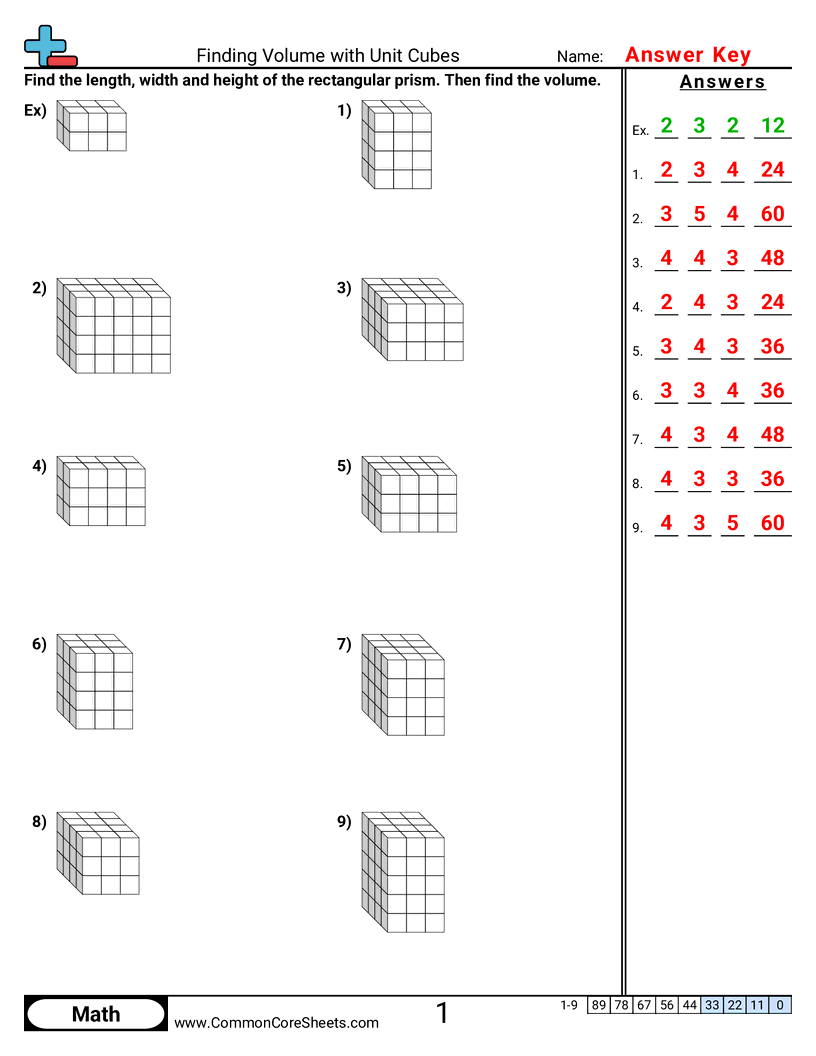
"This worksheet is designed to engage children in learning mathematics, specifically volume calculation using unit cubes. With seven unique problems, kids can unravel basic principles of geometry in an interactive way. The worksheet content is customizable, ideal for distance learning, and can also be converted into flash cards to enhance children's learning experience."
×Student Goals: Understanding of Volume ConceptsCompleting this worksheet would enable students to gain a solid understanding of the concept of volume. They would be able to define volume, recognize it as a measure of space occupied by a 3-dimensional object, and understand how it is measured in cubic units.Skill in Using Unit CubesThis worksheet is designed to inculcate in students the ability to use unit cubes to determine the volume of a structure. They learn to stack and count unit cubes, and to visualize 3-dimensional shapes constructed using these cubes. This ability is critical not only in understanding volume in math but is also an important spatial reasoning skill.Comprehension of Mathematical RepresentationsAn important goal of this worksheet is to enable students to decipher and interpret mathematical representations and diagrams. They would become proficient in discerning the dimensions of given structures with the help of such representations.Numeracy SkillsThese problems hone numeracy skills. Effective completion of the worksheet should boost students' abilities to perform basic mathematical operations and use these operations to work out the volume of various structures accurately.Problem-solving SkillsDetermining volume using unit cubes is a methodical process that requires careful counting and calculating. It demands keen attention to detail and systematic working. By resolving these worksheet problems, students gradually build sound problem-solving skills, which are a vital aspect of an individual’s cognitive development and are essential across various life scenarios.Application AbilitiesLastly, after doing the worksheet, students should be able to apply their knowledge of volume to find the volume of other similar structures beyond the classroom. This application ability is central to the principle of mathematics and empowers students to engage with their spatial environment more effectively.
6g2Open FolderOpen File×Description:
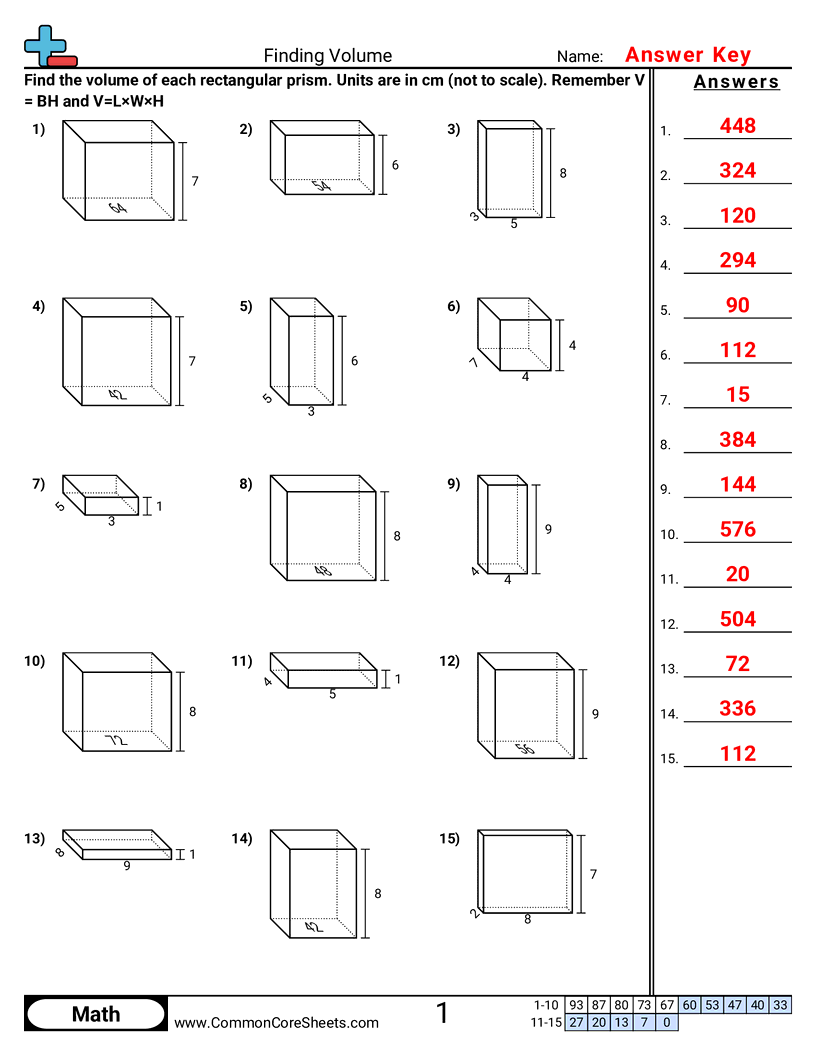
"This worksheet is designed to help children understand and master finding volume in math. It contains 15 problems that involve calculating volume, providing real, practical examples. The worksheet is highly versatile and customizable, allowing the possibility of conversion into flashcards for enhanced memory training. It's also suitable for use in distance learning settings, serving as an excellent resource for educators and parents alike."
×Student Goals: Understanding of Volume ConceptsAfter completing the worksheet, students will have a solid understanding of volume concepts. They will have deep dived into what volume is and how it can be calculated. This is crucial in their mathematical journey as the concept of volume widely applies in different areas of study including geometry and physical science.Ability to Solve Volume ProblemsThe completion of the worksheet equips students with the necessary skills to independently solve volume problems. With a range of problems tackled in the task, they should be flexible and confident in solving volume-related questions. These problem-solving skills will be useful in their daily life where volume measurements are common.Enhanced Numerical SkillsBy working through the various volume problems, students will undoubtedly enhance their numerical skills. This includes both mental arithmetic skills and the ability to manipulate numbers. Such skills are foundational for other complex mathematical problem-solving requirements.Appreciation of Math in Daily LifeLastly, the worksheet helps to establish the connection between mathematics, particularly the concept of volume, and the real world. It helps in instilling a practical perspective in students' mind. By completing the task, they will fully comprehend that math is not just an abstract subject studied in school, but a vital part of everyday life.Improved Mathematical LanguageCompleting math worksheets also helps students to familiarize themselves with mathematical language and conventions, using them appropriately in various contexts. They will be able to demonstrate increased proficiency in mathematical communication, especially regarding volume measurements.
5md4Open FolderOpen File×Description:
"This worksheet is designed to help children grasp the concept of volume using unit cubes. It offers nine engaging problems to make learning interactive and enjoyable. The worksheet is easily customizable, allowing for use as flashcards or as a tool in distance learning environments. The aim is to simplify comprehension of mathematical volume and foster confidence in young learners."
×Student Goals: Understand the Concept of VolumeAfter completing this worksheet, students should have a foundational understanding of the concept of volume, a critical concept in geometry. They will grasp the principle that volume measures the space that an object occupies, typically in cubic units.Ability to Calculate Volume Using Unit CubesStudents will learn how to calculate the volume of various shapes using unit cubes. Through problem-solving, they will gain practical experience in determining the volume, enhancing their calculation skills and numerical comprehension.Develop Spatial ReasoningWorking with unit cubes to calculate volume will help students improve their spatial reasoning skills. They will learn to visualize shapes in three dimensions and understand the spatial relationships between these shapes.Improve Problem-Solving SkillsThe worksheet contains problems that challenge students to apply their understanding of volume and the use of unit cubes. This will not only test their comprehension but also enhance their problem-solving skills, which are crucial in math and other fields of study.Application in Real World ContextsThrough this worksheet, students will also get to understand how to apply the principles of volume in real-life situations. Understanding volume becomes relevant in a myriad of real-life applications such as figuring out how much a container can hold or how much space an object will occupy.Enhance Mathematical Language SkillsAfter completing this worksheet, students will be familiar with terms and concepts related to volume like unit cubes. This contributes to growing their mathematical vocabulary, facilitating their ability to communicate mathematically and enhancing overall math literacy.Confidence in Further Mathematical StudiesUltimately, the ability to understand and calculate volume builds a firm foundation for the student's further studies in more complex mathematical topics. This understanding thus builds their confidence in tackling other related mathematical topics in the future.