Geometry & Measurement (GM)7.GM.3 Use models and proportional/ratio reasoning to determine measurements, justify formulas, and solve problems.7.GM.3.1Convert weights and capacities within a measurement system using appropriate units.
5md1Open FolderOpen File×Description:
"This worksheet is designed to help children explore the concept of American capacity conversions in a fun and engaging way. With 20 interesting math problems, it helps students learn to convert ounces into cups. The convertible format of this worksheet allows it to be customized, transformed into flashcards, or used seamlessly in distance learning environments."
×Student Goals: Understanding American Capacity UnitsAfter completing the worksheet, students will have a deep understanding of American capacity units including ounces, cups, and pints. They will comprehend how these units interrelate and correspond to each other, providing a crucial foundation for further learning in practical measurement scenarios.Practical Application of Mathematical KnowledgeThe completion of the worksheet equips students with the ability to practically apply their mathematical knowledge in daily situations. Be it cooking, purchasing grocery, or comparing the volumes of different containers, students will be skilled at making conversions between ounces, cups, and pints, which are common household measuring units in the United States.Enhanced Problem-Solving SkillsThe worksheet comprises of conversion problems that necessitate critical thinking and cognitive reasoning. Thus, upon completion, students will have enhanced their problem-solving skills. They will be adept at breaking down complex problems into simpler units, applying their theoretical knowledge, and arriving at a logical conclusion.Increased Numeracy SkillsWorking through this worksheet will result in improved numeracy skills. Students will strengthen their skills not only in arithmetic but also in the practical application of these operations. They will become quite facile with the conception of converting units, which is an important aspect of numerical proficiencyPreparation for Advanced Mathematical ConceptsThe worksheet moreover serves as a building block for more advanced mathematical concepts. The ability to convert units plays a vital role when learning concepts like ratios, proportions, and rates, therefore, accomplishment of this worksheet will equip students with skills required to succeed in advanced levels of math.Confidence and Self-Efficacy in MathematicsThe completion of the worksheet instills in students a sense of achievement and self-efficacy, thereby motivating them to tackle more complex problems. By working through these problems independently and successfully, they gain confidence in their own abilities to understand and apply mathematical concepts in practical scenarios.
5md1Open FolderOpen File×Description:
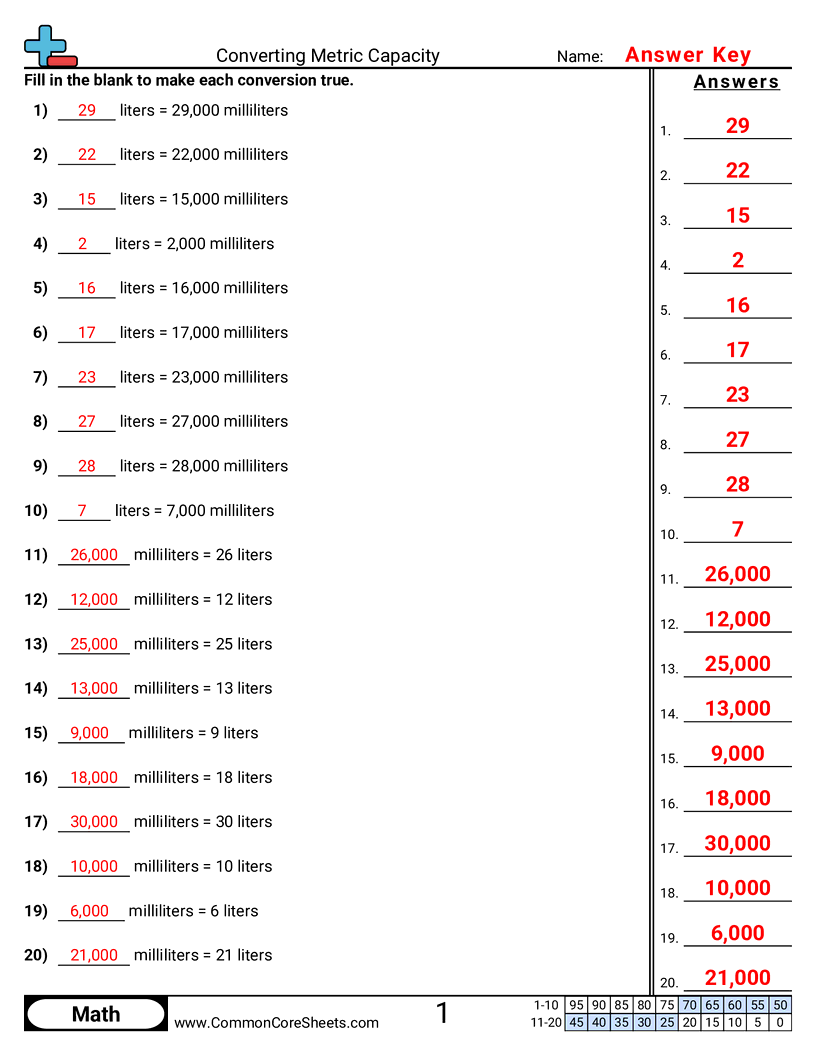
"This worksheet is designed to help children master the concept of converting metric capacity in math. Includes 20 problems, demonstrating conversion between liters and milliliters, that reinforce practical applications of metric measurements. Versatile in format, it can be customized to suit individual needs, transformed into flash cards for quick reference, or used in distance learning settings to enhance comprehension of metric conversion."
×Student Goals:
5md1Open FolderOpen File×Description:
"This worksheet is designed to aid children in converting American lengths for math learning. It features 20 problems, including conversion of feet to inches, yards to feet, fostering practical calculation skills. Ideal for distance learning, it can be customized to fit individual needs, or converted into flashcards for an interactive experience."
×Student Goals: Measurement Conversion UnderstandingAfter successful completion of this worksheet, students will have a clear understanding of how to convert American length units. They will be perfectly equipped to effortlessly interchange between feet, inches, and yards, fundamental building blocks of the American measurement system.Problem Solving SkillsThe variety of problems presented in the worksheet will help students to enhance their problem-solving skills. They will be better at tackling conversion problems, irrespective of the units of length involved, thus strengthening their capability to resolve real-world mathematical problems.Application of Mathematical KnowledgeThis worksheet will enable students to apply their theoretical knowledge of the American measurement system into practical examples. They will be adept at using their mathematical knowledge in everyday situations, be it understanding their height, or estimating the length of objects.Mental Math AgilityPractice makes perfect. Completing this worksheet will improve the student’s mental math agility. The continuous practice of conversion formulas not only fosters their memory recall but also accelerates their mental math speed, an essential skill for further mathematical learning.Boost ConfidenceAs students progress through the worksheet and start getting the correct answers, they will develop confidence in their mathematical abilities. This boost in self-esteem can encourage them to take on more complex mathematical challenges in the future.Foundation for Advanced LearningMastering unit conversion is a foundational requirement for advanced mathematical concepts and scientific calculations, in physics and engineering for example. Hence, successfully completing this worksheet lays the groundwork for students' future learning journey in these areas.
6rp3dOpen FolderOpen File×Description:
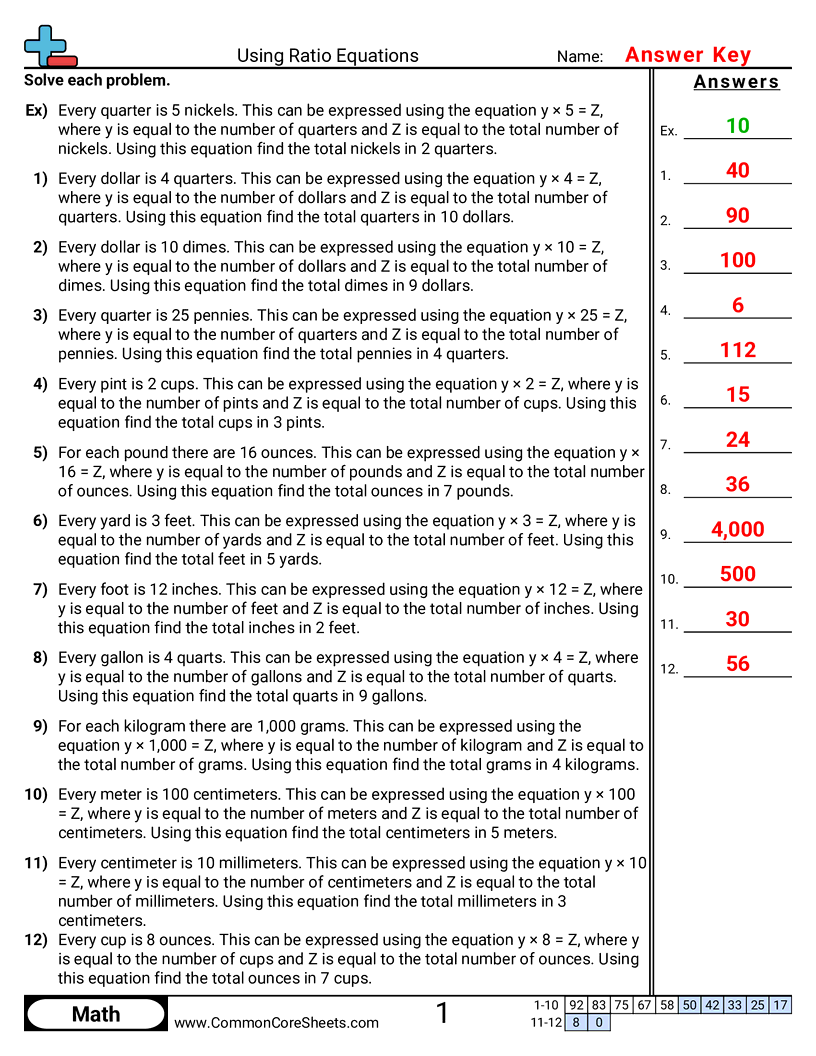
"This worksheet is designed to enhance children's mathematical skills, particularly in using ratio equations. It comprises of 12 problems involving conversion of units in everyday items such as currency, measurement, and volume. With practical examples, children can better understand and apply the concept. The worksheet is customizable, can be converted into flashcards for easy learning and is suitable for distance learning, promoting a flexible and interactive educational experience."
×Student Goals: Understanding of RatiosUpon completion of the worksheet, students should have a thorough understanding of ratios. This allows them to make sense of the relations between different amounts and magnitudes in real-world situations, such as converting feet to inches or dollars to cents. The principle of ratio enables students to see how different quantities relate to each other, which is a critical aspect of mathematical and analytical thinking.Grasping Mathematical EquationsStudents should also be able to grasp mathematical equations, specifically understanding what each variable in a ratio equation represents and how they can be manipulated to find the unknown values. This understanding forms the basis for more complicated algebraic expressions they may encounter in future math lessons.Problem Solving SkillsCompleting the worksheet enhances the students' problem-solving skills. They are given questions and required to find solutions using the given equations, which encourages them to think critically, apply what they have learned and solve problems systematically.Application of Mathematics in Real World ScenariosBy the end of the worksheet, students should be able to apply mathematical concepts to real-world scenarios. Each problem in the worksheet underscores how mathematics, especially ratios, can be seen and used in everyday life, like converting liters to milliliters or yards to feet. This alignment of mathematics to real-world contexts aids in making the subject more relevant and understandable for the students.Enhance Computational SkillsFinally, students should develop and enhance their computational skills. They perform numerous calculations to solve problems that reinforce arithmetic principles. This practice will help improve their speed, accuracy, and confidence in performing basic operations that lay the groundwork for complex mathematical problems that they will face in their future studies.
6rp3dOpen FolderOpen File×Description:
"This worksheet is designed to enhance children's mathematical aptitude by understanding ratios and forming equations. It features 15 problems using everyday examples like conversion of kilometers to meters and quarters to pennies. Adaptable for diverse learning methods, activities can be customized, converted into flash cards, or utilized in distance learning environments to optimize knowledge retention."
×Student Goals: