Numbers & Operations (N)7.N.2 Compute with rational numbers, with and without positive integer exponents, to model and solve problems.7.N.2.5Model and solve problems with rational numbers using addition, subtraction, multiplication, division, and positive integer exponents.
7ns1cOpen FolderOpen File×Description:
"This worksheet is designed to enhance children's understanding of math, specifically focusing on converting rational subtraction to addition. It features 20 problems that transform subtraction scenarios into addition circumstances. This resource can be tailored to individual learning needs and is ideal for distance learning. It can be easily converted into flashcards to facilitate reinforced practice and comprehension of this key mathematical concept."
×Student Goals: Mastering the ConversionsUpon completion of this math worksheet, students should be able to master the concept of converting rational subtraction problems into addition problems. This is a fundamental skill in mathematics, feeding into more complex mathematical principles and operations. Students should not only comprehend the conversion process, but should also be capable of implementing this skill independently within various contexts. This worksheet propels the students towards a new level of competency, allowing them to display an enriched understanding in math.Strengthening Mathematics FoundationConverting rational subtraction to addition is a key foundational element in mathematics. With this worksheet, students should have a firm grasp of this fundamental aspect, thereby strengthening their overarching mathematical foundation. This solid grounding will pave the way for learning more advanced mathematical concepts, fueling their success in future math courses. The repetitive practice provided in this worksheet ensures that students absorb the core concepts thoroughly.Enhancing Problem-Solving SkillsOne of the advantages of learning mathematics is the development of problem-solving skills. After completing this worksheet, students should see an improvement in this area. Understanding the conversion of rational subtraction to addition requires analytical thinking and strategic problem-solving tactics. The completion of the worksheet requires students to use critical thinking, which improves their problem-solving abilities in and beyond mathematics.Boosting Confidence and Enjoyment in LearningAs students begin to understand and master the process of converting rational subtraction to addition, their confidence in handling mathematics questions should increase. This translates to an enhanced learning experience where students can enjoy the process of solving mathematical problems. Empowered by their growing knowledge, students can approach new mathematical challenges with optimism and curiosity.Preparation for Advanced Mathematical ConceptsThe skills learned and practiced within this worksheet set the stage for more complicated mathematical concepts that students will encounter in subsequent grades. Having the ability to convert subtraction to addition will come in useful in topics such as algebra, calculus, and beyond. By completing this worksheet, students are essentially taking one step closer to advanced mathematical proficiency, preparing themselves for a successful mathematical journey ahead.
7ns2dOpen FolderOpen File×Description:
"This worksheet is designed to enhance children's understanding of repeating decimals, an essential concept in mathematics. Featuring 15 engaging problems, children will be tasked to find and recognize patterns in fractions that result in repeating decimals. Additionally, this versatile tool can be customized to suit individual learning objectives, converted into flash cards for easy recall, or incorporated into distance learning curriculums, making mathematics fun and accessible for all learning scenarios."
×Student Goals:
7ns2dOpen FolderOpen File×Description:
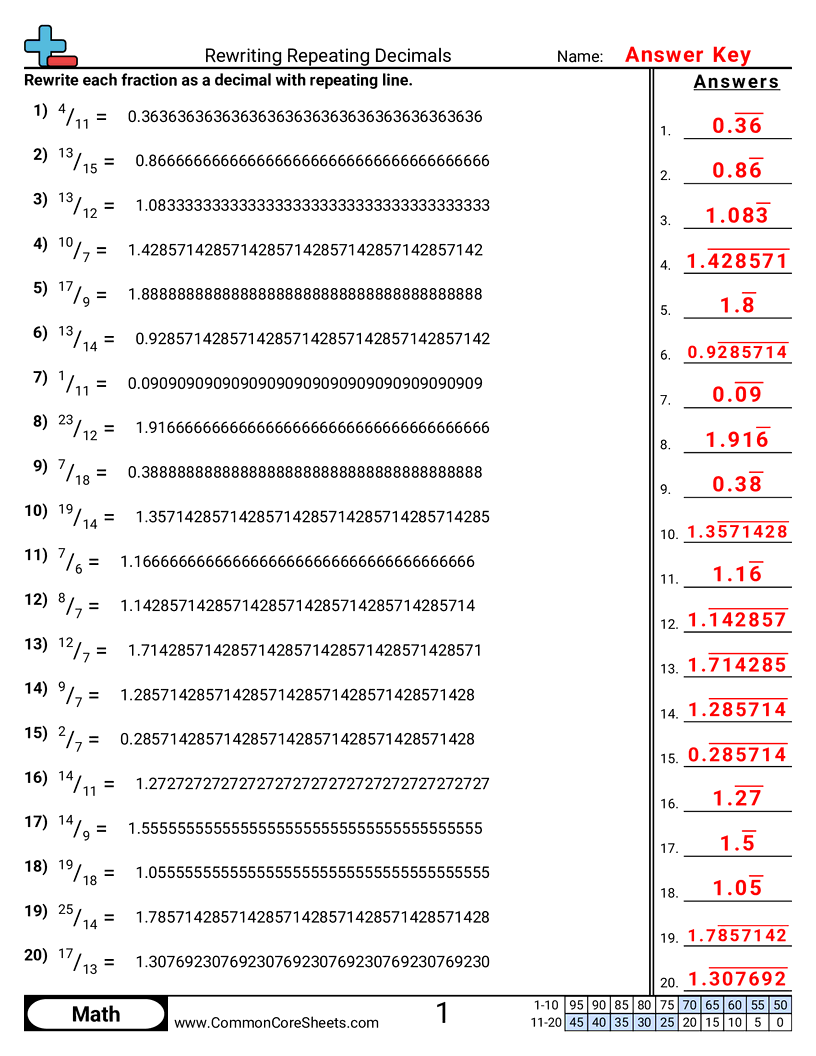
"This worksheet is designed to encourage children's understanding of repeating decimals within the subject of math. Featuring 20 customizable problems, it provides examples such as '8/9 = 0.888888...' that challenge students to rewrite these decimals. Adaptable for various learning modalities, it can be converted into flashcards or utilized in distance learning, offering flexibility in education methods."
×Student Goals: Understand Concept of Repeating DecimalsAfter completing the worksheet, students should be able to grasp the idea of repeating decimals. They would learn that a repeating decimal, also known as a recurring decimal, is a decimal fraction that eventually becomes periodic (i.e., the same finite sequence of digits is repeated). It will help to solidify their understanding that certain fractions, when converted into decimals, don't terminate but rather continue in a looping sequence.Conversion Skill ImprovementThe students will strengthen their ability to convert fractions into their decimal equivalents. They will gain practice in dividing the numerator by the denominator, understanding how to extend the division process until a repeating pattern is observed. They will also improve their precision in identifying when a decimal begins to repeat, fostering a deeper comprehension of the decimal number system.Enhance Arithmetic FluencyAccomplishing the worksheet will give learners a chance to apply and enhance their arithmetic skills, specifically division. By consistently practicing these division problems, learners will effectively improve their calculation speed and accuracy. Counteracting mathematical anxieties, it will help them to increase their comfort level with number manipulation.Problem-Solving and AnalysisStudents will develop critical problem-solving skills and enhance their analytical abilities. They will have to identify the repeating pattern in various problems and apply their understanding to reach the correct solution. By resolving 20 different mathematical problems, they will find patterns, make predictions and test their hypotheses, which are crucial cognitive abilities for mathematics and beyond.Strengthen Foundation for Advanced TopicsThis worksheet lays a good foundation for learning more advanced mathematical concepts. Proficiency in understanding repeating decimals is pivotal before learning topics such as rational and irrational numbers and real numbers. It will also be beneficial if they move onto studying infinite series, which is a sum of infinitely many terms and is considered crucial in calculus.
7ns1aOpen FolderOpen File×Description:
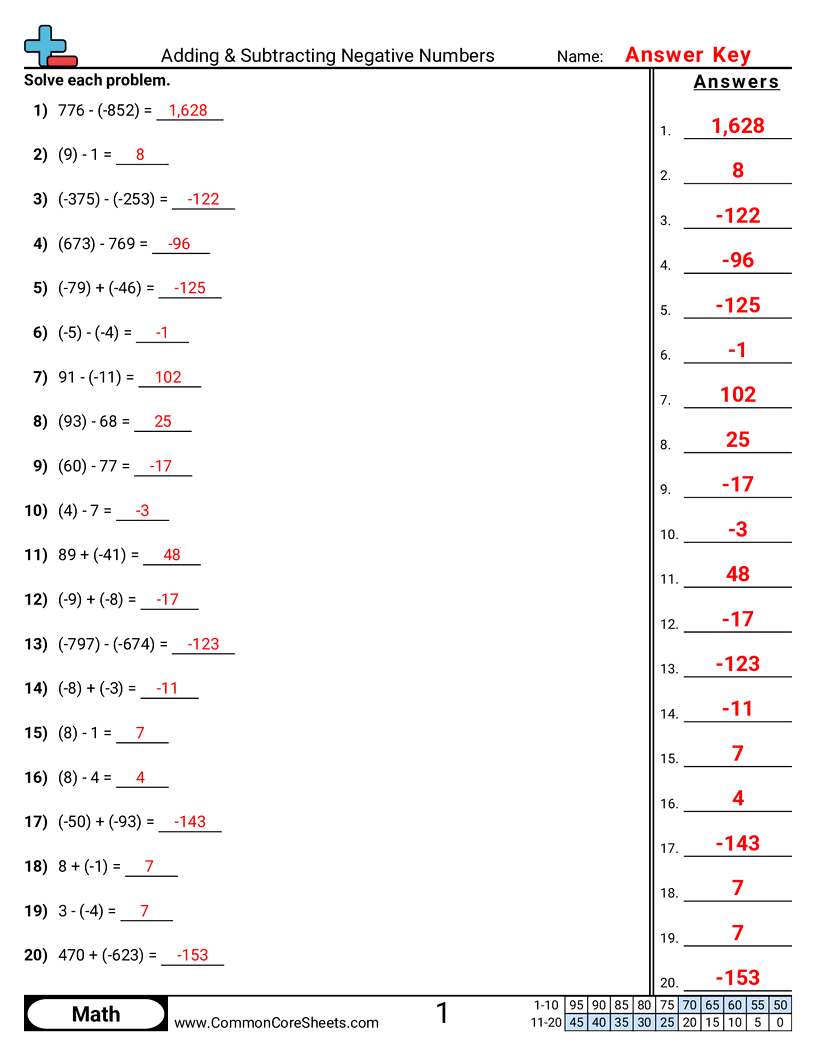
"This worksheet is designed to enhance children's skills in adding and subtracting negative numbers. It features 20 problems aiming to boost arithmetic proficiency with real-life examples. Its adaptability allows for customization, making it a useful tool for distance learning. It can further be converted into flash cards, reinforcing the interactive learning experience and reinforcing the grasp of the complex concept of negative number calculations."
×Student Goals: Understand Concept of Negative NumbersAfter completion of this worksheet, students must have a firm grasp of the concept of negative numbers. They will understand that a negative number is less than zero and lies to the left on the number line. The idea of how mathematical operations like addition and subtraction function when negative numbers come into play should be clear to them.Perform Addition and Subtraction with Negative NumbersPost completion of these exercises, learners should have an ability to swiftly perform addition and subtraction involving negative numbers. They will learn how to add and subtract negative numbers in different scenarios, and with repeated practice through these exercises, can sharpen their calculations, thereby boosting their confidence in tackling similar problems.Comprehend Absolute ValuesBy the end of this worksheet, students should be able to comprehend the absolute values of numbers. They will realize that absolute values refer to the distance of the number from zero irrespective of the direction, and that the absolute value of a number is always positive or zero. This will be a stepping stone to a deeper understanding of the number system.Enhance Problem Solving SkillsThese exercises will also contribute significantly to refining the problem-solving skills of the students. The ability to recognize the negation of a number and dealing with the constraints of the number line can greatly expand their mathematical analytical skills. These skills are vital not only in Arithmetic, but also in a broader spectrum of subjects involving calculations.Boost Mental Math SkillsThe worksheet has the potential to strengthen students' mental math skills. Completing these problems will enhance their fluency with numbers and improve their capability of mental calculations, which will be extremely useful in their academic journey and real life situations. From calculating change to measuring distances in the real world, these skills will come in handy.Develop Mathematical CommunicationThe application of this worksheet will promote mathematical communication. The expression of mathematical thoughts and ideas is a fundamental part of learning. Through this exercise of adding and subtracting negative numbers, students will have a vocabulary for better communication of these ideas. They can share problem-solving strategies, reason out calculations, and articulate their understanding.
7ns1aOpen FolderOpen File×Description:
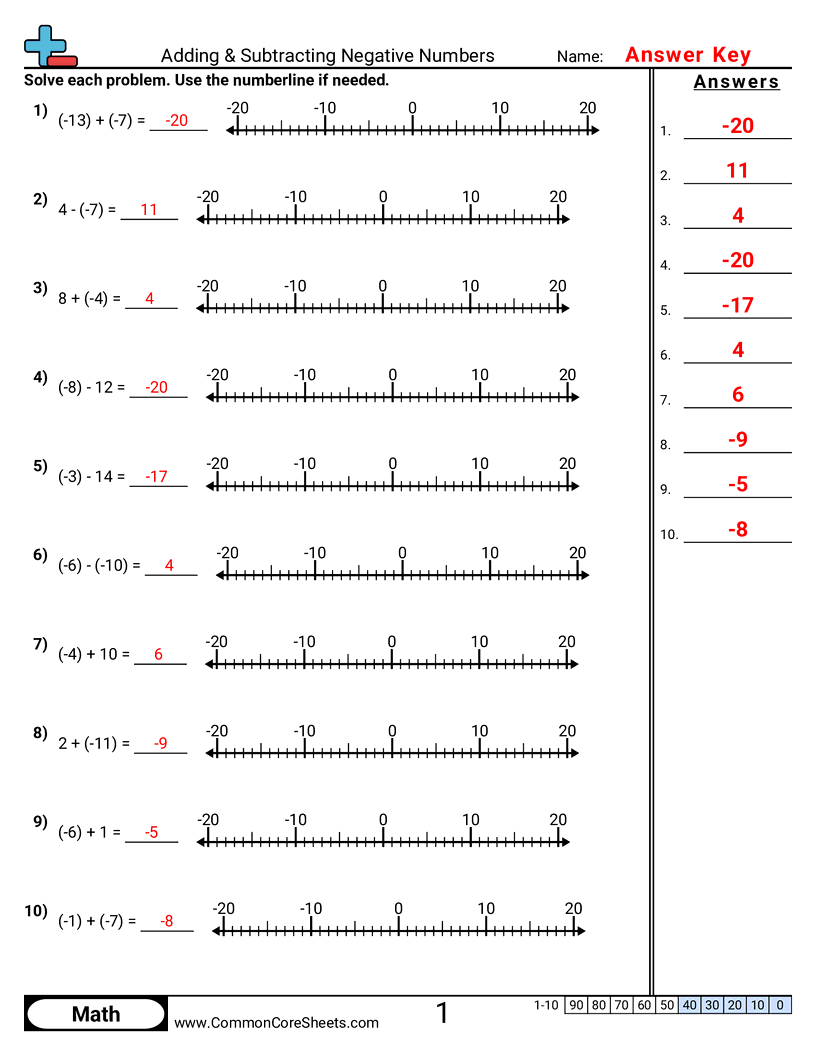
"This worksheet is designed to enhance children's mathematical skills, concentrating on adding and subtracting negative numbers. The arithmetic problems challenge the child's understanding of handling negative values. It includes ten versatile math problems that can be customized according to one's teaching needs, conveniently converted into flash cards for dynamic learning, or incorporated in distance learning modules."
×Student Goals:
7ns1dOpen FolderOpen File×Description:
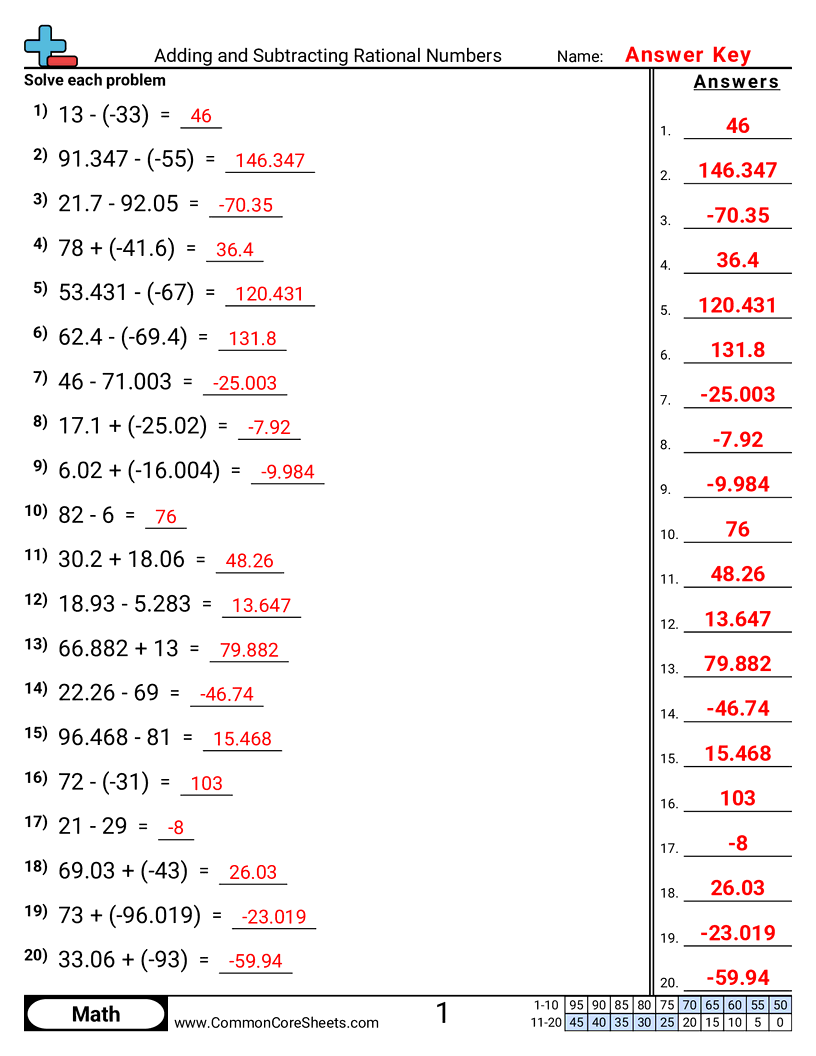
"This worksheet is designed to enhance children's math skills, specifically in adding and subtracting rational numbers. Containing 20 varied problems, the concepts practiced will strengthen number manipulation capabilities. This highly adaptable resource can be customized to fit the learner's needs, transformed into flash cards for tactile learning, or utilized in a distance learning environment for continued academic growth."
×Student Goals: Understanding Rational NumbersAfter completing this worksheet, students should have a deeper understanding of rational numbers. They will be able to confidently identify rational numbers and understand their properties. This knowledge serves as a fundamental building block for more advanced mathematical studies. It helps students to comprehend the logic behind the operations of rational numbers which are crucial in the study of mathematics and its applications in daily life.Proficiency in Addition and SubtractionThe worksheet is designed to enhance students' proficiency in adding and subtracting rational numbers. Through practicing these problems repeatedly, they should achieve fluency in executing these basic mathematical operations. This proficiency is essential as these operations form the base of many mathematical concepts that are learnt in school.Critical Thinking and Problem SolvingBy tackling challenging problems in the worksheet, students can develop critical thinking skills and strengthen their problem-solving abilities. They will learn to approach problems analytically, strategize solutions, and solve them with precision. Such skills are highly transferable and are key to success in many various areas beyond math.Improvement in Numerical Accuracy and SpeedUpon completion of the worksheet, students are expected to show improvement in their numerical accuracy and speed. By systematically solving these problems, they can reduce errors in calculations, increase their speed, and become more efficient in managing time during tests or exams.Building Confidence and Self-efficacyFinally, a significant accomplishment that the students should be able to achieve after completing the worksheet is a boost in self-confidence and self-efficacy. As they overcome the challenges posed by the problems in the worksheet, they strengthen their belief in their ability to solve similar problems. This sense of attainment is crucial for their overall confidence in tackling mathematical problems, encouraging them to strive for higher goals.
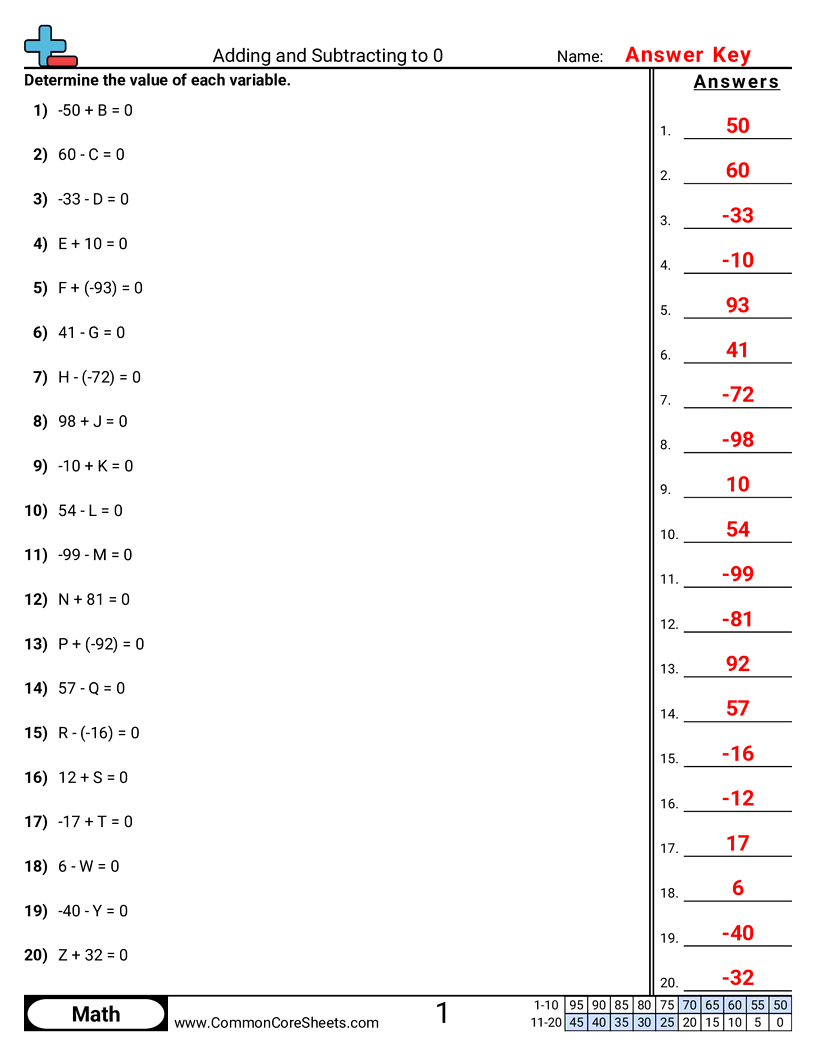
7ns1aOpen FolderOpen File×Description:
"This worksheet is designed to challenge and improve a child's skills in addition and subtraction with a focus on achieving a result of zero. The 20 diverse math problems can be customized to fit individual learning needs, converted into flashcards for interactive practice, or utilized for distance learning, making this worksheet adaptable to various teaching methods."
×Student Goals: Improved Mathematical SkillsUpon completion of the worksheet, students should have improved their basic mathematical skills. They'll be better equipped to perform addition and subtraction operations, particularly involving zero. With consistent practice, they should be able to solve these type of problems more quickly and accurately, boosting their overall math proficiency.Stronger Understanding of Additive InverseThe worksheet presents scenarios where the sum or difference of two numbers results to zero. After working through these problems, students should have a stronger grasp of the concept of additive inverse - the idea that a number and its negative counterpart add up to zero. This understanding is crucial in both basic and advanced mathematical calculations.Enhanced Logical ThinkingMathematics is not just about computation, it's also about logical thinking. Solving these worksheets will help students to develop logical reasoning skills. For each problem, students must discern what number, when added or subtracted, will result to zero. This will require careful thought and rational problem-solving, thereby strengthening students' logical thinking.Broader Mathematical VocabularyThis worksheet introduces symbols and nomenclature like B+(-71)= 0, -30-C= 0, etc. By coming across and understanding these representations, students should expand their mathematical vocabulary. This understanding of mathematical language and representation is vital in progressing through more complex mathematics lessons in the future.Comfort with Negative NumbersNegative numbers can often be tricky for young learners. This exercise, by incorporating negative numbers in various addition and subtraction problems to zero, will increase students' comfort and confidence in working with negatives. This familiarity is essential in understanding the number line, working with equations, and solving real-world problems.Development of Independent LearningWork through the problems in the worksheet facilitates independent learning. Students will gain confidence as they are able to complete the worksheet on their own, equipping them with a sense of responsibility and the understanding of self-paced learning. This is beneficial for their general academic growth and instills a proactive approach to acquiring knowledge.
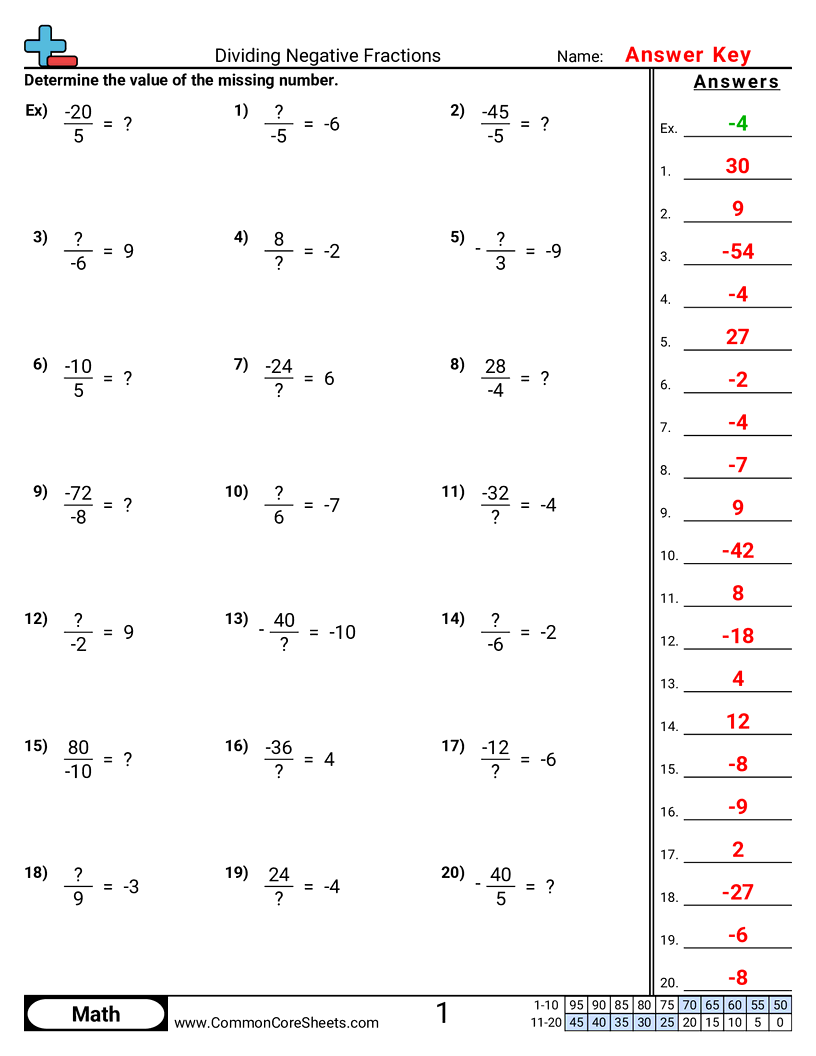
7ns2bOpen FolderOpen File×Description:
"This worksheet is designed to teach children the concept of dividing negative fractions. It consists of 20 problems, challenging kids to fill in missing numbers and solve equations. Customizable to individual learning needs, the worksheet can also be converted into flashcards for interactive learning. Its digital format makes it ideal for both in-person and distance learning environments, fostering a deep understanding of the subject matter in an engaging way."
×Student Goals: Understanding Negative FractionsAfter successfully completing the Dividing Negative Fractions worksheet, children should have a mastered understanding of the concept of negative fractions and the operation of dividing them. This concept can be quite challenging for children as it involves both fractional arithmetic and the rules for manipulating positive and negative signs, but effective completion of this worksheet signifies a strong foundational comprehension.Problem-Solving SkillsThe workout offers 20 distinctive problems on the division of negative fractions that test and improve a student's problem-solving abilities. Correctly handling these tasks denotes that a child can easily identify, break down, and solve problems related to this topic. It also means that the child has improved his mathematical logic and reasoning skills, which are critical for success in future mathematical endeavours.Application of Math RulesThis worksheet provides an opportunity for learners to apply various mathematical rules and theorems, most importantly the rule of signs in mathematics. This practice demonstrates that the child can accurately apply the correct rule at the correct time in order to solve complex mathematical equations.Accuracy and PrecisionWorking through these fractional problems will test and develop a child's accuracy and precision in calculations involving negative numbers. Mastery of this skill is critical as it allows the child to make precise predictions and minimize errors in operational calculations, ensuring accurate mathematical computations.Boosted Confidence in MathSuccessfully completing all twenty problems will boost the child's confidence in their math abilities and develops a positive attitude towards mathematical concepts, equations, and calculations involving negative fractions and divisions. It teaches them to be patient and persistent in overcoming challenges associated with tough mathematical concepts, ultimately making learning math a more enjoyable experience.Preparation for Advanced Math ConceptsUnderstanding of dividing negative fractions is essential as it forms the basis for many more advanced topics in mathematics, including algebraic equations and calculus. By tackling these problems, students establish strong foundational knowledge, preparing them for further study in mathematics. Their developed skills and understanding of dividing negative fractions could be of great use in tackling more complex equations in advanced mathematics.
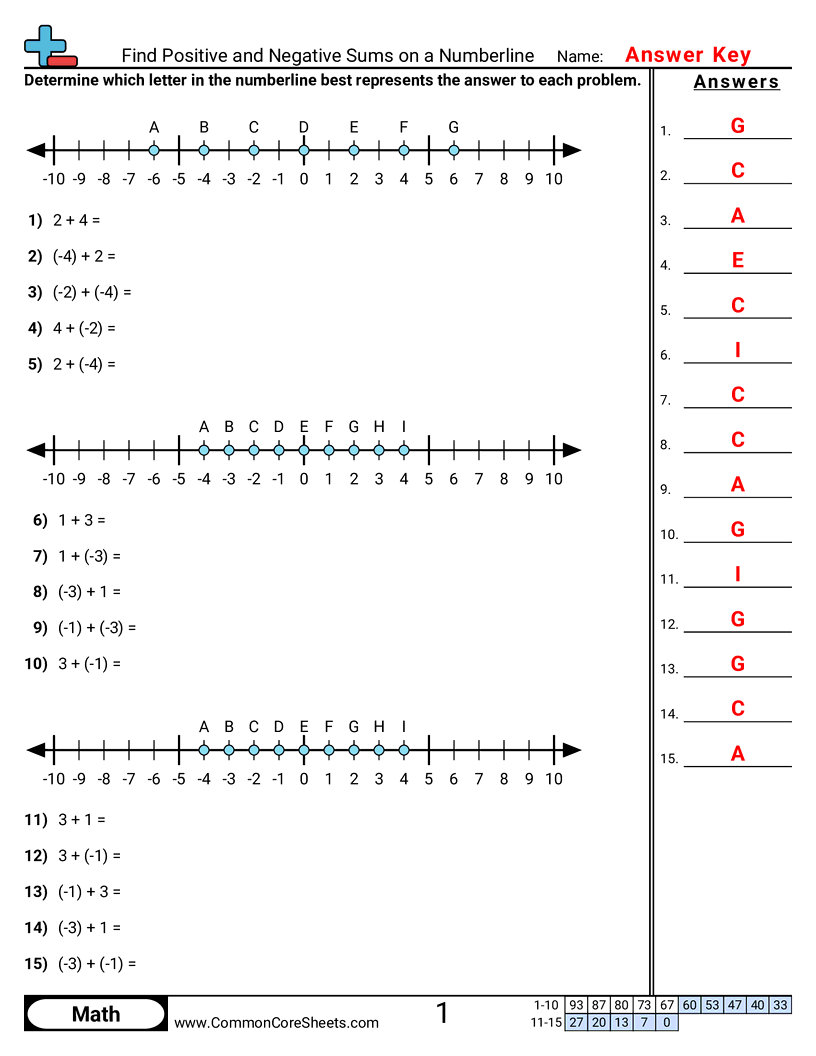
7ns1bOpen FolderOpen File×Description:
"This worksheet is designed to enhance children's understanding of adding positive and negative numbers. It consists of 15 various math problems that prompt children to find the sum on a number line. The concept of positive and negative sums is simplistically encapsulated to ensure effective distance learning. Moreover, the flexibility of format allows for customization and conversion into flash cards for a versatile learning experience."
×Student Goals: Understanding Positive and Negative NumbersUpon completing this worksheet, students will be able to clearly distinguish between positive and negative numbers and understand their application in different contexts. This understanding is foundational in mathematics for working with equations, functions, and real-life scenarios, thus building numerical proficiency.Basic Arithmetic CompetenceThe worksheet fosters the development of basic arithmetic competence as it focuses on using addition operations with both positive and negative numbers. Students will learn to compute mathematical problems quickly and accurately, an essential skill in progressing to more complex arithmetic tasks.Conceptual Understanding of AdditionBy exploring the addition of positive and negative numbers, students will reinforce their understanding of addition as a mathematical operation. Specifically, they will be able to understand how adding a positive number 'moves' to the right along the number line, while adding a negative number 'moves' to the left.Improve Problem Solving SkillsThe worksheet exercises aim to improve students' problem-solving skills. In the process of figuring out the sums, students will be engaged in logical thinking and reasoning, essential skills not only in math but in other subjects and everyday life situations.Understanding Number LinesStudents will reinforce their understanding of the number line, a fundamental tool in mathematics. They will learn about its representation and significance through the process of solving the worksheet problems, mastering its use for the addition of both positive and negative numbers.Boost Confidence and Interest in MathCompleting this worksheet and grappling with the problems presented can boost students' confidence in their mathematical abilities. Due to the relative complexity of working with positive and negative sums, successfully solving these problems can stimulate further interest and curiosity in the subject matter.
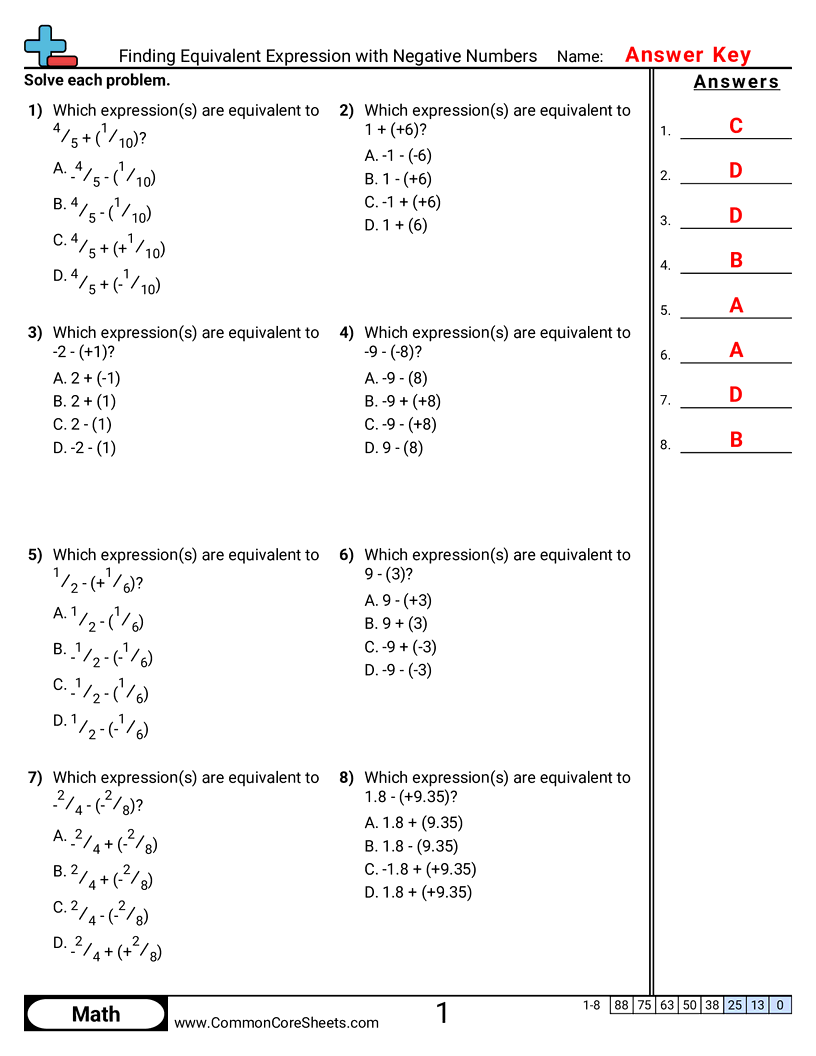
Finding Equivalent Expression with Negative Numbers
7ns1cOpen FolderOpen File×Description:
"This worksheet is designed to enhance children's understanding of math, specifically negative numbers and finding equivalent expressions. It contains 8 examples of problems centered around this concept, each one designed to challenge and improve critical thinking. The worksheet is versatile, allowing for customization, and can be converted into flash cards for additional study methods. Also ideal for distance learning, this resource is a valuable tool for math learners."
×Student Goals: Understanding Negative Numbers and Their OperationsUpon successfully completing the worksheet, students should be able to proficiently demonstrate a solid understanding of negative numbers, and how they interact with other numbers during mathematical operations. This includes grasping the concept of the number line, where negative numbers sit, and how they move on this line during addition or subtraction.Mastering the Concept of Equivalent ExpressionsThe worksheet aids students to grasp the concept of equivalent expressions, an important component of algebra. Through solving the problems, students will learn that different expressions can yield the same results, thus gaining a good foundation for algebraic manipulation.Application of the Commutative and Associative PropertiesThis worksheet is also designed to help students practically apply the commutative and associative properties of numbers. They would be able to understand that the order or grouping of numbers in addition and multiplication does not affect the result.Enhancing Problem-Solving and Logical Thinking SkillsAs the problems in the worksheet require students to analyze and compare different expressions, they will bolster their problem-solving and critical thinking skills. Learning to accurately choose equivalent expressions fosters logical and abstract thinking, which are pivotal elements in higher-level math and science studies.Familiarizing with Mathematical Symbols and ExpressionsCompleting the worksheet assists the students in becoming more familiar with mathematical symbols and expressions, as well as understanding the role of parentheses in changing the meaning of an expression.Building Confidence in Handling Complex Mathematical OperationsBy learning how to work with negative numbers and equivalent expressions, students will develop their confidence in handling more complex mathematical operations. This subsequently prepares them for more advanced math topics that are reliant on a good grounding in arithmetic involving negative numbers.
7ns2aOpen FolderOpen File×Description:
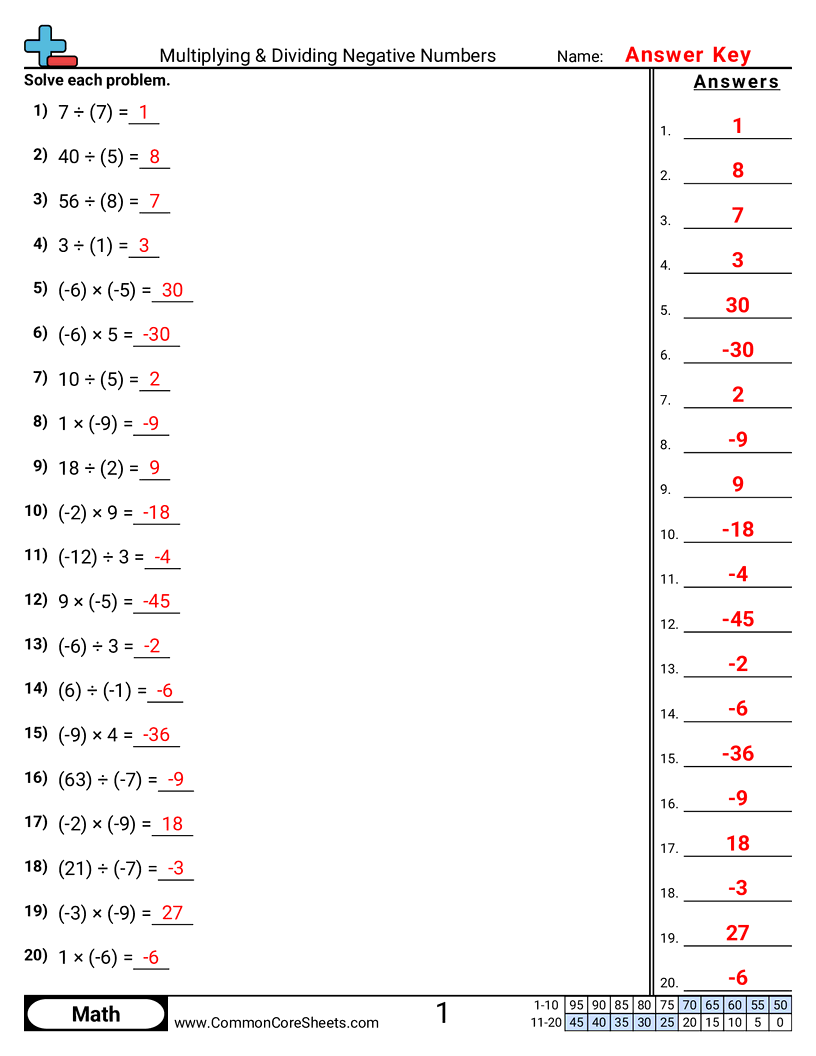
"This worksheet is designed to enhance children's understanding of multiplying and dividing negative numbers. It includes 20 engaging math problems that illustrate the concept beautifully. This versatile resource can be customized to suit individual learning needs, converted into flash cards for interactive sessions, or utilized efficiently for distance learning. Perfect to nurture a mastery in math."
×Student Goals: Understanding Negative Number OperationsUpon completion of the worksheet, students should have a firm understanding of the rules for multiplying and dividing negative numbers. They should be able to identify whether the result of an operation would be a positive or negative number based on the signs of the numbers involved. This comprehension lays an important mathematical foundation for more advanced algebraic concepts.Enhanced Problem-Solving SkillsBy answering these problems, students will enhance their problem-solving skills, especially for mathematical problems that require critical thinking. The operation of negative numbers involves knowing more than just basic arithmetic, and by solving these problems, students are actively improving their ability to find solutions and make decisions.Increased Accuracy and SpeedSolving these math problems will help students increase their computational speed and accuracy. By practicing regularly, students will become quicker and more efficient at processing multiplication and division problems involving negative numbers, improving their overall mathematical fluency.Greater Confidence in MathematicsA successfully completed worksheet provides a boost to students’ self-confidence. Students will realize that they are capable of understanding and applying complicated mathematical concepts like multiplying and dividing negative numbers, ultimately making them more confident in their abilities to tackle complex math problems in the future.Preparation for Advanced MathCompleting the worksheet, students can prepare themselves for more advanced math topics they will encounter in the future. Multiplication and division of negative numbers are fundamental skills that will underpin much of the algebra and calculus they’ll learn in higher grades.
7ns2bOpen FolderOpen File×Description:
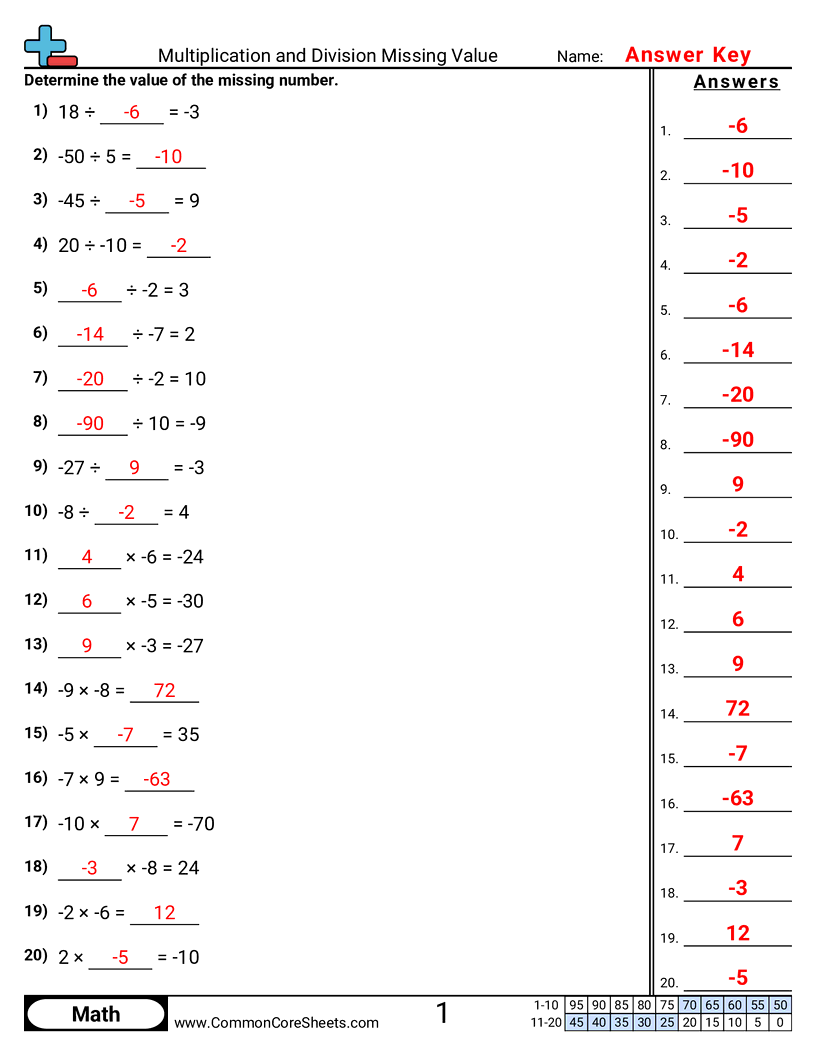
"This worksheet is designed to enhance kids' understanding of multiplication and division. It presents 20 math problems that explore negative and positive integers, helping students identify and fill missing values. Ideal for distance learning, this customizable worksheet can easily be transformed into interactive flashcards for an engaging learning experience. It's the perfect tool for mastering these crucial mathematical operations."
×Student Goals: Understanding of Multiplication and Division ConceptsUpon completing the worksheet, students should have a sturdy foundation in both multiplication and division principles. They should be able to accurately predict and calculate the outcome when given numbers are multiplied or divided. They must be adept in arranging the multiplication and division equations correctly.Comprehension of Negative NumbersThis worksheet would assist students in deepening their comprehension of negative numbers, particularly how they function within multiplication and division. Students should become adept at identifying when the result of a multiplication or division operation with negative numbers will result in a negative or positive output.Problem Solving SkillsStudents should improve their problem-solving abilities through regular practice of multiplication and division problems. By filling in the missing value, they should become better at spotting patterns, making accurate predictions and formulating the right strategy to solve the problem, thus helping them improve their analytical skills.Accuracy and SpeedStudents should also significantly enhance their calculation accuracy and speed. By completing 20 questions per worksheet, they should become quicker and more precise, leading to improved performance in timed tests and exams. This practice will help students become more comfortable and confident during mathematical tests or exams.Improving Mathematical VocabularyAfter completing the worksheet, students should have a better understanding of mathematical vocabulary. They should be able to use mathematical terms accurately in the correct context. They should understand what division and multiplication mean, and be able to identify them within a problem-solving context.Development of PersistenceContinuous practice of such problems can help students develop persistence. They will learn to stick with a problem until it has been solved, improving their perseverance skills. This can also boost their confidence in tackling complex math problems in the future.
7ns1dOpen FolderOpen File×Description:
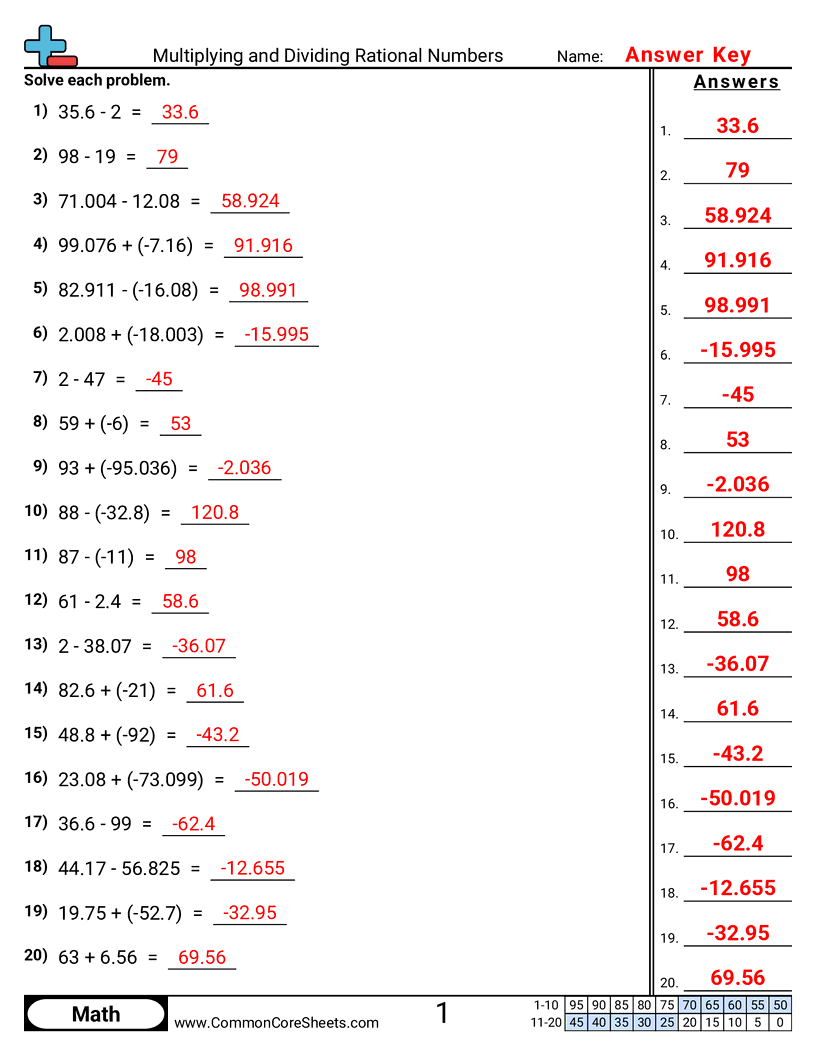
"This worksheet is designed to help children learn and practice multiplying and dividing rational numbers. It contains 20 intricate problems, challenging kids' mathematical skills and extends beyond conventional methods. With customizable features, it can be easily converted into flash cards for interactive learning. This virtual tool is ideal for distance learning, promoting conceptual understanding remotely. Excellent for self-study and classroom use, it makes math more approachable and entertaining."
×Student Goals: Understanding Rational NumbersUpon completion of the worksheet, students should have a stronger grasp of rational numbers. They should understand that rational numbers are numbers that can be expressed as a fraction of two integers. These numbers can be positive, negative, or zero. They will know that every integer can be considered a rational number as they can be expressed as a fraction with themselves as the numerator and one as the denominator.Multiplication and Division of Rational NumbersStudents should be able to confidently multiply and divide rational numbers. They would have understood that the rules of multiplication and division of rational numbers are not significantly different from the rules of multiplication and division of integers. They'll understand the general principle that the product of two rational numbers with the same sign is positive while the product of two rational numbers with different signs is negative.Handling Complex Rational ProblemsStudents should be trained in handling complex arithmetic problems involving multiple operations with rational numbers. They'd have learned to systematically work through these complex problems by applying the rules of the order of operations properly. As a result, they'll be more confident in resolving such problems which is an essential skill to have as they progress in their Math studies.Critical Thinking SkillsAs students work through complex problems in the worksheet, they will improve their critical thinking and problem-solving skills. They will be able to analyze each problem, understand what is being asked, think about what they need to do to find the answer, and apply their existing knowledge and skills to solve the problem.Mathematical FluencyAfter completing this worksheet, students will be more fluent in the language of mathematics. This includes understanding mathematical symbols and operations, and being able to communicate mathematical ideas effectively. They should be capable of explaining in their own words the process they went through to solve each problem on the worksheet.
7ns1bOpen FolderOpen File×Description:
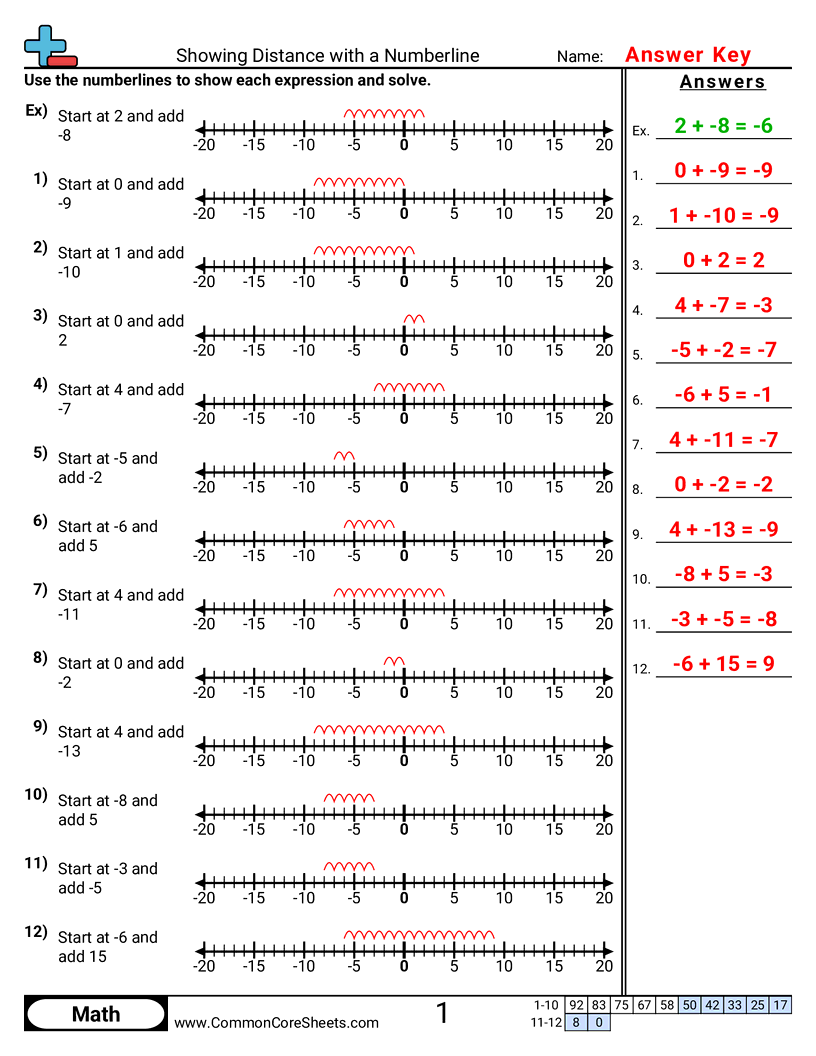
"This worksheet is designed to enhance children's math skills, focusing on the concept of number lines and calculating distance. It includes 12 numerical problems that ask learners to start at a specific point and add or subtract a number. Perfect for distance learning, the customizable worksheet can be converted into flashcards for more interactive and engaging learning."
×Student Goals: Understanding Number LinesUpon completion of this worksheet, students should have a robust understanding of number lines and how to use them to show distance. They should be able to plot positive and negative numbers on a number line accurately. Grasping the concept of number lines is fundamental in mathematical knowledge, as it forms the groundwork for understanding more complex topics in calculus and other higher-level mathematics courses.Understanding Negative NumbersThe students will gain a good understanding of negative numbers. Negative numbers are part of everyday life, and understanding how to add and subtract them is paramount. Students should be able to differentiate and understand that negative numbers are less than zero and are represented on the left side of the number line. By repeatedly working with number-line problems involving negative numbers, students can confidently master this concept.Enhanced Problem Solving SkillsCompleting this worksheet will enhance the problem-solving skills of the students. Mathematical problem-solving forms part of critical thinking. The ability to start at a number and add or subtract another number hones their skills in logical thinking, decision making, and strategic planning making them more effective problem solvers.Improved Mental Arithmetic SkillsStudents will improve their mental arithmetic skills through the completion of this worksheet. The ability to quickly and correctly add and subtract numbers mentally is a skill that improves with practice and will be useful in many aspects of life beyond math class. By chaining together multiple problem sets, students will improve their ability to perform mental sums more accurately.Fluency with Addition and Subtraction on a Number LineStudents will become fluent in utilizing a number line for addition and subtraction. The ability to accurately and quickly perform these operations is a fundamental arithmetic skill, and this worksheet provides the necessary repetitive practice to help students become fluent in these skills. The exercises in this worksheet, if completed successfully, should help students to internalize the process and gain speed when performing these operations in the future.
7ns3Open FolderOpen File×Description:
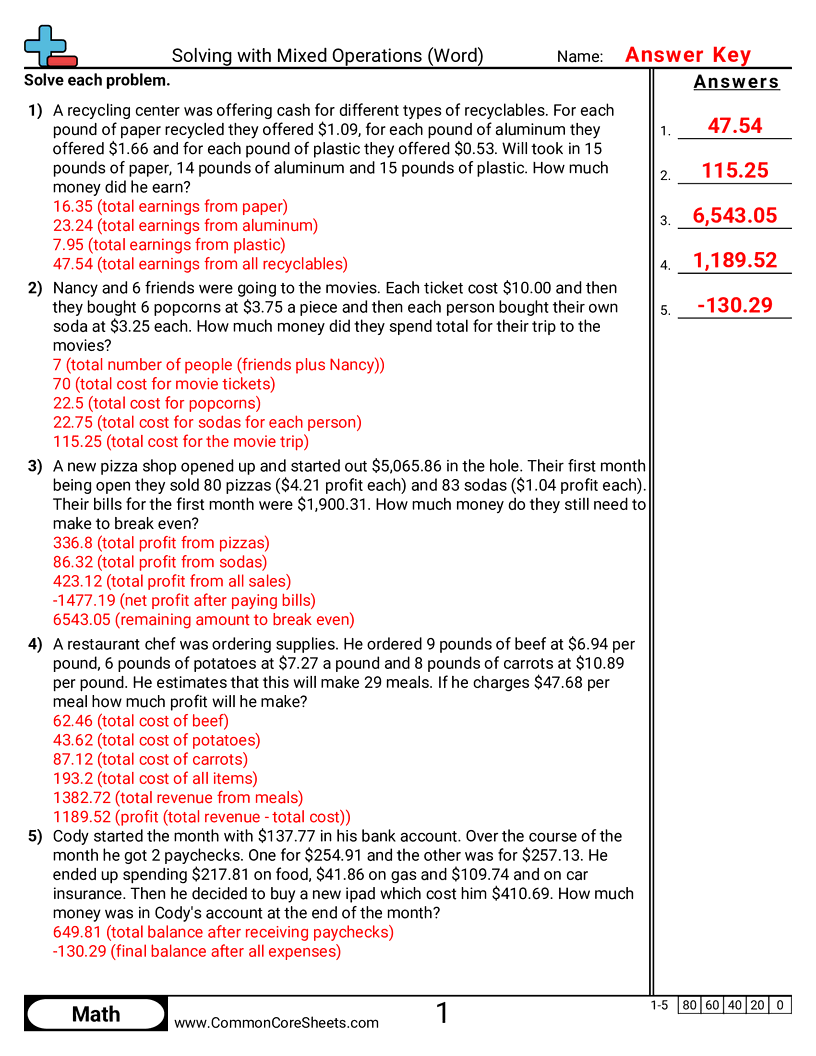
"This worksheet is designed to improve students' mathematical skills in solving mixed operations via real-life word problems. Covering five unique number problems, the worksheet involves calculations like multiplication, addition and subtraction. Perfect for enhancing critical thinking, it can be personalized and converted into flash cards for interactive learning. It's also suitable for distance learning, making math comprehensive yet engaging for children."
×Student Goals: Mastery of Mixed OperationsUpon completion of this worksheet, students will have demonstrated their proficiency in performing mixed operations. This implies understanding and correctly applying the order of operations in mathematical problems, such as using parentheses to define the sequence of calculations, as well as being able to add, subtract, multiply, and divide within one mathematical problem.Understanding Real-world Applications of MathThe worksheet's real-world scenarios allow students to understand how math can be applied in daily life situations, such as calculating wages, determining shopping expenses, estimating restaurant profits, managing game points, etc. Completing this worksheet enables students to realize that math isn't merely an abstract concept, but a critical tool that helps us make sense of the world around us.Improved Problem-solving SkillsBy tackling the worksheet's problems, students sharpen their problem-solving skills. This includes understanding what the problem is asking, identifying the necessary mathematical operations to solve it, executing these operations accurately, and interpreting the solution in the context of the problem. As such, students develop an essential skill set that's applicable in other areas of study and in life in general.Familiarity with Mathematical Notation and LanguageThe worksheet provides students with an opportunity to become familiar and comfortable with mathematical notation and language. They will gain understanding of how mathematical formulas are written and interpreted. By the end of the worksheet, students should be comfortable with symbols like parentheses, multiplication signs and can read, write, and interpret these notations correctly.Development of Critical ThinkingFinally, students will have strengthened their critical thinking abilities. Each problem posed in the worksheet requires thoughtful analysis and a step-by-step approach to arrive at the correct solution. Learning to think sequentially and logically about problems, examines different scenarios, and calculate multiple steps is a critical aspect of math education, which this worksheet addresses.
6ee1Open FolderOpen File×Description:
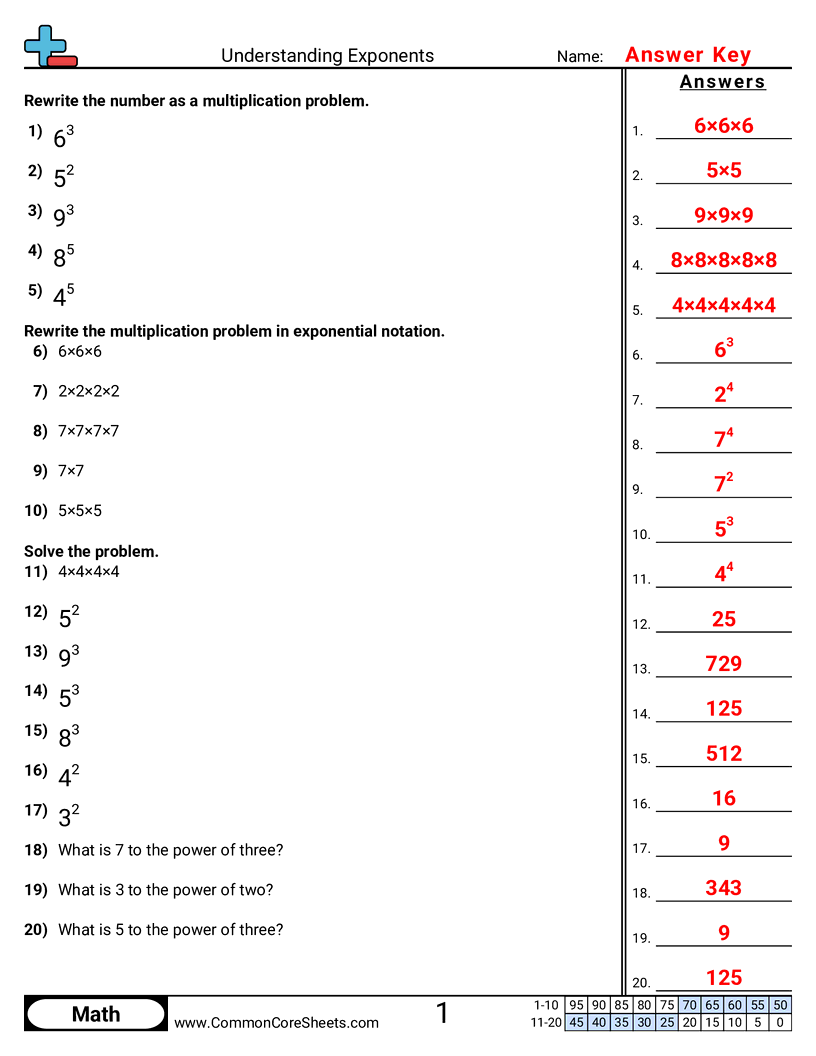
"This worksheet is designed to help children understand the concept of exponents in math. With 20 diverse problem examples featuring raised and whole numbers, learners can explore power laws in an engaging way. The worksheet can be customized as per the child's learning pace, converted into flashcards for revision, or implemented in distance learning. It's a versatile tool for learning exponent rules effortlessly."
×Student Goals: Comprehend Exponential ConceptsThrough this worksheet, students will obtain a firm understanding of the key concepts of exponents including the base number and its power. They will be able to translate the multiplication of numbers repetitively into an exponent form, enhancing their conceptual understanding of mathematical notations and symbols.Apply Exponential RulesStudents should be able to apply the concept of exponents in their calculations. This will shape their problem-solving skills, where they will easily transform complex multiplication series of the same number into an exponential form, making calculations quicker and more efficient.Introduce Higher-Order Math SkillsThis worksheet will serve as an introduction to higher-order math skills as they learn to handle exponent related problems confidently. Students will start using powers and the laws of exponents, which will prepare them for algebra and other advanced mathematical concepts.Enhance Mental Math AbilitiesWith regular practice of such worksheets, students should improve their mental math capabilities. This is because comprehending and utilizing exponent rules require a certain level of mental computation and agility. It will hence quicken their thinking process and improve their mental visualization capabilities.Promote Mathematical PrecisionWorking with exponents will obligate students to be precise in their calculations because one misstep can drastically alter the outcome. This will encourage attention to detail and precision, which are important skills not only in math, but all academic, professional, and everyday situations.Develop Algebraic ReasoningExponents are fundamental in algebraic reasoning. Students that can carefully comprehend and utilize exponents will have an easier transition into algebra and other more complex mathematical concepts. Being able to understand exponents is a critical step in developing mathematical literacy.Stimulate Critical ThinkingExponent-related problem-solving demands a lot from the learner’s critical thinking skills. This worksheet will require the student to employ strategic thinking, reasoning, and decision making when tackling each problem. This will in turn promote a more in-depth understanding of mathematical principles.Expand Mathematical VocabularyFinally, consistent interaction with exponents will naturally expand the learner’s mathematical vocabulary as they become more familiar with terms related to exponents such as base, power, square, cube, and so on. An expanded mathematical vocabulary will enhance their communication in mathematical contexts, making it easier for them to express mathematical ideas more succinctly and accurately.
Multiplication of Rational Numbers with Commutative Property
7ns2cOpen FolderOpen File×Description:
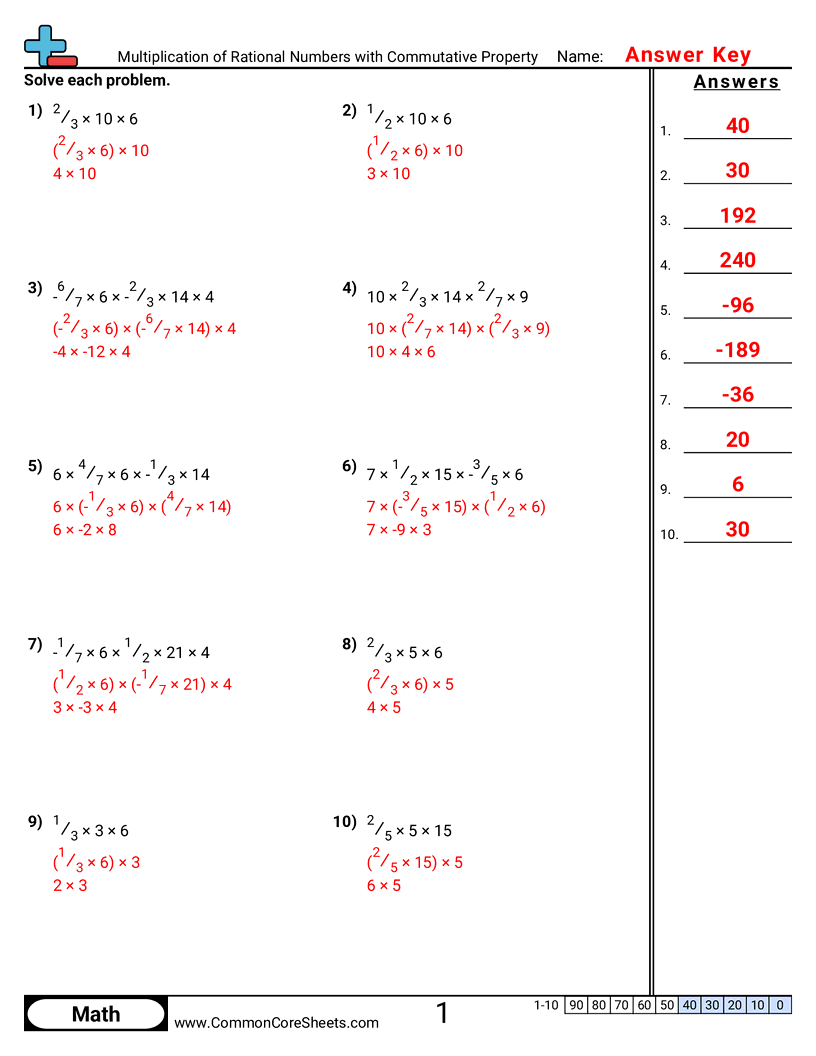
"This worksheet is designed to enhance children's understanding of the multiplication of rational numbers using the commutative property. It offers 10 varied problems where kids are encouraged to rearrange the order of operations, thereby reinforcing the concept. Ideal for distance learning, the worksheet can be adapted to user needs, transformed into flash cards, or customized for individual learning styles."
×Student Goals: Understanding Multiplication of Rational NumbersUpon completing this worksheet, students will gain a thorough understanding of the multiplication of rational numbers. They will know how to multiply fractions by whole numbers and vice versa. They can confidently handle positive and negative rational numbers in multiplication scenarios, and the combination of both.Mastering the Commutative PropertyThe worksheet serves as a platform for students to understand and apply the Commutative Property of Multiplication. They will realize that the order of numbers does not affect the product, giving them flexibility in mathematical expressions and equations. Furthermore, they will be adept in using parentheses and the commutative property to simplify complex calculations.Developing Problem-Solving SkillsBy solving these problems, students will improve their problem-solving skills, critical thinking, and mathematical analysis. They will learn how to approach mathematical problems from different angles, find alternative solutions and check their solutions for consistency. This skill is not only limited to math subjects but is also vastly applicable in real-world situations.Enhancing Calculation Accuracy and SpeedThrough consistent practice from this worksheet, students will become more accurate and faster in their mathematical calculations. They will develop their mental math abilities, leading to improved performance in timed math tests and homework. The strides in these areas will provide an overall boost to their confidence in math and in academic subjects broadly.Promoting Perseverance in Learning MathematicsLastly, by attempting to solve the multiplication problems of different complexity levels in the worksheet, students will foster their perseverance and resilience in mathematical learning. They will learn to remain focused and persistent in problem-solving activities until they arrive at the correct solutions, cultivating patience and dedication towards their studies.