Number and Operations in Base Ten Extend the counting sequence.1Count to 120, starting at any number less than 120. In this range, read and write numerals and represent a number of objects with a written numeral.
1nbt1Open FolderOpen File×Description:
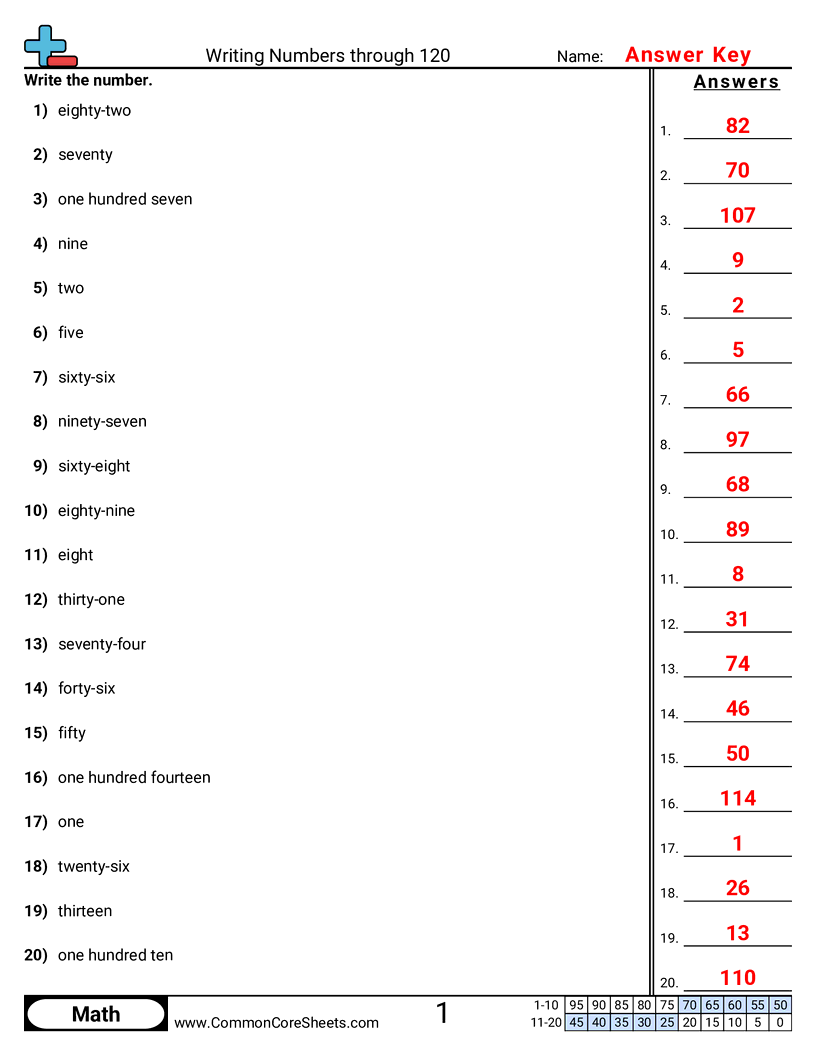
"This worksheet is designed to strengthen children's math skills by writing numbers up to 120. Including 20 problems, it features examples such as "eighty", "thirty-nine", and "one hundred eight". Perfect for distance learning, it is easily customizable and convertible into flashcards for flexible and interactive learning. Supports foundational math lessons in an engaging manner."
×Student Goals: Number Literacy DevelopmentUpon completing the worksheet, students will potentially advance their understanding of number literacy. Essentially, they'll be able to comfortably read, write, and interpret numbers up to 120 - a basic skill that underlies most math operations. Besides, they will gain mastery in number sequencing. This means they could independently recognize missing numbers in a series and efficiently fill them in the correct order, thereby enhancing their cognition and pattern identification capabilities.Enhance Number Word SpellingAn integral accomplishment that students should be able to achieve is the correct spelling of number words up to 120. Each question provides such an opportunity to regularly interact with these number words therefore reinforcing their spelling abilities. This progression in spelling not only complements their maths competence but also their language learning as number words often form part of communication across different subjects.Improved Computational SkillsThe worksheet also offers students a chance to improve their computational skills. Whether they're tallying scores, calculating change, or pondering fractions, they'll need to understand the fundamentals of numbers up to 120. With the skills that they've nurtured through the worksheet, they'll be well-equipped to handle practical math problems beyond the classroom.Math Terminology FamiliarizationThe worksheet will help students become more familiar with math terminology. Through repeated exposure to number words in the worksheets, students become more fluent in using math vocabulary like hundreds, tens, and ones. This terminology becomes second-nature, assisting students in understanding the number system more accurately, and facilitating communication about mathematical concepts.Confidence in Number HandlingAnother accomplishment would be an increase in students' confidence when it comes to dealing with numbers. Fear or confusion about numbers can make learning math a challenging endeavor for many students. However, with regular practice, such as completing this worksheet, students can face numbers without apprehension, affirming their confidence in tackling even more complex mathematical tasks in the future.
1nbt1Open FolderOpen File×Description:
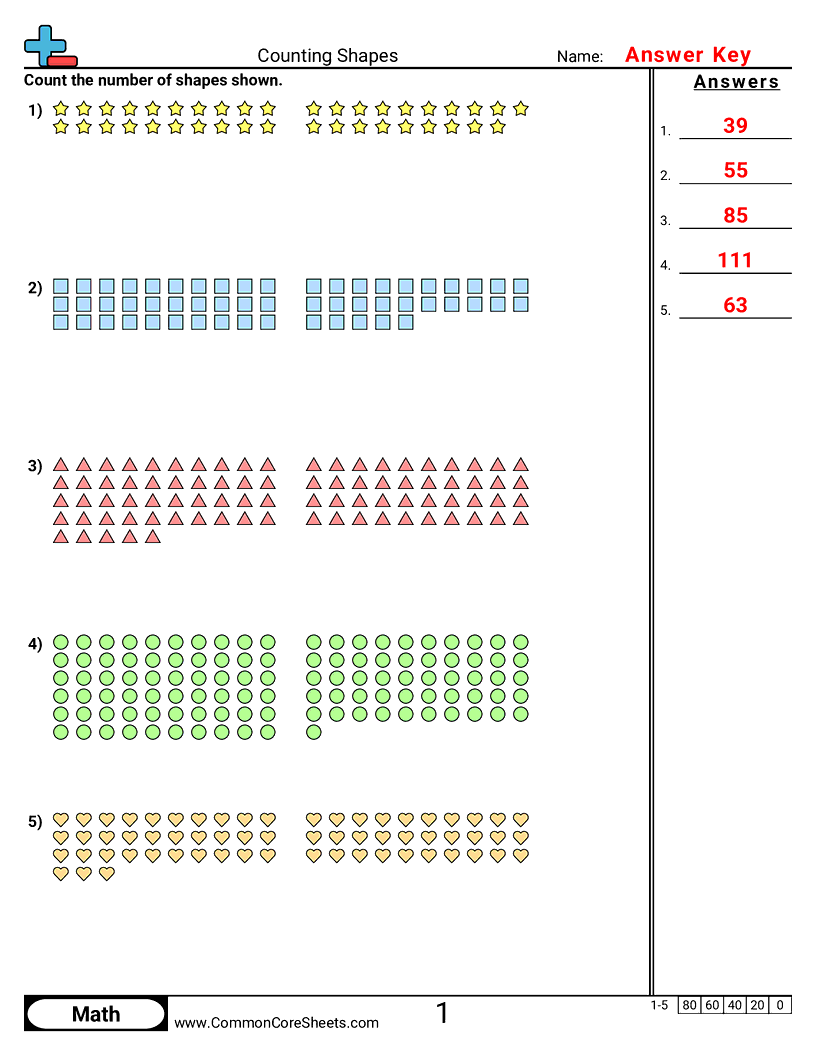
"This worksheet is designed to help children enhance their mathematical skillset by focusing on shape counting. It uses colorful illustrated problems that encourage users to count the number of specific shapes, aiding in visual recognition and number learning. Primarily composed of five problems featuring stars, circles, and heart shapes, it serves as an engaging tool for both distance learning and traditional classroom settings. Furthermore, it offers versatility, being customizable to individual learning paces and easily converted into flash cards for simplified, fun-filled education."
×Student Goals: Develop Counting SkillsUpon completion of the Counting Shapes worksheet, the children are expected to exhibit substantial improvement in their basic counting skills. These early number skills form the foundation for more advanced math concepts. By recognizing, grouping, and counting different shapes, the students enhance their ability to identify numbers, understand their value, and relate this knowledge to real-world examples.Shape RecognitionStudents will enhance their ability to recognize and distinguish different shapes, an essential geometry skill that paves the way for higher-level math. Shape identification encourages visual spatial understanding about how shapes relate to each other. The symmetry or lack thereof, roundness, and number of sides all become more apparent and familiar to the children.Cognitive DevelopmentWorking on the Counting Shapes worksheet can also aid in the cognitive development of the students. It cultivates their problem solving and critical thinking skills. With every shape they correctly identify and count, their confidence grows leading them to approach new tasks and academic challenges with vigor and enthusiasm.Improve Focus and ConcentrationFurthermore, this exercise is designed to help improve the students' focus and concentration. Keen attention to detail is required in order to correctly recognize and count the shapes. This therefore assists in promoting the heightened attentiveness necessary for the students to thrive in academic and personal endeavors.Promote Curiosity and ExplorationThis worksheet also promotes curiosity and exploration in the students. As they count and categorize the shapes, they are encouraged to question why things are and introduce them to basic principles of science and physics. By fueling this curiosity, it helps in instilling a love for learning that lasts far beyond the classroom walls.
1nbt1Open FolderOpen File×Description:
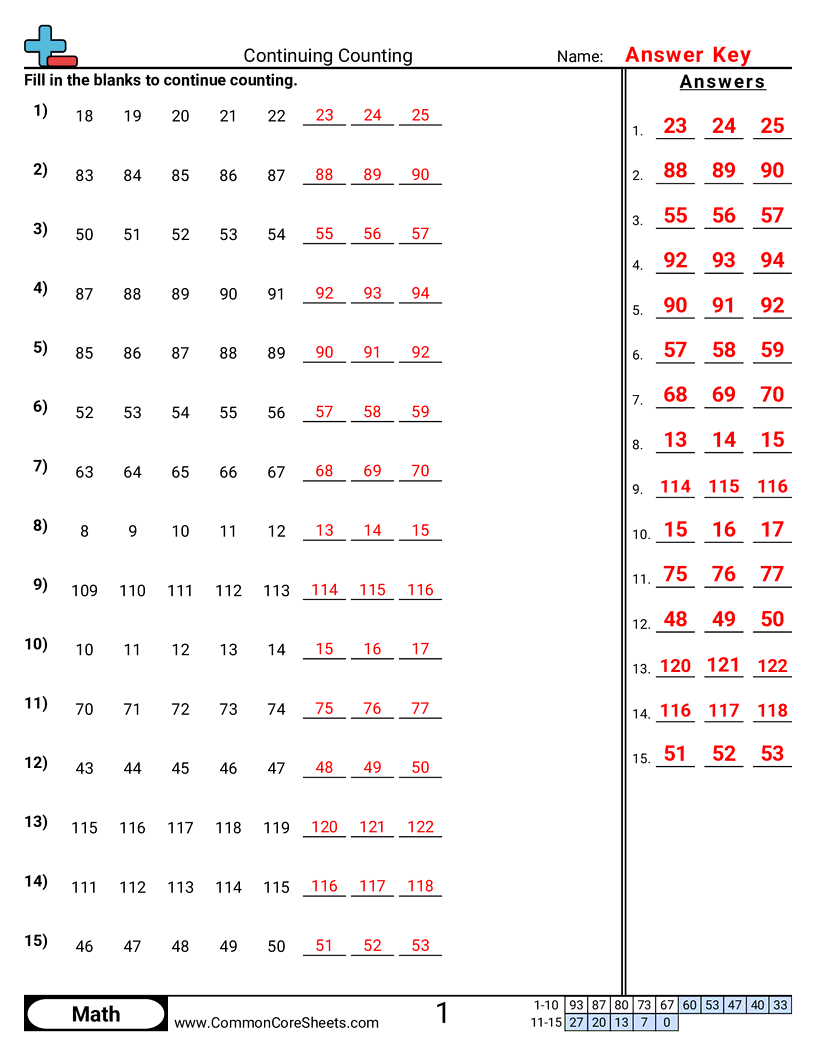
"This worksheet is designed to enhance children's learning in math, specifically in the concept of sequence counting. Comprising of 15 customizable problems, the worksheet provides examples ranging from the 50's to 120's series. A versatile tool, it can easily be converted into flashcards or adapted for use in distance education. It's a dynamic way to keep math learning interactive and fun, even from afar."
×Student Goals: Number RecognitionAfter completing the worksheet, students should have an enhanced ability to recognize numbers. This should not be limited to single-digit numbers but should extend to double and potentially triple-digit numbers. They will understand the 'look' of different numbers and will be quicker and more efficient in spotting them in various contexts.Number SequencingStudents should have developed an improved understanding of number sequences. They should notice patterns and learn the rule of incrementing the count by one. They will be well-equipped to continue with a number series even after it breaks off, thereby solving counting problems with greater ease.Counting FluencyChildren should increase their fluency in counting quantities methodically. That is, the worksheet will enforce their ability to move from one number to the next in an orderly and predictable way. This fluency forms the building blocks of more complicated mathematical reasoning and problem-solving skills.Problem-Solving SkillsAlthough the worksheet is primarily about counting and number recognition, it also encourages rudimentary problem-solving skills. By spotting patterns and applying the rules of counting, each task on the worksheet is essentially a small problem to solve. Over time, this will contribute to the development of broader problem-solving abilities.Confidence in MathematicsAs children master the ability to count and recognize numbers, they should gain increased confidence in their mathematical abilities. The consistent progression through the number sequences in the worksheet should bolster self-assuredness, leading to a more positive attitude towards math.Preparation for Advanced Math ConceptsWhile counting may seem like a straightforward endeavor, it's a fundamental math concept that lays the foundation for more advanced topics. Thus, students will be better prepared to tackle tasks involving addition, subtraction, multiplication, and division in the future, underlining the continued importance of number familiarity and sequencing competency.