Number and Operations in Base Ten Understand place value.1Understand that the three digits of a three-digit number represent amounts of hundreds, tens, and ones; e.g., 706 equals 7 hundreds, 0 tens, and 6 ones. Understand the following as special cases:a100 can be thought of as a bundle of ten tens - called a "hundred."
2nbt1aOpen FolderOpen File×Description:
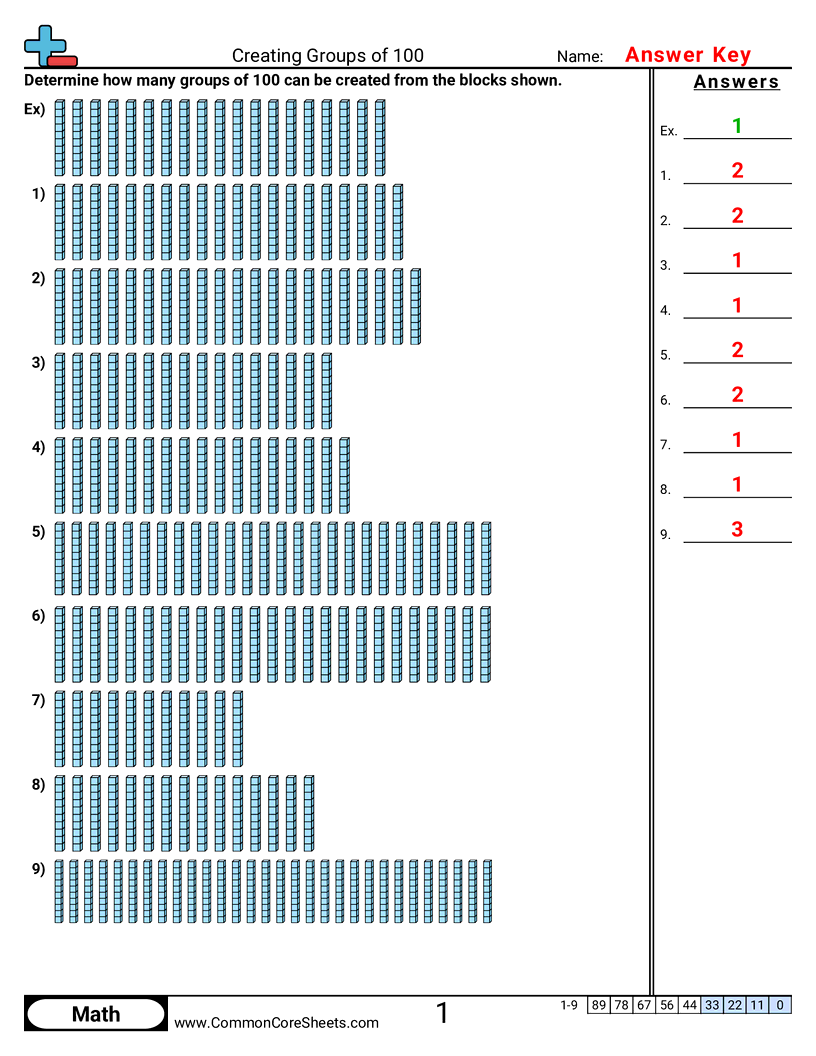
"This worksheet is designed for children to enhance their math skills by creating groups of 100. Comprising of 9 unique problems, it simplifies numerical concepts into engaging tasks. Featuring customization, it can be transformed into flash cards, serving as an effective tool for distance learning. With its flexibility and interactivity, this resource promotes fun while learning mathematics."
×Student Goals: ComprehensionBy completing this worksheet, students should have developed an understanding of how to create groups of 100. This fundamental mathematical concept enables them to subdivide large numbers into easily manageable groups, greatly improving their numeric comprehension skills. They would also have developed mental math strategies for dealing with numbers, making it easier for them to perform quick calculations in their heads.Critical ThinkingStudents should showcase an enhanced ability to solve problems. They would be able to strategize, deduce, and sift through various possibilities to determine the correct groupings of numbers. This critical thinking capability is not exclusive to math alone. Properly cultivating it can transfer seamlessly into other subjects or areas where problem-solving abilities are needed. This worksheet helps in tackling complex problems by breaking them down into smaller, manageable parts.Number FluencyThe completion of this worksheet should correlate to increased numerical fluency. That is, they would demonstrate a strong familiarity with numbers, and their proficiency in manipulating them should be evident. Participating in exercises, where they need to create groups of 100, would have effectively reinforced the concept of the base-10 number system, thereby ameliorating their numerical agility.Confidence and EncouragementBy completing these tasks, students would have taken steps towards improved confidence in their mathematical abilities. The sense of accomplishment found in successfully creating groups of 100 would serve as a motivational boost, encouraging them to engage further with mathematical problem-solving activities. This can be crucial in setting a robust foundation for more complex mathematical theories and numerical applications in the future.Integration of KnowledgeBeyond gaining familiarity with numbers, students would learn how to integrate different parts of knowledge in a cohesive manner. They would understand number operations, connections among numbers, and how they can break down and group numbers in varied ways for different purposes, thus showing evidence of considerable cognitive growth in number sense. This worksheet stands as a stepping stone in the journey to develop sophisticated numerical capabilities that are the backbone of higher-level mathematic comprehension.
2nbt1aOpen FolderOpen File×Description:
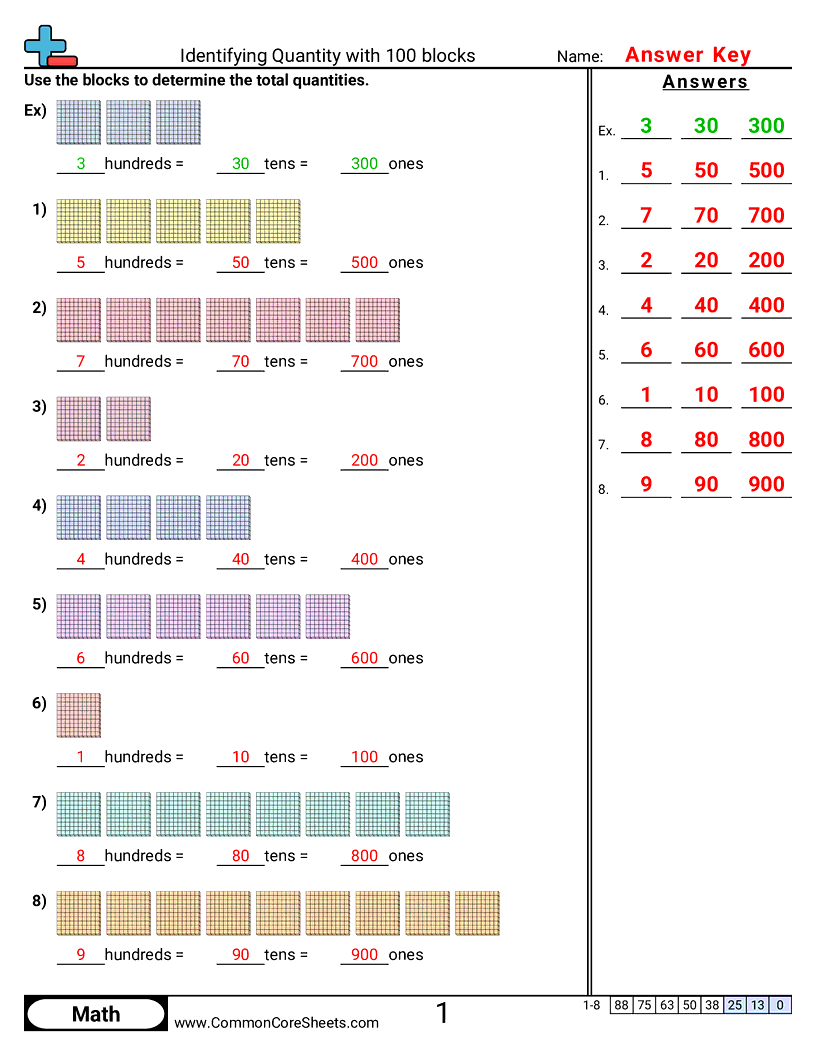
"This worksheet is designed to reinforce children’s understanding of numbers and quantities in hundreds, tens, and ones format. Featuring eight engaging math problems, the worksheet challenges learners to identify the value of hundreds, tens, and ones in numbers like 300, 500, and 700. Adaptable for various learning styles, its format can be customized, used as flash cards, or incorporated into distance learning curriculums, offering a versatile tool to strengthen foundational math skills in an engaging way."
×Student Goals: Master Basic Math ConceptsStudents should be able to have a firm grasp of basic math concepts, particularly the value of numbers and the quantity they represent. They should understand the number system, identify and differentiate between hundreds, tens, and ones. This foundational knowledge will aid them in tackling more complex math equations in the future.Enhance Critical Thinking and Problem-solving SkillsUpon completion of the worksheet, students should be able to apply learned concepts to solve problems. By determining the quantity that each block set of hundreds, tens, and ones represents, they enhance their critical thinking and problem-solving skills, which are invaluable in everyday life and across academic disciplines.Grow Counting and Calculation SkillsAfter completing the worksheet, students should show significant improvement in their counting and calculation skills. They get to practice counting by hundreds up to a thousand, reinforcing their ability to count and calculate quickly and accurately.Develop Understanding of Place ValuesThe teaching of hundreds, tens, and ones forms the core of the place value system, which is a fundamental concept in arithmetic and number theory. Students should be able to recognize and understand how place values work and apply this knowledge when reading and composing numbers.Boost Cognitive Ability and FocusThe worksheet targets the enhancement of children's cognitive abilities and their focus. By following the set of problems and solving them, students train their brain to focus, maintain attention, and carry out critical cognitive functions.Build Confidence in MathSuccessfully completing the worksheet should instill confidence in students, allowing them to approach Math's future tasks and challenges with less fear and hesitation. This confidence can enhance their overall academic performance and attitude towards learning.
2nbt1aOpen FolderOpen File×Description:
"This worksheet is designed to enhance children's understanding of the mathematical principles of place value. It includes 12 creative problems where students construct numbers based on given hundreds, tens, and ones. It's versatile, enabling customization for specific learning needs, conversion to flash cards, and adaptability for distance learning. An indispensable resource for effectively teaching and learning math concepts in a varied and engaging manner."
×Student Goals: Understanding of Place ValuesUpon completion of this worksheet, students should have a robust understanding of place values in mathematics. They will comprehensively comprehend the concepts of ones, tens, and hundreds and how these individual units contribute towards forming a complete number.Handwriting and Formation of NumbersWorking on this worksheet will also enable students to improve their handwriting skills. Since the tasks involve writing numbers based on given number units, children will get ample practice in forming each digit from 0 to 9. This repeated practice will ensure they master the art of writing numbers clearly and legibly.Problem-solving AbilityThis activity will enhance children's problem-solving ability. It will teach them to approach written problems systematically and find solutions by utilising their understanding of place values. This not only fosters a key skill in mathematics but also cultivates an analytical mindset, beneficial across diverse subjects.Cognitive SkillsThe successful completion of this worksheet contributes directly to the development of multiple cognitive skills. Children need to read, comprehend the problem, and translate the words into numerical form – an activity that requires cognitive flexibility, working memory, and sustained attention.Fundamental Math SkillLearning place values is a building block for complex mathematical operations. By performing these problems, children will lay a strong foundation for future topics in mathematics, such as arithmetic operations (addition, subtraction, multiplication, and division), fractions, decimals, and even percentages.Confidence BoostThe successful completion of problems in this worksheet will boost children's confidence in their mathematical abilities. As they conquer each problem and see their correct solutions, they'll gain a sense of accomplishment and confidence that will contribute towards fostering a positive attitude to mathematics.Independent WorkingCompleting this worksheet also promotes working independently. Students are pushed to understand, interpret, and solve problems without any direct interference. This develops a sense of responsibility, independence, and self-confidence in their academic skills, which is crucial for their long-term academic success.