Geometry Reason with shapes and their attributes.2Partition shapes into parts with equal areas. Express the area of each part as a unit fraction of the whole. For example, partition a shape into 4 parts with equal area, and describe the area of each part as 1/4 of the area of the shape.
3g2Open FolderOpen File×Description:
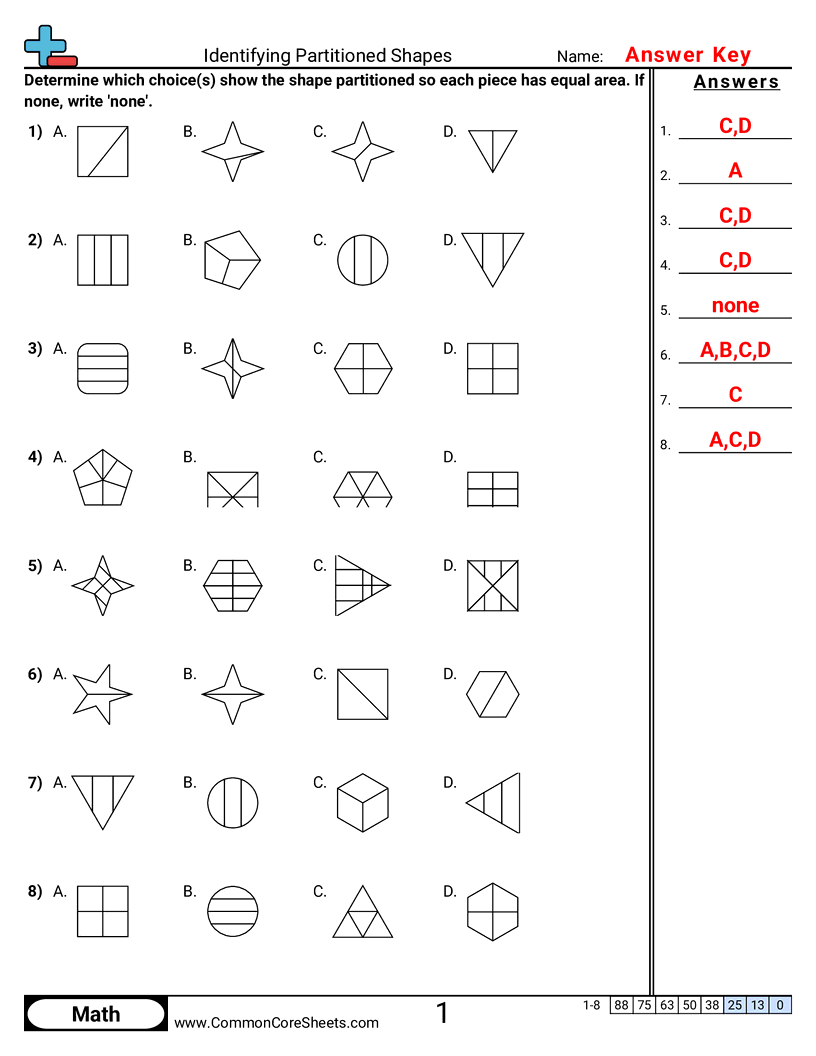
"This worksheet is designed to enhance children's understanding of partitioned shapes in mathematics. It comprises 8 interactive problems, promoting active learning in recognizing and differentiating various segmented shapes. Utilized as customizable flash cards, it serves as a fun and engaging tool for both classroom and distance learning. This versatile worksheet offers a dynamic approach to math education, fostering improved comprehension and retention.".
×Student Goals: Shape IdentificationAfter completing this worksheet, students should be able to identify a variety of partitioned shapes with increased accuracy and confidence. This process will help boost their geometric awareness and visual discrimination skills.Spatial UnderstandingBy working through spatially-oriented problems, students improve their ability to perceive and understand the spatial relationships among shapes. This skill is foundational in many areas, including higher mathematics, engineering and day-to-day spatial tasks.Critical ThinkingThis worksheet provides an opportunity for students to enhance their critical thinking skills. They will need to apply logic and reason, deducing the nature of the different partitioned shapes presented to them. Over time, this practice can lead to improved problem-solving abilities.Memory RecallStudents will exercise their recall skills in this worksheet. By identifying partitioned shapes that they've studied before, they strengthen their memory recall capabilities, which are essential in many learning environments and real-life scenarios.Pattern RecognitionThis exercise also promotes pattern recognition, a critical skill in mathematics and sciences. Recognizing patterns in shapes or sequences helps child to predict and understand natural and mathematical phenomena.Perseverance & ResilienceIn striving to solve the problems on this worksheet, students learn the importance of perseverance and building resilience. They are likely to encounter difficulties along the way, but these challenges will serve to motivate them to press on, thereby fostering a growth mindset.Application of KnowledgeCompleting this worksheet enables students to put into practice the knowledge they have learned in class. By actively engaging with the lesson content in a practical manner, they are more likely to internalize and retain the concepts and principles taught, leading to a deeper understanding of the subject matter.Mathematics AppreciationIn identifying and categorizing different partitioned shapes, students are exposed to the beauty and diversity of geometrical figures and the world of mathematics. This could potentially spur their interest and positively influence their attitude towards the subject.
3g2Open FolderOpen File×Description:
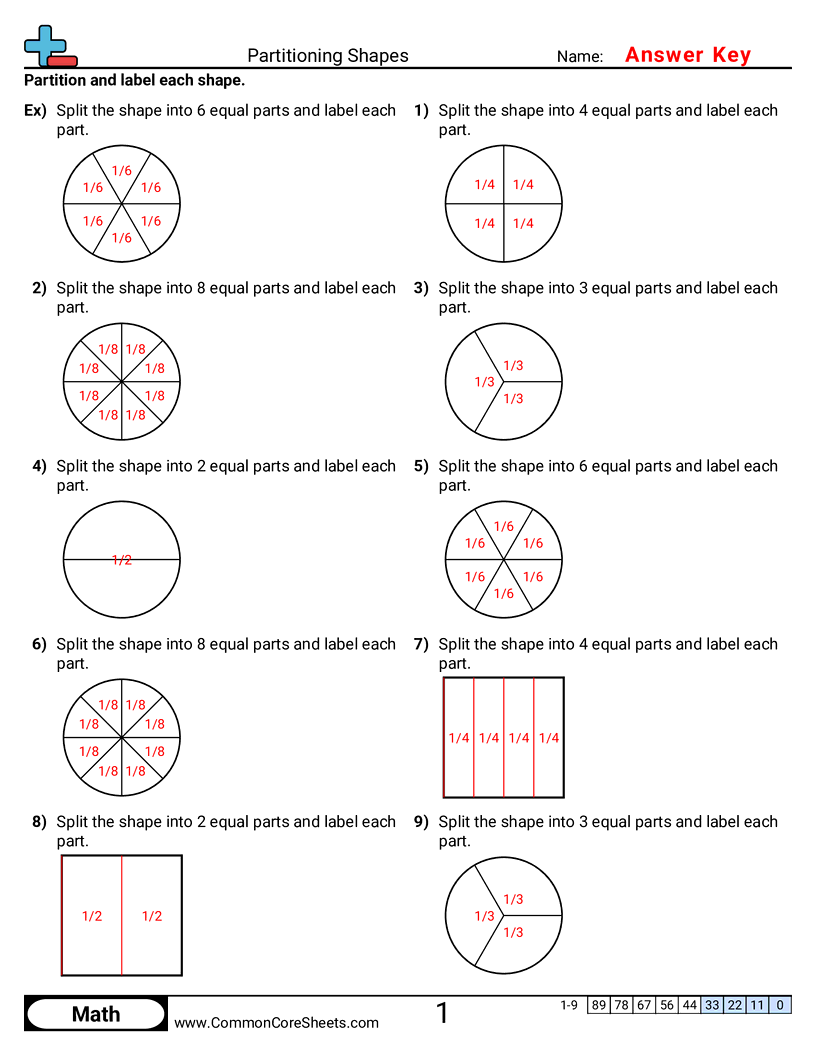
"This worksheet is designed to enhance children's understanding of shape partitioning in math. The 9-problem set involves dividing different shapes into 2, 3, 4, 6, or 8 equal parts, reinforcing the concept of fractions. Customizable for diverse learning needs, the worksheet can also be converted into flashcards or utilized in distance learning environments to support flexible, interactive education."
×Student Goals: Understanding of Mathematical PartitioningUpon completion of the worksheet, students can gain a comprehensive understanding of mathematical partitioning. They should be capable of dividing shapes into equal pieces, showcasing an understanding of fair sharing and equal distribution - fundamental mathematical concepts. Students also learn to identify fractions as they label each part of the divided shape, therein making the connection between partitioned shapes and their numerical representation in fractions.Recognition and Comparison of FractionsThe skills acquired from this worksheet extend to the recognition and comparison of fractions. With varying problems that require splitting shapes into different quantity of parts - such as halves, thirds, quarters, sixths, and eighths - students will become adept at identifying these common fractions. In comparing these fractions visually, they may also begin to intuitively understand the core concept that different fractions can represent the same proportional quantity, riding the leap from concrete to abstract thinking in mathematics.Development of Fine Motor SkillsCompleting this worksheet also aids in the development of students' fine motor skills. Through drawing and partitioning shapes, students will showcase and enhance not only their mathematical understanding, but also their control, precision, and coordination in a fun and engaging way. This in turn, plays a pivotal role in the improvement of handwriting skills, dexterity, and speed in tasks that involve the hands.Problem Solving and Logical ReasoningAnother key accomplishment from this worksheet involves problem solving and logical reasoning. It promotes students to think critically on how to divide each shape evenly and use logical reasoning to ensure that each section represents the correct fractional part. This helps improve their capacity for strategic planning, and analytical thinking, creating a robust foundation for other areas of learning.Confidence in Mathematical MasteryLast but certainly not least, students upon completing the worksheet should experience a significant boost in mathematical confidence and self-efficacy. By successfully partitioning shapes and mapping them to the correct fractions, students gain tangible proof of their mathematical prowess and progress, thereby motivating them to tackle more complex mathematical concepts. The sense of accomplishment from completing the worksheet can thus serve as a powerful intrinsic motivator in their continued mathematical journey.