Geometry Draw and identify lines and angles, and classify shapes by properties of their lines and angles.1Draw points, lines, line segments, rays, angles (right, acute, obtuse], and perpendicular and parallel lines. Identify these in two-dimensional figures.
4g1Open FolderOpen File×Description:
"This worksheet is designed to engage elementary students in understanding the concept of a 90° angle. It includes 20 interactive problems where students determine the relationship of different angles to 90°. The digital format makes customization easy, allowing conversion into flash cards, or adaptation for distance learning. It reinforces fundamental math principles and promotes hands-on learning."
×Student Goals: Understanding AnglesBy successfully completing this worksheet, students will have enhanced their knowledge on angles. They will be better able to identify an angle as either more, less, or equal to 90°. In other words, students should have a clear understanding of acute, right, and obtuse angles. This ability is essential as it serves as a foundation for various other aspects of geometry, including but not limited to understanding the properties of triangles, quadrilaterals and other polygons.Building Problem-Solving SkillsThe worksheet is designed to encourage students to apply their logical and mathematical thinking in order to determine the relation of various angles to 90°. This requirement will not only help students to strengthen their comparison and analytical abilities, but it will also assist them in problem-solving tasks that will crop in later higher-level mathematics subjects. Through the repeated practice of evaluating different angles, students are expected to have developed better problem-solving skills.Developing PrecisionWith the aim of accurately determining the relationship of given angles to 90°, students are expected to have developed a keen sense of precision and accuracy. In the field of Mathematics, precision is key, and by accurately identifying the measurement of each angle, students are honing their attention to detail. This complimented with consistent practice, the worksheet will help students become more accurate in their mathematical computations and deductions.Enhancing Mathematical VocabularyUpon completion of the worksheet, students would have broadened their mathematical vocabulary as well. They should be comfortable with using terms like 'acute', 'right', and 'obtuse' to describe and categorize angles, further embedding these terms in their learning. Understanding these terms is not only valuable for their mathematical progress but also facilitates effective communication of mathematical concepts with peers and teachers alike.
4g1Open FolderOpen File×Description:
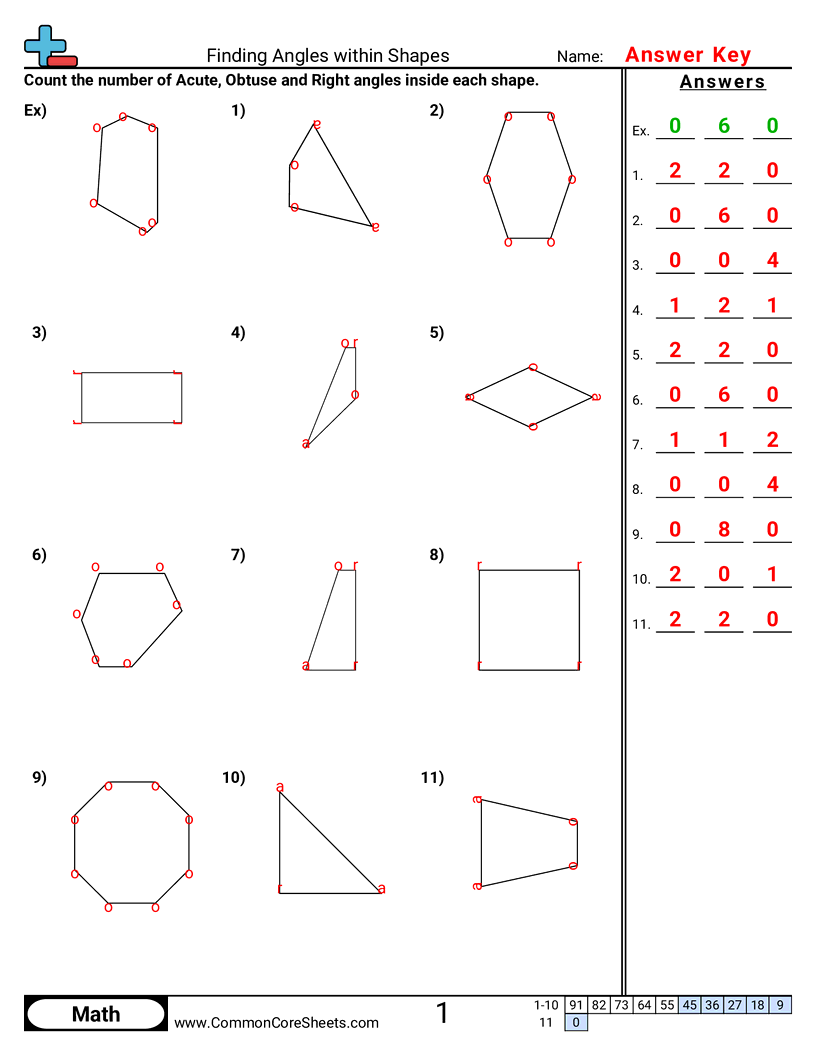
"This worksheet is designed to help children explore geometry, specifically finding angles within shapes. With 11 problems featuring illustrations of various shapes, students will adapt their mathematical skills to recognize and calculate different angles. The engaging and stimulating problems can be customized to suit any learning style. The flexibility of this resource allows it to be easily transformed into flashcards or utilized for distance learning, making math both fun and accessible for all learners."
×Student Goals: Mastering Geometry ConceptsBy proceeding through this math worksheet, students will gain further reinforcement in understanding angles within various shapes. By the completion, they should have a stronger grasp of basic geomtry concepts and the logical reasoning connected to these. This worksheet provides the groundwork necessary for expanding their mathematical abilities.Critical Thinking and Problem-Solving SkillsThis collection of problems encourages students to stretch their analytical capabilities and problem-solving skills. Working through this worksheet, students should be able to understand angles and their relationships better, developing strategies for solving related problems easily. By the end, they should be able to apply these new strategies to a variety of difficulties encountered.Enhancement of Spatial AwarenessThis worksheet aids students to develop their spatial thinking by having them to identify angles within different shapes. By doing so, students will foster their spatial awareness and a deeper comprehension of how shapes fit together. Afterwards, students should be able to analyze different shapes and identify various angles effectively.Ability to Calculate AnglesWorking through the problems in this worksheet would furnish the students with the capacity to calculate different angles within a variety of shapes. This is a critical competancy in geometry and this worksheet serves as a reliable tool to improve this skill. After completing the worksheet, students should be able to distinguish and estimate different angles confidently.Drawing Connection Between Theory and PracticeBy engaging with the diverse problems in this worksheet, students bridge the gap between the theoretical concepts and practical applications in the field of geometry. Upon completion, they should have a thorough understanding of how angles function in different shapes, and be able to identify them in practical, real-world contexts.Foundation for More Complex ConceptsThis worksheet is an excellent platform for setting a solid foundation for more complex concepts in geometry. Through understanding the basics of angles and shapes, it becomes a stepping stone for students, propelling them towards the comprehension of further complex geometrical concepts. After completing the worksheet, students will be ready to tackle more complex geometry topics with greater confidence and understanding.
4g1Open FolderOpen File×Description:
"This worksheet is designed to help children in understanding and determining angles visually. It contains 20 unique problems aimed to enhance students' math skills, focusing specifically on angle calculation. Each problem features SVG graphics that simplify the learning process and captivate pupils' interest. The teacher can customize these problems, convert them into flashcards, or integrate into distance learning. It's an ideal tool to enhance online math education."
×Student Goals: Mathematical KnowledgeUpon completion of the worksheet, students should have a greatly enhanced understanding of angles, specifically in visually determining the degrees of various angles. They would have developed a strong foundational mathematical knowledge, essential for their progress in further intricate concepts of mathematics.Visual Recognition SkillsStudents will dramatically improve their visual recognition skills. The ability to accurately estimate degrees by merely looking at an angle is a valuable mathematical and spatial skill. This skill can enhance a child's visual-spatial intelligence, which is crucial for success not only in mathematics but in other fields such as art and sports.Problem Solving AbilitiesSuccessfully completing this worksheet will bolster the pupils' problem-solving abilities. Each challenge presented requires the student to apply strategies and techniques to correctly determine an angle's degree visually. This process exercises their problem-solving skills and encourages logical thinking and analytical acuity.Understanding of GeometryStudents will attain a broader and more in-depth understanding of Geometry, primarily through the study and recognition of angles. They will learn how angles form a key component of geometrical shapes and figures, setting up a foundational understanding for more complex geometrical topics.Confidence in MathematicsThe practical task of visually determining angles can instill greater confidence in students towards the subject of Math. By breaking down complex mathematical concepts into accessible and interactive tasks with immediate feedback, students can gain self-assurance in their ability to tackle Math problems.Preparedness for Advanced TopicsBy mastering the ability to visually determine angles, students will be well-prepared for more advanced mathematical topics. Concepts such as trigonometry and calculus, which extensively involve angles and their measurements, become simpler and more manageable for students grounded in the basics of angles.Consistency and PatienceWith a total of 20 problems to be solved, this worksheet will instill a sense of consistency and patience in students. Continuously estimating angles will train them to remain focused and persistent in solving problems, which are essential attributes for achieving success in academic goals.
4g1Open FolderOpen File×Description:
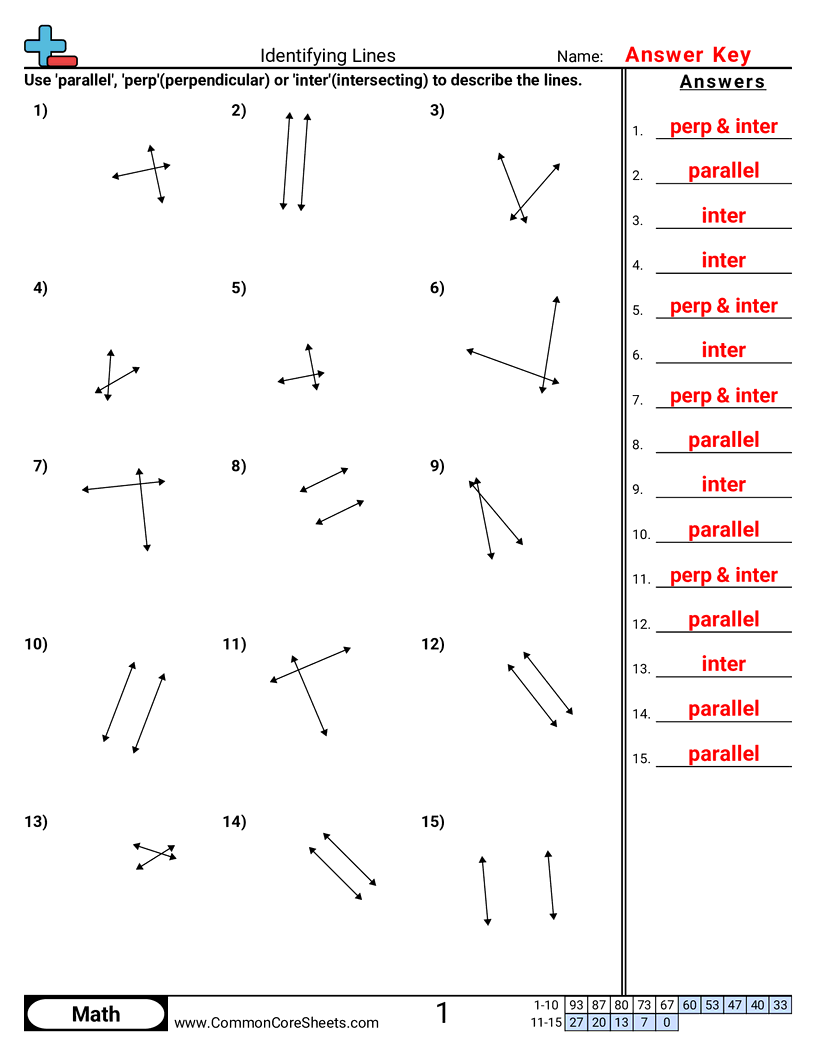
"This worksheet is designed to enhance children's mathematical skills in identifying lines. Consisting of 15 customizable problems, it can be easily converted into flashcards or utilized for distance learning. It provides a hands-on approach for students to explore and understand the basic geometric concept of lines, aiding in their cognitive development in the field of math."
×Student Goals: Enhancing Analytical SkillsBy successfully completing the worksheet, students are expected to have developed their analytical skills. They should be able to interpret and solve problems more rapidly and effectively as they identify lines in various exercises, demonstrating a solid understanding of concepts taught in math classes.Increased Accuracy in IdentificationOne of the main accomplishments of this worksheet is the ability to accurately identify straight, curved, and zigzag lines in various graphical situations which could be seen in architecture, engineering, and art. This precision is a stepping stone to higher-level math concepts.Grasping Mathematics FoundationMathematics is highly contextual and procedural. This worksheet should help students to secure these basic concepts, and reinforce the foundation of their math knowledge. Being able to identify lines, an essential aspect of geometry, is a critical skill that acts as a building block for future more complicated concepts.Applying Knowledge in Real World ContextAfter finishing the worksheet, pupils should have gained the ability to apply learned knowledge in real-world situations. Lines are not only mathematical concepts, but are also omnipresent in our everyday life. Understanding them theoretically means students should now be able to recognize and make use of this knowledge practically.Boosting Problem-Solving SkillsProblem-solving is a universal skill that is honed by practice. By working through various examples and exercises in the worksheet, students should be better at problem-solving, not only in mathematics but in varied academic and life situations. The mental flexibility gained will support them in independently overcoming obstacles.Enhancing focus and patienceCompleting the worksheet requires attention to detail and patience. This exercise should have allowed students to practice these skills further, leading to an improvement in levels of concentration and patience when tackling similar tasks, which can be applied across different areas of study and beyond academic setting.