Measurement and Data Geometric measurement: understand concepts of angle and measure angles.5Recognize angles as geometric shapes that are formed wherever two rays share a common endpoint, and understand concepts of angle measurement:aAn angle is measured with reference to a circle with its center at the common endpoint of the rays, by considering the fraction of the circular arc between the points where the two rays intersect the circle. An angle that turns through 1/360 of a circle is called a "one-degree angle," and can be used to measure angles.
4md5aOpen FolderOpen File×Description:
"This worksheet is designed to strengthen children's understanding and skills in estimating angles, associating mathematical knowledge with visual diagrams. With a total of 9 problems, it guides learners through angle interpretation, using labelled diagrams to aid comprehension. The resource is fully customizable to accommodate individual learning speed and level. For flexible usage, this worksheet can be converted to flash cards and complements distance learning platforms, catering to diverse learning environments."
×Student Goals: Master Estimating AnglesAfter completion of the worksheet, students will have developed proficiency in estimating angles. They will demonstrate a strong understanding of how to guess the measure of an angle, an essential skill in mathematics. They will learn how to advantages of their visual perception to estimate the degree of different angles.Understand Angular ConceptsBy successfully finishing the worksheet tasks, learners will gain a clear conceptual understanding of angles. They will grasp the key principle that an angle signifies a measure of rotation or turn, and how this turns are represented in degrees. They will also comprehend the structural formation of angles, by identifying the vertex and the sides.Enhance Problem-solving AbilitiesCompleting the worksheet also assists in enhancing learners' problem-solving abilities in mathematical concepts. They will be faced with myriad problems with varying degrees of difficulty, and being able to solve them improves their problem-solving competence. They will also showcase their ability to analyze problems and make proper estimations, contributing significantly to their general math problem-solving capabilities.Boost Critical ThinkingWorking through the worksheet and successfully completing it boosts students' critical thinking skills. The exercises are crafted in a way that will prompt the pupils to mobilize their thinking, especially when estimating the value of an angle. By doing this repeatedly, they will be promoting their higher-order thinking skills, a vital aspect not only in math but also in other subjects and life’s situations.Application in Real-life SituationsLastly, by finishing the worksheet, learners will learn how to apply the skill of angle estimation in real-life scenarios. Angles are everywhere, from ramp slopes, staircases, clocks, to sectors of a circle. Their newfound ability to estimate angles might come into play in everyday scenarios such as planning the angle to kick a ball in a soccer match or evaluating the steepness of a hill while hiking. This practicality of the skills they learn contributes to their comprehensive learning process.
4md5aOpen FolderOpen File×Description:
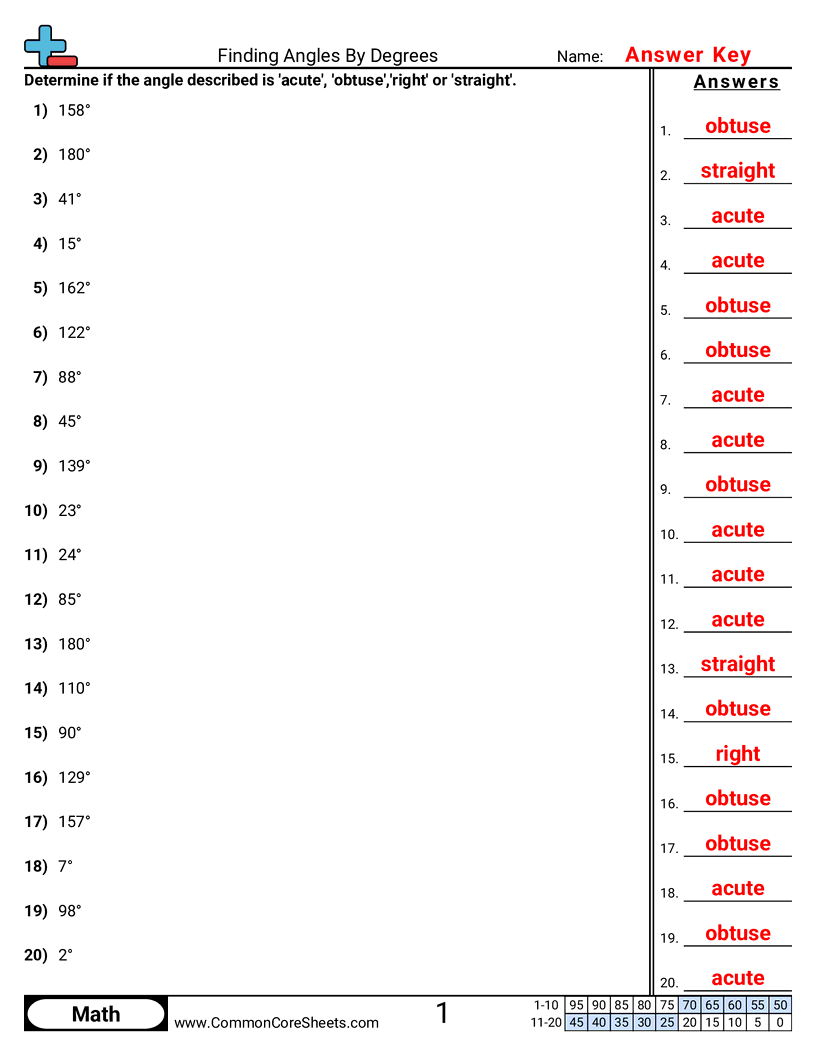
"This worksheet is designed to enhance children's knowledge of mathematics, specifically in finding angles by degrees. Comprising 20 problems, it provides practical training in dealing with different degrees of angles, such as 169°, 157°, and 21°. Furthermore, it offers versatility in usage as it can be customized to an individual's needs, converted into interactive flashcards for efficient learning, or utilized in distance learning modules, fostering an adaptable and engaging learning environment."
×Student Goals: Understanding of AnglesAfter completing this worksheet, students should have a comprehensive understanding of angles and their corresponding degrees. They will acquire the critical skill of being able to identify and differentiate angles based on their degree of rotation. This knowledge forms the foundation for more complex mathematical and geometric studies in subsequent learning stages. Enhanced Cognitive DevelopmentWorking through this worksheet aids cognitive development in children by promoting numerical reasoning skills. Children are required to visualize and understand the concept of angles; this process contributes to honing their spatial intelligence. This is important in developing problem-solving skills, not only in math but in everyday life situations.Practicing PrecisionPrecision and accuracy in identifying angles form a vital part of the learning process when working on this worksheet. Students will appreciate the discipline required in observing detail and the difference that slight changes in angles can make. The completion of the worksheet will, therefore, add to their precision in answering math problems.Improved Proficiency in MathThis worksheet helps to improve overall mathematical proficiency. By understanding angles and their degrees, students can apply this knowledge to other branches of mathematics such as algebra, calculus, and trigonometry. This deepens their understanding and grasp of math concepts, making them more proficient.Boosts ConfidenceNavigating through the problems in this worksheet successfully is likely to boost the students' confidence in their mathematical abilities. The completion of this worksheet demonstrates the students' ability to understand and apply complex concepts, which in turn, increases their self-assuredness and readiness to face more complex mathematical challenges.Application in Real-Life ScenariosWith the knowledge gained from this worksheet, students will be able to apply what they've learned to real-life scenarios. From identifying different angles in architecture to interpreting data in statistics, the applications are vast. It, therefore, cultivates a deeper appreciation of the prevalence and importance of mathematics in the world around us.