Number and Operations—Fractions Apply and extend previous understandings of multiplication and division to multiply and divide fractions.4Apply and extend previous understandings of multiplication to multiply a fraction or whole number by a fraction.aInterpret the product (a/b) × q as a parts of a partition of q into b equal parts; equivalently, as the result of a sequence of operations a × q ÷ b. For example, use a visual fraction model to show (2/3) × 4 = 8/3, and create a story context for this equation. Do the same with (2/3) ×(4/5) = 8/15. (In general, (a/b) ×(c/d) = ac/bd.)
5nf4aOpen FolderOpen File×Description:
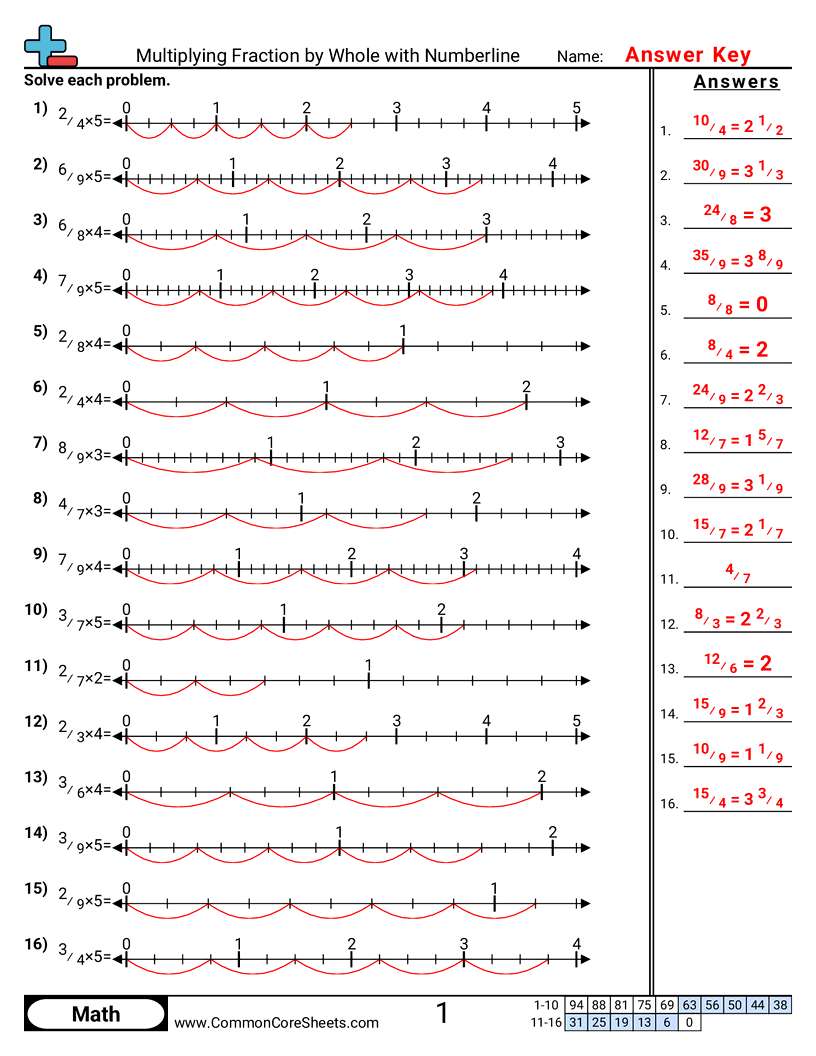
"This worksheet is designed to help children grasp the concept of multiplying fractions by whole numbers using number lines. It offers 20 math problems ranging from simple to complex fractions, enhancing their skills in this area. This resource can be customized to suit individual learning needs, converted into interactive flash cards, or utilized for distance learning. It's a versatile tool supporting a child's progressive understanding of fractions."
×Student Goals:
5nf4aOpen FolderOpen File×Description:
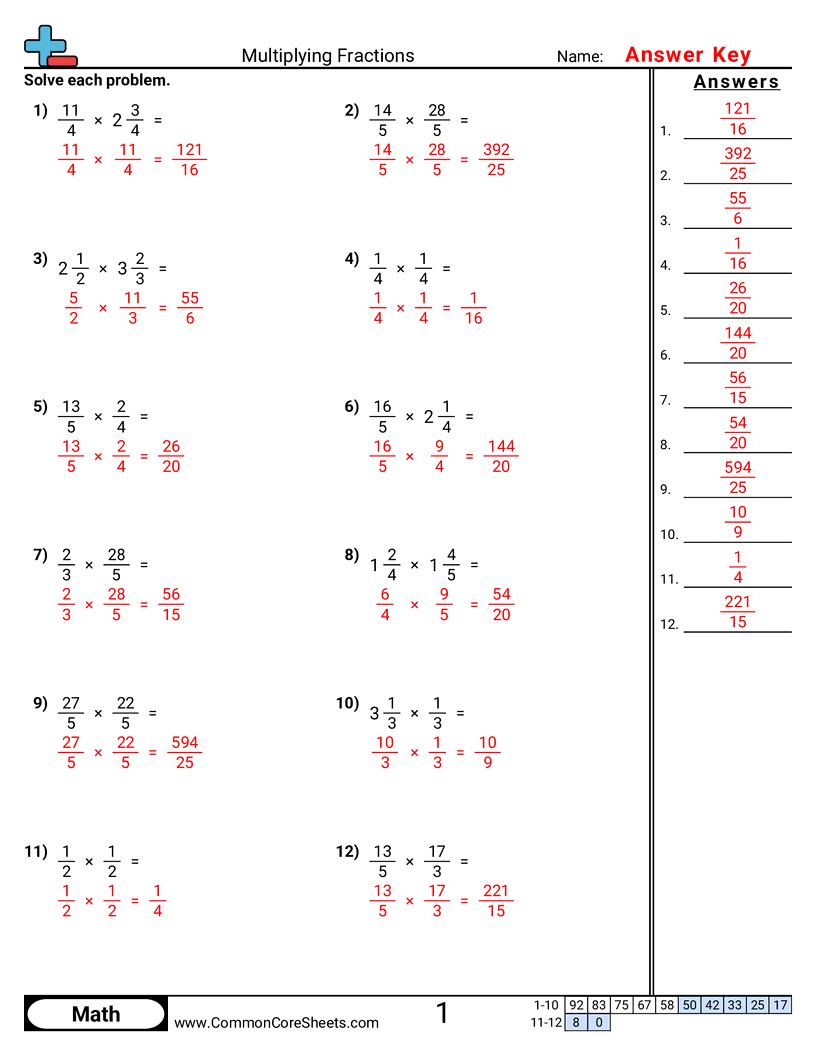
"This worksheet is designed to enhance students' skills in multiplying fractions, introducing 12 math problems to assist them in mastering the concept. It demonstrates a variety of fraction multiplication scenarios, inviting them to solve each unique numerical challenge. This customizable tool can also be converted into flashcards for quick revision or seamlessly integrated into distance learning platforms for flexible education."
×Student Goals: Concept UnderstandingUpon completing the worksheet, students should develop a clear understanding of the fundamental concept of multiplication of fractions. They should be able to identify and engage with the steps of multiplying fractions which encompass fraction number identification, multiplication of the numerators and denominators separately and simplifying the gained products to the lowest terms.Problem-Solving SkillsAfter solving these math problems, student’s ability to apply the underlying principles of fraction multiplication to solve complex problems efficiently should enhance. Furthermore, they should be capable of recognizing and interpreting problem statements, therefore breaking them down into smaller, manageable tasks.Numeracy SkillsBy the end of this activity, their numeracy skills should be improved, suggesting they should be proficient in conducting basic arithmetic computations accurately involving fraction numbers. They should be able to manipulate fractions comfortably and correctly, by multiplying the numerators together to form a new numerator, and similarly with the denominators.Critical ThinkingThis worksheet will aid in the improvement of critical thinking skills. After completing the worksheet, students should demonstrate their ability to think logically and methodically to find the correct answer. This includes being aware of common mistakes and misconceptions, and logical application of steps to proceed from one calculation to the next.Facilitation of More Advance TopicsThe mastery of multiplication of fractions can serve as a building block to more advanced mathematical topics. Having accomplished this worksheet, students should be prepared to tackle harder topics like division of fractions, operations with mixed numbers, and solving real-life problems involving fractions.Confidence BuildingSuccessfully completing this worksheet should also help to build confidence in their abilities in the mathematics area. As students practice and become comfortable in dealing with fraction multiplication, they should gain greater assurance in their skills, which can encourage a more positive attitude towards handling complex mathematical problems in the future.Time ManagementMultiplication of fractions worksheet will also train students in managing their time more efficiently as they progress through the set of problems. With repetitive practice, they should notice a significant reduction in the time they require to solve similar mathematical equations, hence improving their time management skills.