The Number System Compute fluently with multi-digit numbers and find common factors and multiples.4Find the greatest common factor of two whole numbers less than or equal to 100 and the least common multiple of two whole numbers less than or equal to 12. Use the distributive property to express a sum of two whole numbers 1–100 with a common factor as a multiple of a sum of two whole numbers with no common factor.
6ns4Open FolderOpen File×Description:
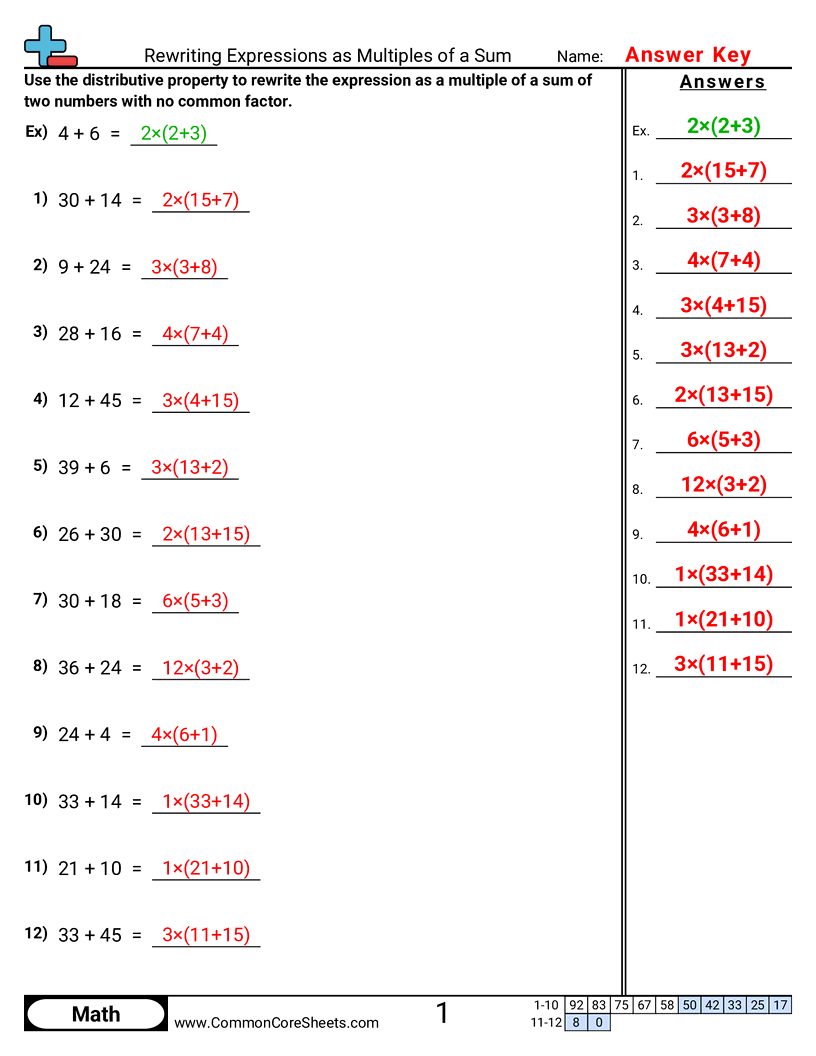
"This worksheet is designed to reinforce math skills by teaching children how to rewrite expressions as multiples of a sum. Tailored for distance learning, it features 12 problems where kids can manipulate numbers to form new equations, such as 27+14 becoming 1×(27+14). Customizable for various learning styles, it can also easily transform into a set of interactive flashcards for hands-on practice. Ideal for enhancing arithmetic comprehension in a fun, engaging way."
×Student Goals:
6ns4Open FolderOpen File×Description:
"This worksheet is designed to educate children about the concept of Greatest Common Factor (GCF) in mathematics. It features nine structured problems, highlighting factors of individual numbers. The interactive, easy-to-understand format makes it ideal for distance learning. The worksheet is customizable to suit each student's learning pace and can easily be converted into flashcards for a more engaging experience."
×Student Goals: Understanding FactorsAfter completing this worksheet, students should have a strong foundational understanding of what factors are. They should be able to successfully identify the factors of any given number, helping them to break down numbers into their most basic components.Identifying Common FactorsStudents should develop the ability to identify common factors between two numbers. This skill helps them grasp the relationship between different numbers, enhancing their computational fluency. Also, with an ability to efficiently diagnose common factors, they can simplify fractions more effectively.Determining Greatest Common FactorWith the successful completion of this worksheet, students would have honed their competency in determining the greatest common factor (GCF) between two numbers. Mastery of GCF is crucial, as it directly impacts a student's capacity to simplify fractions and perform various computational operations involving fractions.Improving Math FluencyThrough the diligent practice of worksheets like this, students should be able to improve upon their overall mathematical fluency. This improvement is evidenced by their ability to gain familiarity with the concepts of factors, become comfortable visualizing mathematical relationships, and speed up their mathematics problem-solving skills.Developing Analytical SkillsFollowing the successful completion of this worksheet, students will noticeably develop their analytical skills. They'll be able to approach a problem, analyze it, and determine the most efficient method to arrive at a solution. Determining common factors and greatest common factors requires a logical analysis of numbers, and thus is a strong exercise in analytical thinking.Building Problem-Solving SkillsStudents will also enhance their problem-solving skills, learning how to pace themselves through each problem, how to review their work for errors, and how to apply what they have learned to new and different problems. This skill ties directly into real-world application, with problem-solving being a highly valuable and necessary skill in many aspects of life and work.Fostering Patience and PerseveranceA worksheet like this can often challenge a student's patience and tenacity. However, after conquering the difficulties, students should develop a stronger disposition towards overcoming academic hurdles, fostering patience, perseverance, and building overall academic resilience.
6ns4Open FolderOpen File×Description:
"This worksheet is designed to enhance math skills by focusing on finding the least common multiple. Featuring 10 uniquely problematic number sequences, it invites children to delve into the world of number theory. The problems can be tailored to the child's level, converted into flashcards, or incorporated into distance learning plans. It's an ideal tool to make math learning interactive and engaging."
×Student Goals: Problem Solving SkillsAfter completing the worksheet on finding the least common multiple, students should be able to solve mathematical problems more effectively and efficiently. They should be adept at recognizing patterns and employing logical reasoning to arrive at solutions.Mastery in Least Common MultipleStudents should achieve a thorough understanding of the concept of the least common multiple (LCM). They should be able to identify the least common multiple of a given set of numbers confidently and without any difficulties, and apply this concept in different mathematical and real-world contexts.Numeracy SkillsPerforming the exercises on the worksheet should help improve the students' numeracy skills. It should reinforce their understanding of number sequences and ability to manipulate numbers, which is a fundamental skill that is involved in various computational tasks.Mental Math AbilitiesThe worksheet should enhance the students' mental math capabilities. They should be capable of performing calculations in their heads, without the need for a calculator. This could provide a significant benefit in examinations and situations where they are required to do computations quickly.Conceptual UnderstandingThrough the worksheet, students should gain a deep conceptual understanding of the mathematical principles associated with the least common multiple. They should be able to explain the concept, methods of finding the LCM, and its applications, to others demonstrating a firm grasp over the subject.Math ConfidenceCompleting the worksheet should also bolster students' confidence in their math abilities. By mastering the concept of LCM, they would feel more confident about tackling more complex mathematical theories and problems, thereby fostering a positive attitude towards learning and examining mathematics as a whole.Application of LearningStudents should be proficient at applying their knowledge of LCM to various problems and scenarios. This includes making connections to previous learnings, applying these in new, unfamiliar contexts, and employing this knowledge to solve complex problems.Independence in LearningLastly, after consistent practice and completion of the worksheet, students should be able to operate independently. This means they should be able to tackle numerical problems in the same domain, without guidance, and be self-reliant in learning new concepts and methods in mathematics.