Ratios and Proportional Relationships Understand ratio concepts and use ratio reasoning to solve problems.3Use ratio and rate reasoning to solve real-world and mathematical problems, e.g., by reasoning about tables of equivalent ratios, tape diagrams, double number line diagrams, or equations.cFind a percent of a quantity as a rate per 100 (e.g., 30% of a quantity means 30/100 times the quantity); solve problems involving finding the whole, given a part and the percent.
6rp3cOpen FolderOpen File×Description:
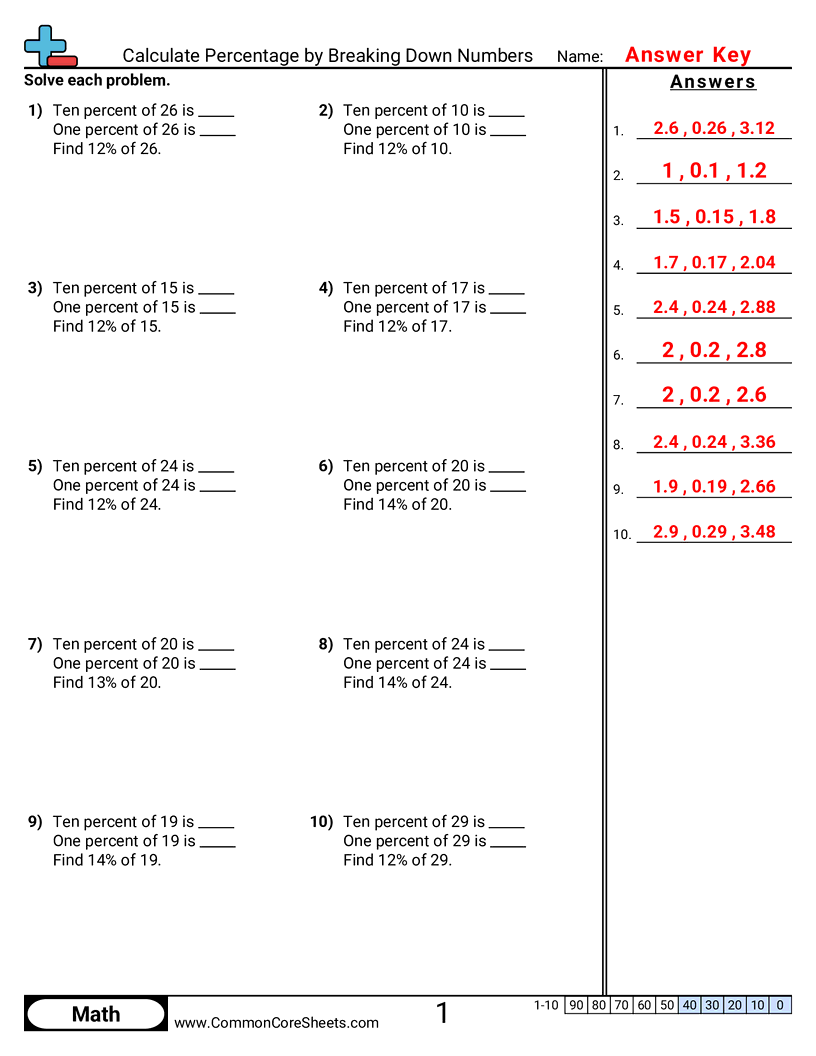
"This worksheet is designed to strengthen a child's understanding of percentages, using approachable number breakdown methods. It houses 10 unique math problems which guide children to calculate different percentages of specific numbers. Perfect for incorporation into distance learning programs, this worksheet can also be adapted into flash cards to suit personalized learning pedagogies. With its focus on making percentage calculations simplified, it's an effective tool for enhancing math skills."
×Student Goals:
6rp3cOpen FolderOpen File×Description:
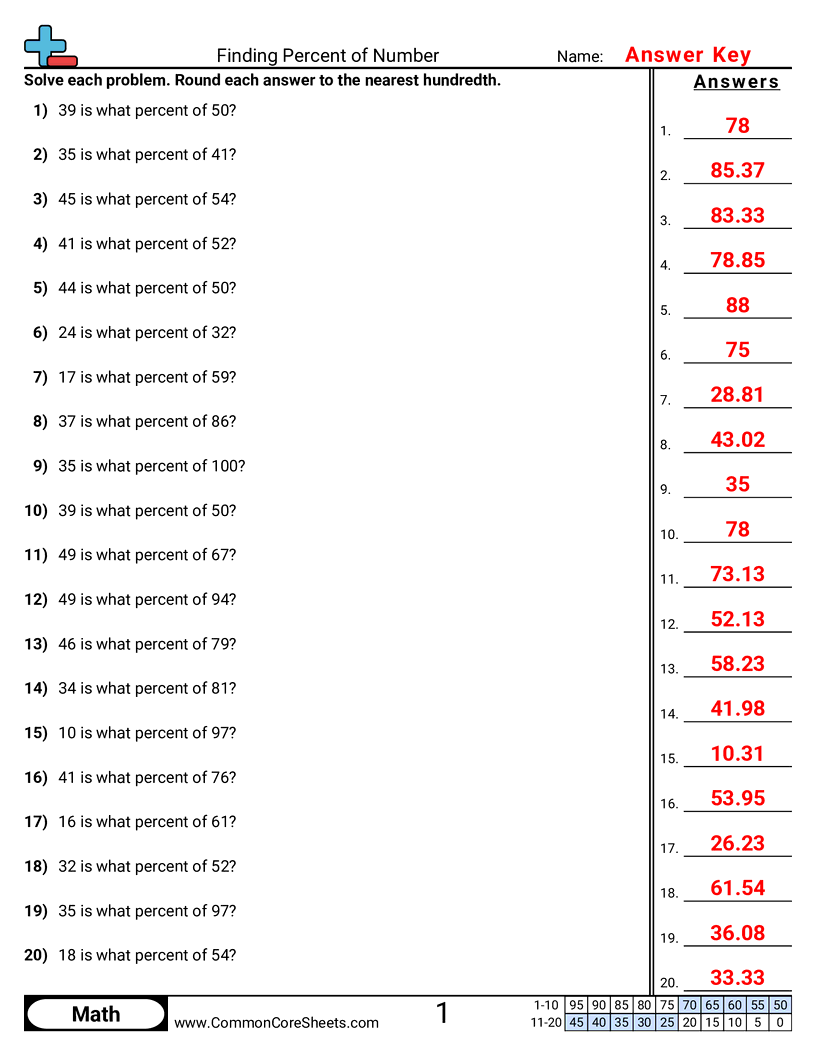
"This worksheet is designed to strengthen children's understanding of percentages in math. It provides 20 problems that require finding the exact percentage of a number. The problems can be customized based on the learning needs of the student and can also be used as flashcards for refreshing concepts. Ideal for distance learning, this worksheet is an effective tool for improving number comprehension."
×Student Goals: Understanding of PercentBy completing the worksheet, students will gain a solid understanding of what a percent is. They will grasp the concept of a percent as a fraction of 100 and comprehend how it is used to represent a portion of a total.Percentage Calculation SkillsStudents will be proficient in calculating the percent of a particular number. They will learn the formulas and procedures for determining exact percentages and will be capable of quickly and accurately performing these calculations.Application of PercentageAs they work through the worksheet, students will learn to apply the concept of percentages to real-world scenarios. They will be equipped to use percentages to interpret data, make comparisons and solve problems.Improvement in Problem-Solving AbilitiesStudents will enhance their problem-solving abilities. By confronting and resolving the problems in the worksheet, they will develop skills in critical thinking, logical reasoning, and strategic planning. They will also learn to approach mathematical problems methodically and analytically.Progress in Mathematical FluencyThe worksheet will serve to increase students' mathematical fluency. By constantly working with numbers and computations, children will become more comfortable with arithmetic operations and will become faster and more accurate in their calculations.Retention and RecallRepeatedly calculating percentages will bolster students' ability to retain and recall information. It helps to consolidate mathematical concepts in their memory, thereby providing a firm foundation for further, more advanced studies in mathematics.Confidence BoostFinally, successfully completing the worksheet will enhance students' confidence. The ability to calculate percentages correctly and efficiently can give them a sense of achievement and self-belief, which is crucial for their overall academic development and progress.
6rp3cOpen FolderOpen File×Description:
"This worksheet is designed to help children master the mathematical concept of finding the percent of a number. With 20 diverse, customizable problems, learners will understand how to calculate percentages in various contexts. This resource is a flexible tool that can be converted into flashcards or incorporated into distance learning curriculums, catering to diverse learning styles and needs."
×Student Goals:
6rp3cOpen FolderOpen File×Description:
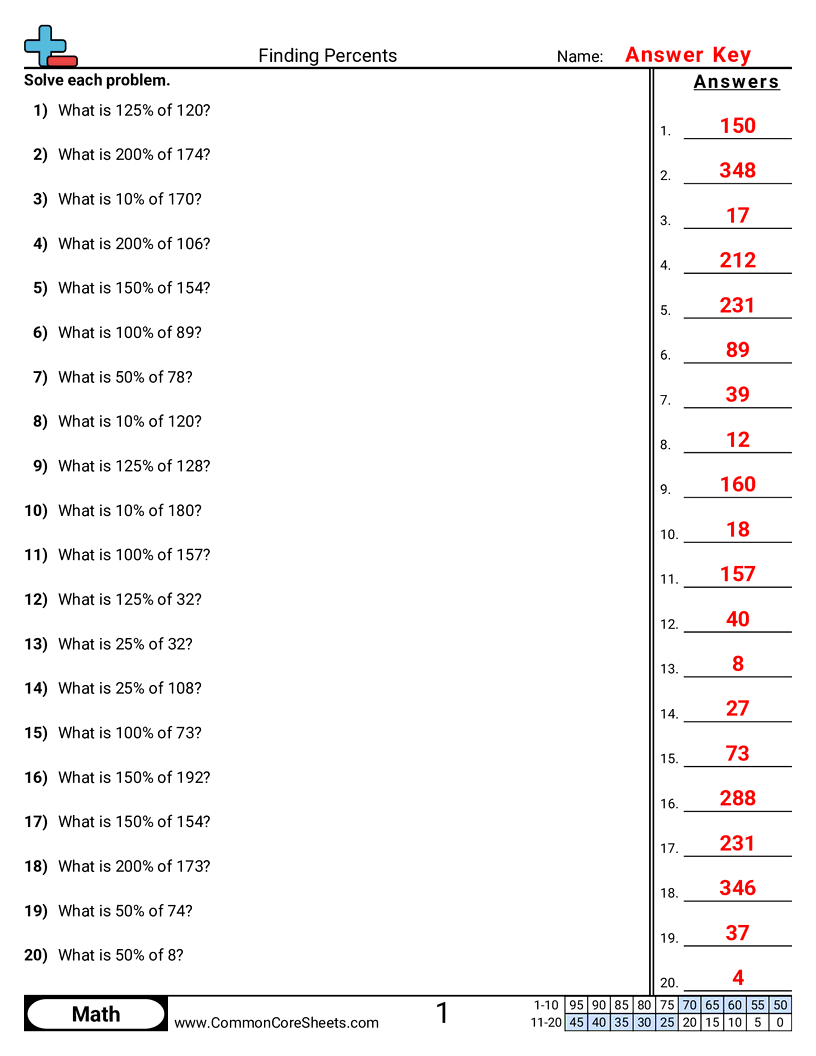
"This worksheet is designed to strengthen children's percentage calculation skills in math. It presents 20 varied problems, challenging kids to find the percentage of a given number. Ideal for remote learning, this versatile tool can also be customized to suit individual learning needs or converted into flash cards for further practice."
×Student Goals: Develop Mathematical SkillsAfter completing the 'Finding Percents' worksheet, students should have honed their mathematical abilities and significantly enhanced their skills in working with percentages. They would have grasped the concept of percentages, allowing them to carry out calculations accurately and understand the implications of the results. Understanding percentages is a crucial aspect of math that is used in various fields, and this worksheet ensures that students are well-prepared for its applications in real-life situations.Improve Problem-Solving CapabilitiesWorking through a set of 20 problems on the worksheet would have challenged the students and, in the process, elevated their problem-solving capabilities. They would be adept at taking a systematic approach to solving problems, starting from understanding the problem statement, making relevant calculations, and finally interpreting the output. This makes students more confident and well-rounded, enabling them to tackle more complex problems in the future.Increase Critical ThinkingThis 'Finding Percents' worksheet should allow students to build and expand their critical thinking skills. They should have learned to apply logic and reason, approach situations with a numerical lens, and develop techniques for calculating percentages. The skill of critical thinking is not just useful in academic settings but also in making everyday decisions, making this a truly valuable accomplishment.Build EfficiencyStudents should be more efficient in solving math problems after completing this worksheet. By repeatedly practicing the process of calculating percentages through a variety of problems, they would have learned to reach solutions more quickly and accurately. This aids in exam situations where they have to solve problems within a specific time limit.Promote Confidence in LearningBy successfully working their way through the worksheet, students would feel a sense of achievement, encouraging an enthusiastic approach towards learning. This sense of accomplishment motivates them to engage deeper with other areas of mathematics and academic learning overall, thus, fostering a lifelong love for learning.
6rp3cOpen FolderOpen File×Description:
"This worksheet is designed to enhance children's understanding of ratios in a fun and interactive way, through vivid real-life examples. Covering a range of scenarios from race times to soda sales to video game levels, this 10-problem activity sharpens math skills and improves conceptual knowledge. Not only can this worksheet be personalized to suit individual learner needs, it can also be transformed into flash cards or utilised effectively in distance learning environments."
×Student Goals: Understanding of RatiosAfter completing the worksheet, students should have a firm grasp on the concept of ratios. They should understand what a ratio is and how to interpret it, being able to relate quantities in a meaningful way. They should also be able to distinguish when ratio is used in a sentence, and identify the quantities being compared.Application of RatiosSuccessfully completing the worksheet should equip students with the ability to apply ratios to practical, real-life situations, be it a movie rental story, a parking lot dilemma, or a pet store sales analysis. They'll be able to contextualize and calculate ratios in various scenarios, making them more confident in their math abilities.Problem-solving SkillsThrough the math problems provided, students will reinforce their problem-solving skills. They'll be tasked with determining how to extract the necessary information from problems, use it to create a ratio, and then solve for the ratio. As a result, they should see a notable improvement in their problem-solving capabilities.Mathematical ReasoningUpon worksheet completion, students' mathematical reasoning will be markedly improved. Ratios entail critical thinking skills, as students must understand the comparison and relationship between two quantities. This will enhance their ability to think critically in a mathematical context, and cultivate logical thinking patterns.Ratio ConversionA part of understanding ratios is knowing how to convert them into different forms or units. Therefore, after this worksheet, students should be competent in converting ratios to different formats, such as fractions, decimals, or percentages. This knowledge will serve as a building block for future topics in mathematics.Communication of Mathematical IdeasLastly, students should be proficient in communicating mathematical ideas more effectively after working through this worksheet. The ability to express the reasoning behind a solution is fundamental in learning. So, being able to explain how a ratio is derived and used to solve a problem is a vital gain from this exercise.
6rp3cOpen FolderOpen File×Description:
"This worksheet is designed to enhance children's understanding of reducing ratios in math. Comprising of 20 engaging problems, children can learn to simplify ratios such as 24:54 to 4:9. The content is customizable, offering flexibility for different learning approaches. It can be conveniently converted into flashcards or integrated into distance learning modules, making math education accessible and effective."
×Student Goals: Understanding RatiosAfter completing this worksheet, students will have a clear understanding of ratios and their practical applications. They will be skilled at identifying, interpreting, and reducing ratios in different situations.Enhancing Numerical ProficiencyStudents will advance their numerical proficiency by practicing the process of reducing ratios. This process requires them to simplify numbers while maintaining their relationship—a key mathematical skill. This further aids creative problem-solving abilities and fosters numerical manipulation skills.Critical Thinking and Problem-Solving SkillsThis worksheet will help students develop critical thinking and problem-solving skills. They will learn to analyze problems by breaking down numbers and discerning their relationships. This form of analytical thinking is crucial for understanding broader mathematical principles and solving complex math problems.Real-world Mathematical ApplicationsBy successfully reducing ratios, students will be better equipped to understand real-world applications of math. Ratios can be found in everyday situations like recipes, proportions in drawings, scaling models and more. Grasping ratios will help students apply mathematical concepts beyond the classroom.Mathematical ConfidenceBy solving these problems, students will gain confidence in their mathematical abilities. Each successfully reduced ratio will serve as a confidence builder, supporting them in tackling increasingly complex mathematical problems. This confidence is essential for fostering an enduring interest in mathematics and higher levels of mathematical education.Independent Learning and PracticeCompleting this worksheet will also promote independent learning as students work alone to solve each problem. This will enhance their capability to think independently, an important skill for lifelong learning.Time Management SkillsFinally, by working through a set number of problems, students will improve their time management skills. They will learn to allocate sufficient time to each problem, promoting a more efficient approach to solving math problems and aiding their overall academic progress.