Ratios and Proportional Relationships Analyze proportional relationships and use them to solve real-world and mathematical problems.2Recognize and represent proportional relationships between quantities.dExplain what a point(x, y) on the graph of a proportional relationship means in terms of the situation, with special attention to the points (0, 0) and (1,r) wherer is the unit rate.
7rp2dOpen FolderOpen File×Description:
"This worksheet is designed to improve children's competencies in math, specifically in the area of interpreting and examining graphs. It contains three engaging problem sets featuring realistic scenarios like printing pages, earning points by defeating enemies, and counting candies. These concepts are tailored to keep children interested while developing their graph reading skills. The worksheet can be customized and converted into flash cards to aid in review, and it is suitable for distance learning."
×Student Goals: Understanding GraphsAfter completing the worksheet, students should be able to thoroughly understand and interpret various types of graphs. They will gain in-depth knowledge of how data is represented graphically and how it translates into real-life situations. Decoding the relationship between various data points on the graph should come easily to them.Develop Mathematical SkillsThe worksheet will play a crucial role in improving students' mathematical skills. Successfully navigating through the problems will help them apply basic arithmetic operations and understand correlations. This will also aid in the development of their problem-solving approach, numerical fluency, and critical thinking.Relating Mathematics to Real-World ScenarioThe completion of the worksheet allows students to develop a vital skill - connecting mathematical concepts to everyday life situations. They will have a clearer understanding of how mathematical graphs are used to represent and decode information in various fields, enhancing their practical knowledge.Analytical SkillsStudents will foster their analytical skills as they dissect the elaborate data sets represented in the graphs. Analyzing different sets of data will allow them to draw conclusions and comparisons, boosting their analytical abilities.Attention to DetailBy working through the problems on this worksheet, students will enhance their attention to detail. They will have to closely examine the different data points and their corresponding values to solve the problems, thereby promoting precision and meticulousness in their work.Understanding of Quantitative RelationshipsThe worksheet will help students recognize and comprehend the quantitative relationship between different elements. They will be able to predict and interpret how a change in one quantity can affect another, thereby augmenting their understanding of dependent and independent variables.
7rp2dOpen FolderOpen File×Description:
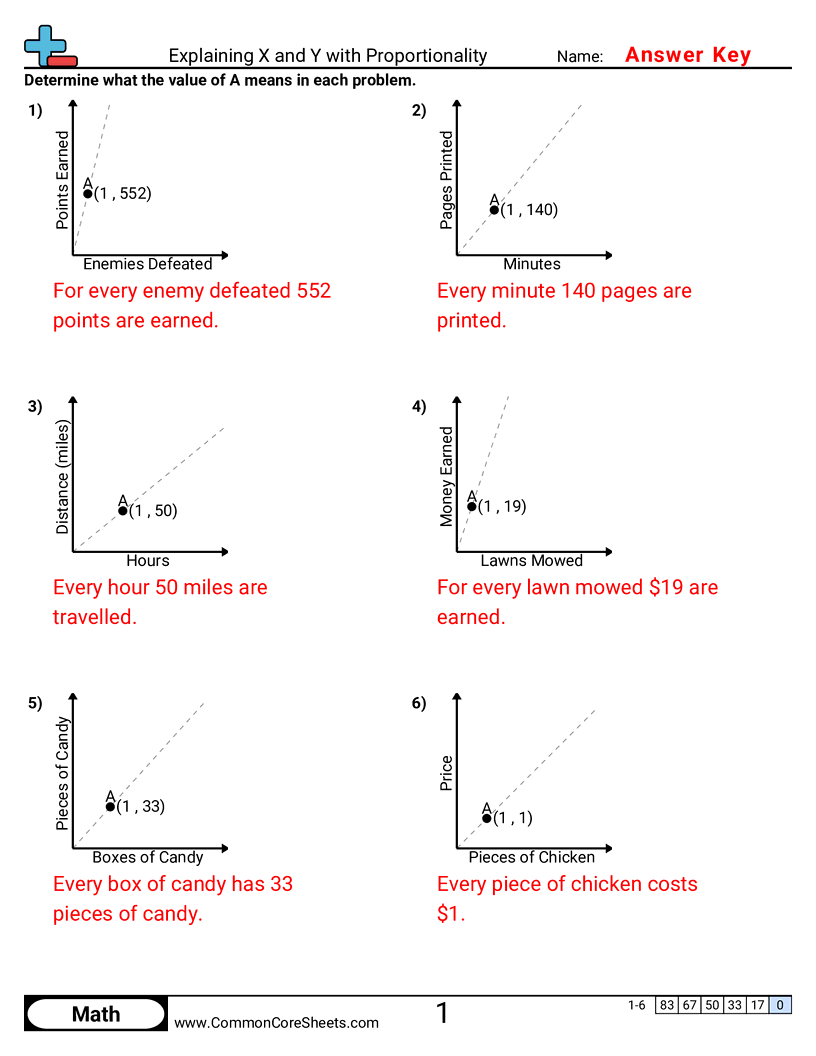
"This worksheet is designed to help children understand the concept of proportionality in math through practical examples such as lemonade preparation, game scoring, and purchasing groceries. The worksheet contains six customizable problems that can be converted to flashcards for interactive learning. It is ideally suited for both in-person and distance learning, fostering comprehensive understanding of X and Y relations."
×Student Goals: Understanding of Proportionality ConceptAfter completing the worksheet, students will have a strengthened understanding of the concept of proportionality which is integral to mathematics. They would be adept at discerning the relationship and ratio between two units in different contexts.Problem Solving SkillsThis worksheet serves as an effective tool to enhance problem-solving abilities. With a total of six problems, students would be able to efficiently analyze and solve problems related to proportionality which involves a number of elements.Application of Theoretical KnowledgeStudents will learn to apply their theoretical knowledge of math to practical situations. They will now understand that the concepts learned are not confined to textbooks and can be applied to daily life scenarios.Improved Numerical AbilitySolving problems based on real life instances involving numbers can boost the numerical ability of students. They will become proficient in handling various units of measurements and their proportions.Increased AccuracyThe worksheet helps in precision by teaching students proportions and ratios. Aided by this, they will learn to avoid common mistakes, thereby improving their accuracy.Assimilation of Practical ExamplesThe worksheet will also facilitate greater assimilation of practical examples, further strengthening the students' grasp on the concept of proportionality and fostering their ability to use mathematical concepts in a variety of practical contexts.Critical ThinkingLastly, it will promote critical thinking among students. They would learn to approach different problems strategically and think about the different aspects before deriving a solution.