Statistics & Probability Use random sampling to draw inferences about a population.1Understand that statistics can be used to gain information about a population by examining a sample of the population; generalizations about a population from a sample are valid only if the sample is representative of that population. Understand that random sampling tends to produce representative samples and support valid inferences.
7sp1Open FolderOpen File×Description:
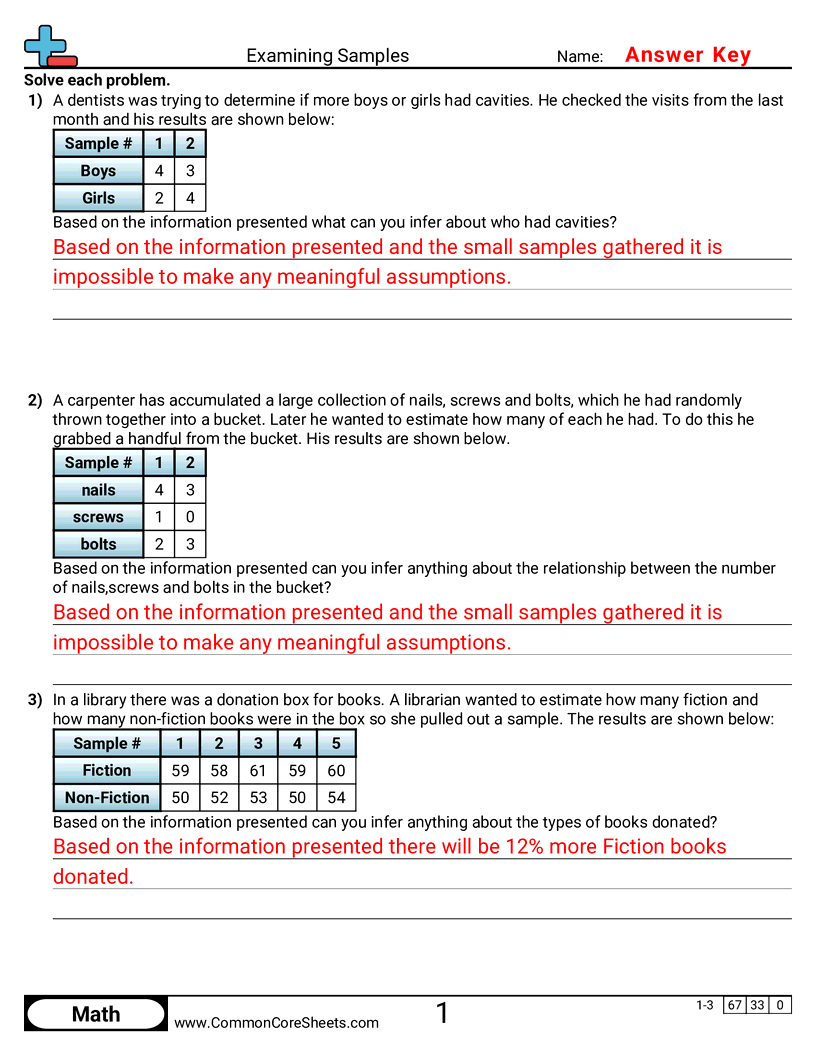
"This worksheet is designed to enhance children's analytical abilities in math using real-life scenarios. It presents three engaging problems relating to sampling and data interpretation in diverse contexts: online shopping, carpentry, and product packaging. This versatile resource can be customized according to individual academic needs, transformed into flashcards for interactive learning, or utilized for effective distance learning, thus facilitating a comprehensive understanding of the subject."
×Student Goals:
7sp1Open FolderOpen File×Description:
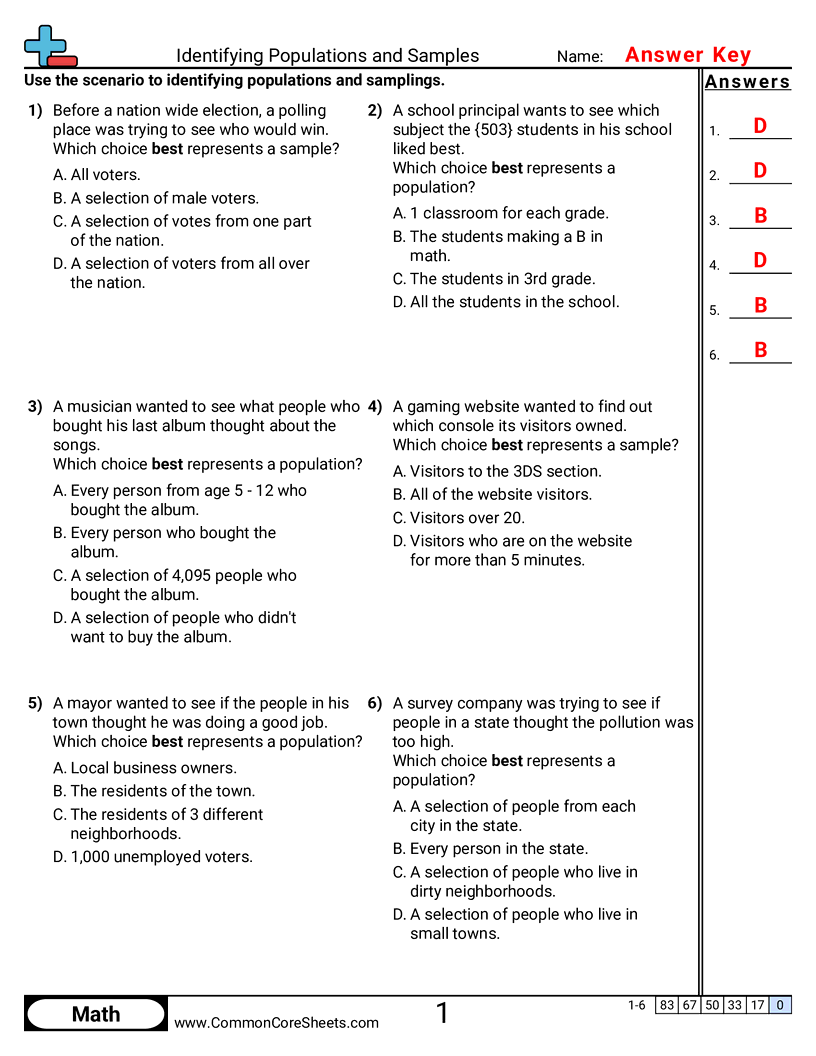
"This worksheet is designed to enhance children's understanding of the mathematical concepts of populations and samples. It includes 6 distinct problem scenarios in contexts like politics, market research, and environmental studies, each with multiple-choice answers. Adaptable for a variety of learning formats, this resource can be customized, converted into flashcards, or utilized in distance learning environments."
×Student Goals: Statistical UnderstandingAfter completing this worksheet, students should have an improved grasp of basic statistics- specifically regarding the concepts of populations and samples. This understanding will assist them in making informed decisions about suitable samples and populations in various contexts, enabling them to accurately interpret and critique survey and polling data in real-life situations.Improved Problem-solvingThe worksheet's problems are designed to engage the student's problem-solving skills. They will be able to evaluate different scenarios, identify relevant data, and choose the appropriate statistical group (population or sample). This will not only reinforce their mathematical critical thinking abilities, but it will also enhance their overall problem-solving capabilities, which are an essential part of quantitative reasoning.Analytical ThinkingAs students navigate through the problems, they will be exercising their analytical thinking skills. They'll learn to differentiate between complete (population) and selected subsets (samples) based on certain criteria in scenarios varying from politics, customer service, environmental concerns, and entertainment. This type of analysis lays the foundation for higher-level statistical studies and data interpretation skills.Practical ApplicationThe real-world problems included in this worksheet are centered around situations commonly encountered in daily life- opinion polls, customer reviews, environmental surveys, and gaming preferences. Students will learn to not just understand these concepts theoretically, but to also apply this knowledge practically. This will aid them in making sense of the world around them, from understanding election polls to interpreting customer feedback in business scenarios.Foundation for Advanced StudiesCompleting this worksheet paves the way for more advanced studies in statistics and related fields. With the solid foundation in understanding populations and samples, students will be well-equipped to deal with complex topics such as data collection methods, distribution, inferential statistics, hypothesis testing, correlations, and regression.