Expressions & Equations Understand the connections between proportional relationships, lines, and linear equations.5Graph proportional relationships, interpreting the unit rate as the slope of the graph. Compare two different proportional relationships represented in different ways. For example, compare a distance-time graph to a distance-time equation to determine which of two moving objects has greater speed.
Comparing Approximate Measurement with Charts and Tables
8ee5Open FolderOpen File×Description:
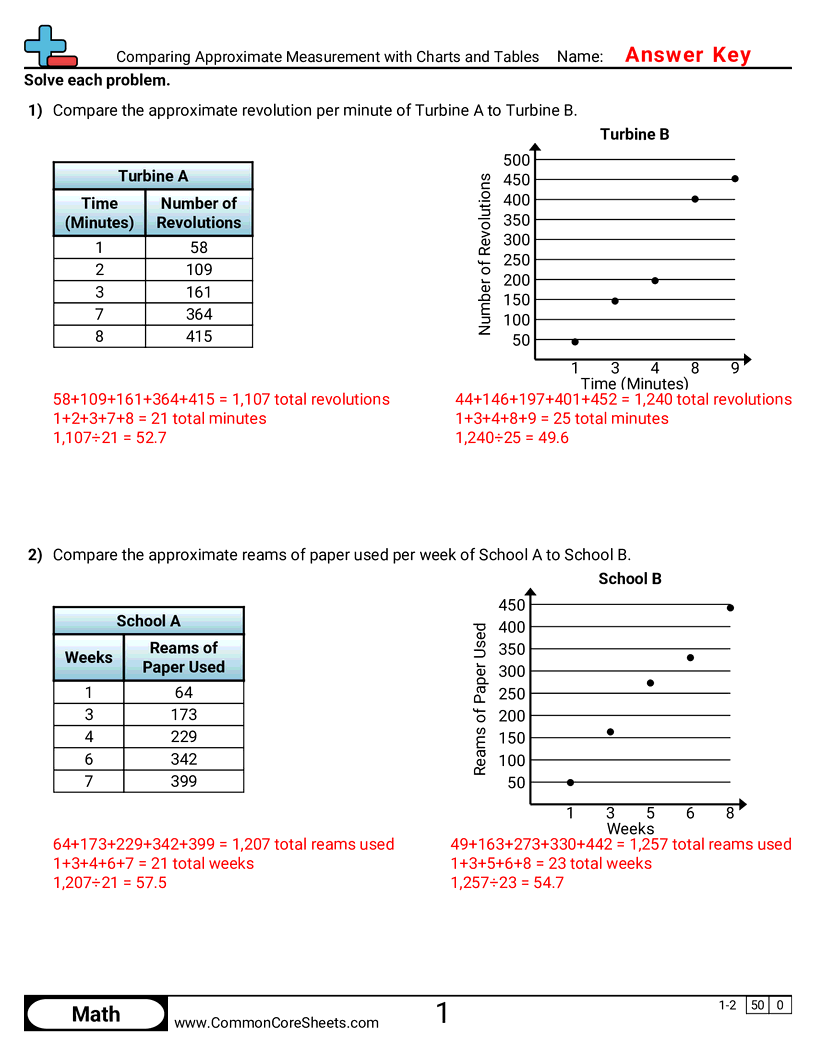
"This worksheet is designed to enhance children's math skills, specifically in comparing approximate measurements using charts and tables. It presents problems related to real-world situations such as comparing paper usage in schools and boat speeds. The interactive worksheet can be customized according to individual learning needs, converted into flash cards, or utilized as an effective tool for distance learning. It's a perfect tool for promoting the practical application of mathematical concepts."
×Student Goals: Understanding of Approximate MeasurementsStudents should have a clear grasp of how to interpret and compare approximate measurements. They should be confident in using charts and tables to understand data before making comparisons. They should also be able to comprehend what approximate measurements are and how they are used in various real-world scenarios, such as calculating the revolutions per minute of turbines or the liters of juice that can be produced from a certain number of orange crates. This will foster their quantitative reasoning skills as well as their ability to apply such reasoning in diverse contexts.Mathematical Computation SkillsUpon completing the worksheet, students should demonstrate improved skills in the realm of mathematical computations, particularly with respect to operations involving addition and division. They should be adept at summing series of numbers and calculating averages which are fundamental aspects of the problems in the worksheet. These vital arithmetic skills are applicable in a plethora of academic and real-world situations, bolstering their overall mathematical competency.Problem Solving and Analytical SkillsStudents should have honed their problem-solving and analytical skills after working through the problems on this worksheet. They should show the ability to decipher the problem, assimilate the information given, perform necessary calculations, and draw accurate comparisons. This would not only improve their adeptness at tackling complex mathematical problems but also enhance their analytical thinking and decision-making skills in broader contexts.Data Interpretation and Comparison SkillsAfter completion of the worksheet, students should be proficient at interpreting and comparing data from charts and tables. They should be able to extract important information from such sources of data, manipulate it to make meaningful computations and ultimately, draw valid conclusions or comparisons from their findings. This would lead to better comprehension of data and its uses in various aspects of life and studies.Conceptual Understanding and ApplicationLastly, students should gain a depth of conceptual understanding that goes beyond simply performing computations. They should understand why they are performing certain operations and how these operations relate to the real-world scenarios being explored in the problems. Furthermore, they should be able to take these concepts and apply them to new, unfamiliar problems, demonstrating a firm and flexible grasp of the subject matter.
8ee5Open FolderOpen File×Description:
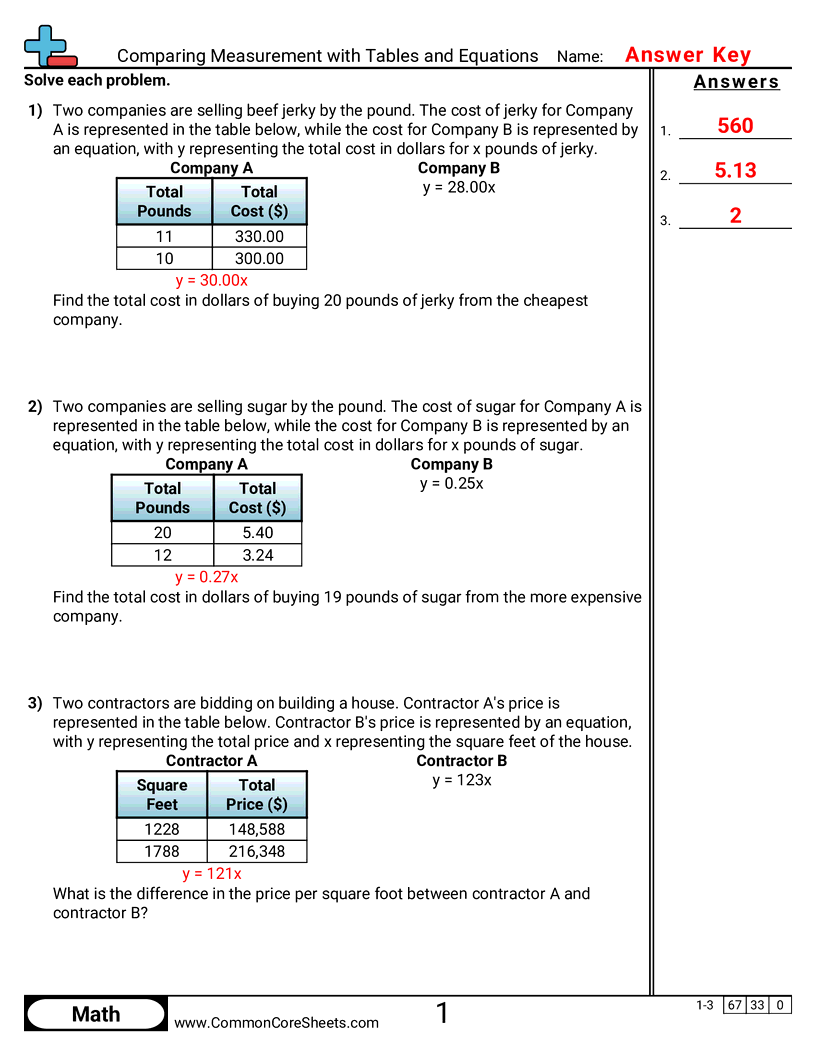
"This worksheet is designed to help children grasp the mathematical concept of comparing measurements through tables and equations. Focusing on practical life scenarios, it includes problems on comparing contractors' prices, electricity costs, and sugar prices. Suitable for distance learning, it is customizable and can be converted into interactive flashcards, providing an engaging and adaptable learning tool."
×Student Goals: Understanding and Applying Mathematical ConceptsUpon completion of the Comparing Measurement with Tables and Equations worksheet, students would have deepened their understanding of mathematical concepts. They should be able to identify and use tables and equations in real-world scenarios. They should also fully understand how to derive and equate different values for practical purposes.Problem Solving and Critical ThinkingThe worksheet is designed in such a way that students will develop and sharpen their problem-solving skills. They will be challenged to analyze the problems presented and figure out the right solutions. It means they should be able to deduce the less expensive option between two given alternatives. This reinforces their economic understanding and decision-making ability.Use of Algebra in Practical SituationsStudents should be able to understand and apply the method of writing equations in various situations as outlined in the worksheet problems. They should acknowledge that algebra is simply not an abstract concept, but a useful tool indicating relationships and values in real-life situations.Mathematical Reasoning CapabilityThe problems solved will boost students' mathematical reasoning capabilities. They will be able to break down complex scenarios into simpler equations or tables and then use them to reason and determine the best outcomes.Comparison SkillsThis worksheet boosts students' comparison skills. They should be able to analyze two different junk yards, beef jerky companies, or contractors using the given equations and tables. This will subsequently enhance their decision-making abilities and help them choose the most beneficial or cost-effective option.Application of Mathematics in Daily LifeStudents will recognize the application of mathematics in day-to-day tasks. Through solving problems related to junk yards, food shopping, and contractor hiring, they would realize how mathematics directly impacts their daily lives and decisions.
8ee5Open FolderOpen File×Description:
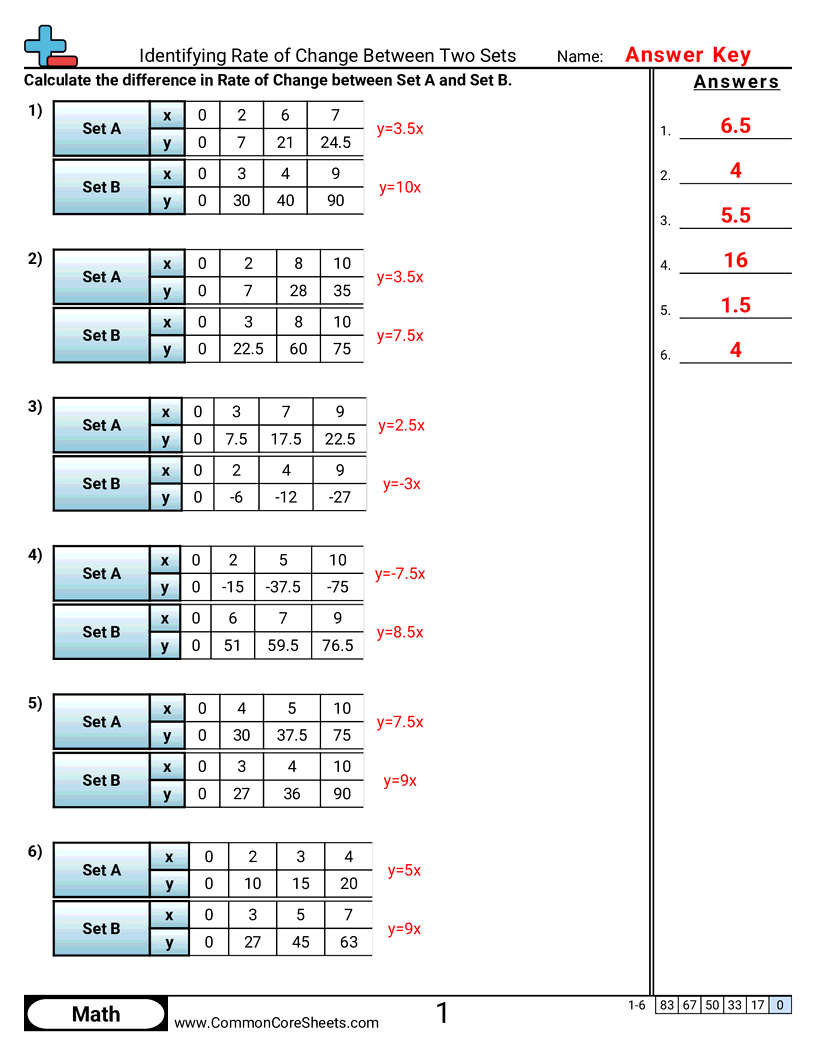
"This worksheet is designed to reinforce a child's understanding of the mathematical concept of rate of change between two sets. Through six problems, learners are challenged to analyze varying x and y values to identify the rate of change. Adaptable to individual needs, the content can be customized, used as flash cards for more interactive learning, or incorporated into distance learning modules, adding versatility to its utility in enhancing math competencies."
×Student Goals: Understanding of Rates of ChangeAfter completing this worksheet, students should exhibit a robust understanding of the concept of rates of change in mathematics. They should be able to correctly identify the rate of change between two sets of data points and grasp how changes in one variable affect another. This concept builds a foundational knowledge of the interplay between variables, which is crucial in math and in real-world scenarios where dependency relationships exist.Application of Mathematical FunctionsPost worksheet completion, students are expected to adeptly apply mathematical functions to given sets of data points. They must be able to calculate the resultant output correctly when the function rule, such as 'y=5x' or 'y=-7.5x', is applied to the input data. This proficiency in carrying out mathematical operations is fundamental to further learning in complex algebra and calculus.Practical Understanding of Negative and Positive RatesChildren are anticipated to gain a practical understanding of how negative and positive rates affect the relationship between two quantities. Furthermore, they should be able to distinguish between situations where quantities increase or decrease in relation to each other, basing their findings on whether the rate of change is positive or negative. This knowledge is pivotal in many real-world teachings like physics, economics, and other natural sciences.Skill Enhancement in Problem-SolvingBy troubleshooting the problems presented in this worksheet, students will be honing their problem-solving skills. They will have a successful method for confronting a mathematical challenge, building a strategy to solve it, and carrying out that strategy to the end. This is a critical skill that can be employed across several areas of life and study, not only in mathematics.Analytical Reasoning AbilitiesLastly, this worksheet is designed to improve the students' analytical reasoning capabilities. They should be able to analyze numerical patterns and relationships between different data sets by the end of it. Proficiency in recognizing and interpreting patterns is key to understanding more significant mathematical concepts and contributes greatly to logical thinking and reasoning in various fields.