The Number System Know that there are numbers that are not rational, and approximate them by rational numbers.1Know that numbers that are not rational are called irrational. Understand informally that every number has a decimal expansion; for rational numbers show that the decimal expansion repeats eventually, and convert a decimal expansion which repeats eventually into a rational number.
8ns1Open FolderOpen File×Description:
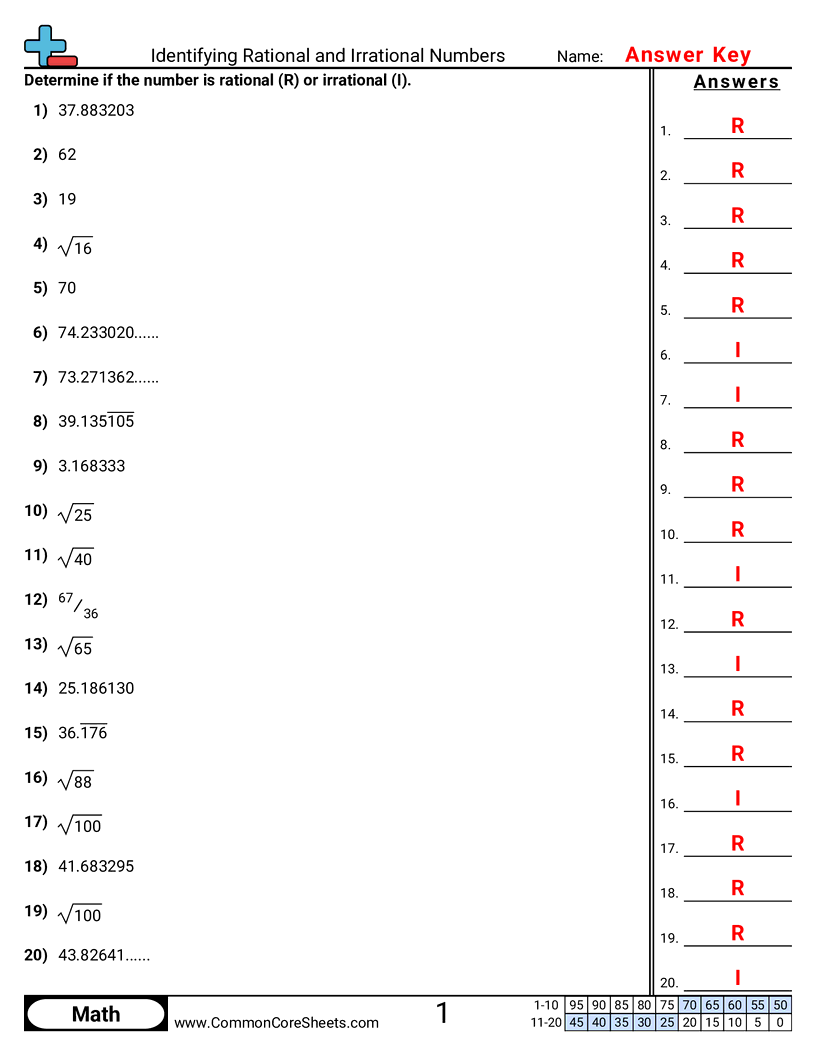
"This worksheet is designed to engage children in math by examining the intriguing subject of identifying rational and irrational numbers. Featuring 20 progressively challenging problems, kids can decipher patterns in sequences like squared decimals or fraction bars. Perfect for remote learning, the content can be customized and converted to flashcards for enhanced learning experiences. This worksheet caters to diverse learning styles, reinforcing the abstract concepts of number types in mathematics."
×Student Goals: Develop Number Classification SkillsUpon completion of the worksheet, students should possess a firm understanding of the key differences between rational and irrational numbers. They should be able to quickly identify and classify these numbers, therefore building a solid foundation for more complex math concepts down the line. This skill is not only essential in terms of advancing in math education but also enhances logical thinking and categorization skills, important tools for various dimensions of day-to-day life.Enhance Problem-solving AbilitiesCompleting this worksheet should enhance students' problem-solving abilities as they exercise their minds to differentiate between rational and irrational numbers. They would be refining their analytical thinking skills while identifying patterns and making calculated guesses. These skills are pivotal in all aspects of life, from making strategic decisions to thinking critically about different challenges.Boost Confidence in Mathematical ConceptsThis worksheet is designed to boost students' confidence when dealing with numbers in general and more specifically rational and irrational numbers. The more they practice identifying these numbers, the more comfortable they'll become at handling them. This increase in mathematical confidence can lead to better performance in classroom activities, tests, and further educational pursuits.Improve Precision and AccuracyThrough working on this worksheet, students should be able to enhance their precision and accuracy when dealing with numbers. This skill extends beyond mathematics, being applicable in science, technology, and even daily life situations where precision is needed. It encourages them to pay attention to every detail and meticulously examine each problem before judging it.Strengthen Mathematical VocabularyFinally, successfully identifying rational and irrational numbers will inherently improve the students' mathematical vocabulary. They will be more versed with mathematical jargon, which is key in understanding and communicating mathematical concepts effectively. Better mathematical communication leads to better comprehension and higher learning efficacy in the subject overall.
8ns1Open FolderOpen File×Description:
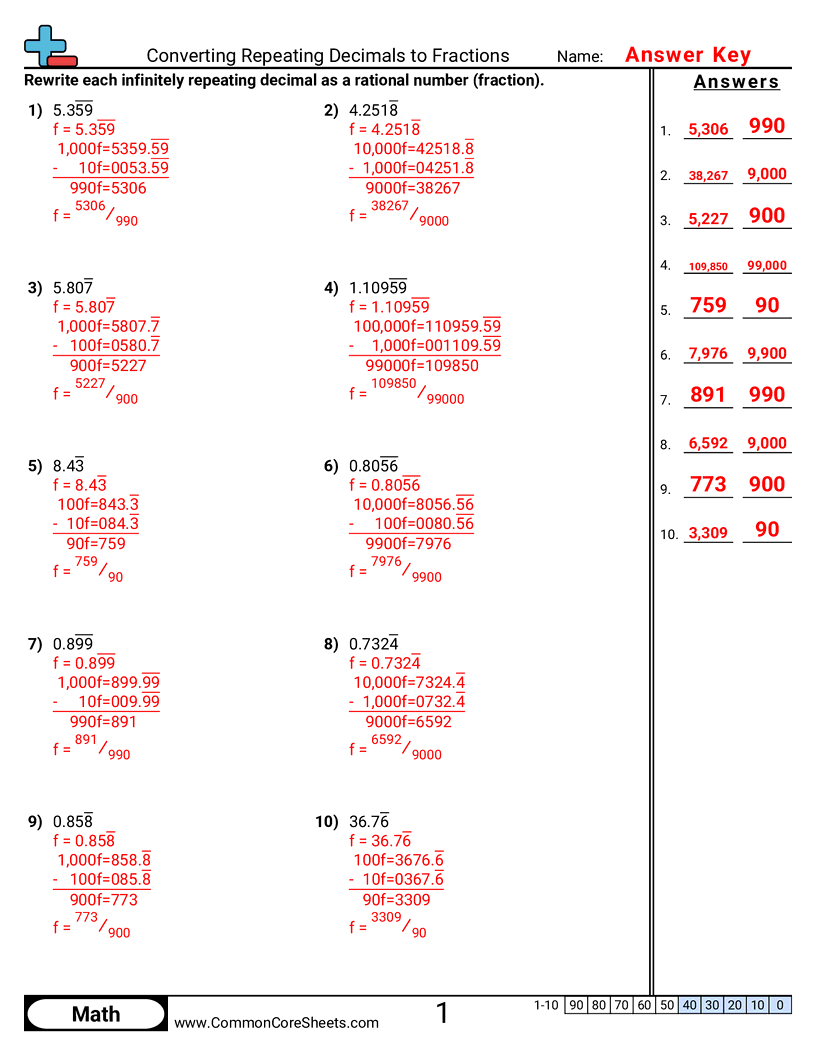
"This worksheet is designed to enhance children's math skills specifically in converting repeating decimals to fractions. With ten clearly outlined problems, children can dive into the concept of repeating decimals with examples like 3.83, 43.26, and 0.6319. This customizable learning tool accommodates various teaching methods, making it perfect for flashcards or distance learning modalities. It combines the power of visual aids and hands-on exercises for an engaging learning experience."
×Student Goals: Understanding ConceptsAfter completing the worksheet, students should gain a comprehensive understanding of the concept of converting repeating decimals to fractions. They should be able to recognize and differentiate repeating decimals and use the appropriate steps to convert them into fractions.Problem Solving SkillsThe completion of the worksheet should enhance the students’ problem-solving skills. They should be able to apply mathematical methods proficiently in solving the problems. This experience could help promote their confidence in handling similar problems in the future.Mathematical FluencyBy solving the problems provided in the worksheet, students should improve their mathematical fluency. They will actively practice and apply the learnt concept, which will assist in solidifying their skills and knowledge in math, particularly in the topic of fractions and decimals.Critical ThinkingThis worksheet should help improve the students’ critical thinking abilities. In solving the problems, they will need to think analytically and strategically. They will also learn how to approach problems from different angles, further enhancing their critical thinking skills.Application of KnowledgeUpon completion of the worksheet, students should be in a position to apply the knowledge gained in real-world situations. Understanding decimals and fractions is essential in many everyday contexts, such as shopping and time keeping. This worksheet provides a foundation for such application of knowledge.Independence in LearningWorking through this worksheet should help students develop independence in their learning process. The ability to decipher the problems and find solutions by themselves will likely improve their confidence and autonomy in learning not just math, but other subjects as well.