Numbers & Operations (N)5.N.1 Read, write, represent, and compare fractions and decimals; recognize and write equivalent fractions; convert between fractions and decimals; use fractions and decimals in real-world and mathematical situations.5.N.1.4Recognize and generate equivalent terminating decimals, fractions, mixed numbers, and fractions in various models.
Finding Decimals on Number Line (10ths and 100ths)
4nf6Open FolderOpen File×Description:
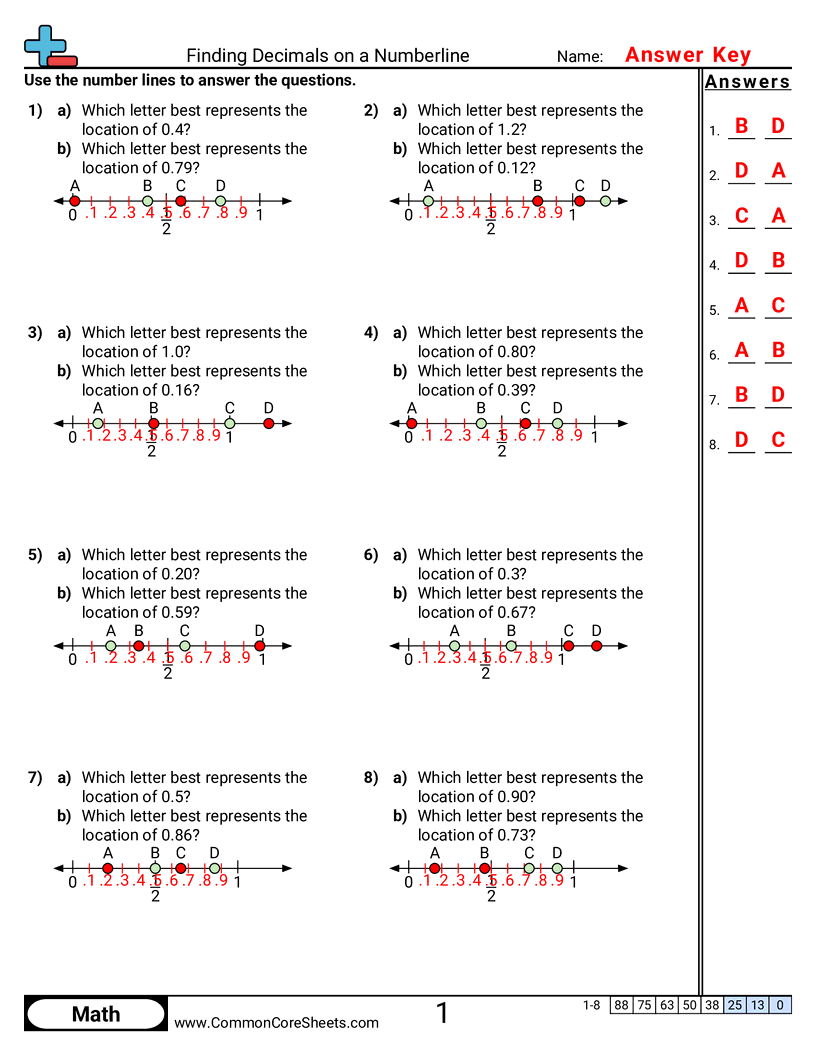
"This worksheet is designed to aid children in understanding decimals and their proper placement on a numberline. It presents the concept across eight dynamic problems with visual assistance. Students are guided to identify the location of specific decimal points, enhancing their grasp on numerical concepts. The worksheet is adaptable and can be personalized to match varying learning paces. Its interactive format also allows for transformation into flashcards or integration into a distance learning curriculum, making it a valuable tool for diverse mathematical learning settings."
×Student Goals: Understanding of Decimal NumbersUpon completing the worksheet, the students will have a firm grasp of the concept of decimal numbers. They will understand that decimals represent fractions or percentages and fall between whole numbers on the number line. This knowledge helps in mathematical modeling and computation in various aspects of day-to-day life.Number Line ProficiencyStudents will gain competence in using a number line, a critical mathematical tool, primarily for understanding decimals. They will be able to utilize the number line for decoding the relative position of decimal numbers, thereby enhancing their number sense. This skill, apart from reinforcing their decimal competency, will boost their overall arithmetic skills.Problem Solving CapabilityThis worksheet encourages students to apply their theoretical understanding of decimals practically. By determining the position of given decimals on the number line, students reinforce their problem-solving skills. They also learn to visualize mathematics, which helps in simplifying complex problems.Critical Thinking and Analytical SkillsThe task of identifying locations of decimal numbers on a number line promotes critical thinking and analytical skills. Students will learn to analyze the properties of decimal numbers, break down larger problems into smaller components and approach mathematical challenges methodically.Precision and AccuracyPrecision is crucial when dealing with decimal numbers. By pinpointing decimals on a number line, students practice their ability to work with accuracy. This skill is not only vital for mathematics but also applicable to various other subjects and real-world scenarios where precision is required.Advanced Mathematical ConceptsThe understanding of decimals and their locations on the number line lays the groundwork for more advanced mathematical concepts such as algebra and calculus. Students can move on to learn negative numbers, complex equations, and functions with a strong understanding of decimals.Confidence in MathematicsAs they master decimal numbers, a foundational aspect of mathematics, students become more confident in their mathematical abilities. This confidence propels them to explore more challenging mathematical problems and concepts, thereby fostering a broader interest in the subject.
4nf6Open FolderOpen File×Description:
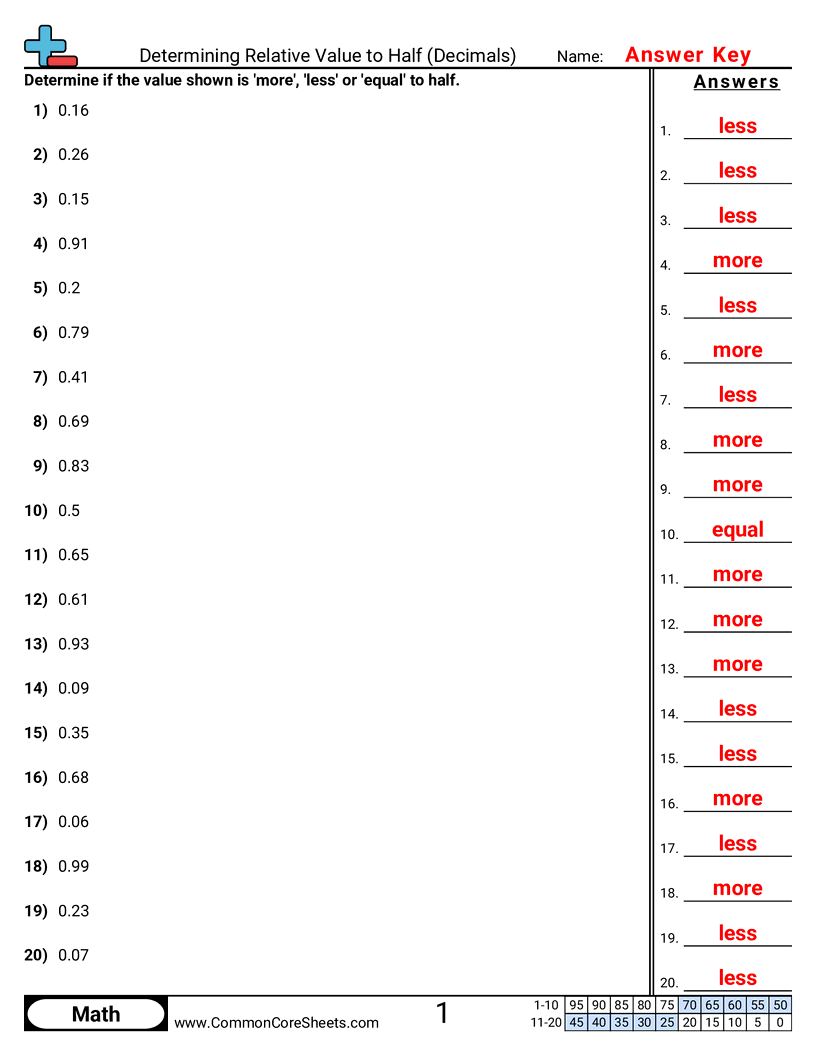
This worksheet is designed to help children understand and determine the relative value of decimals up to the half. It offers 20 math problems, using examples like 0.76, 0.47, and 0.97 for practice. Perfect for distance learning, the worksheet is customizable to suit individual learning needs and can be converted into flashcards for interactive learning.
×Student Goals: Understanding of Decimal NumbersAfter completing this worksheet, students should have an enhanced understanding of decimal numbers. They should be able to effortlessly identify and distinguish decimal numbers and be able to relate these numbers to their respective fractional halves.Improvement in Mathematical SkillsThe consistent practice provided by this math worksheet should help to improve students' overall mathematical abilities. By determining the relative value to half, students will enhance their comparison skills, recognizing larger and smaller values, which are fundamental in understanding mathematical operations and equations.Critical Thinking and Problem SolvingWorking through this worksheet aids in enhancing critical thinking and problem-solving skills, as they’ll need to work out the relative value to half, which encourages cognitive development. This strengthens their ability on how to approach and solve mathematical problems.Ability to Apply Concept in Real LifeAfter completing the worksheet, students should be able to apply the gained knowledge in real-life context. Understanding and working with decimal numbers frequently occur in daily activities such as dealing with money or understanding measurements. Students should be able to relate this demonstrated mathematical skill in real-life situations.Boosted ConfidenceAchieving accurate answers for each problem will instill a sense of accomplishment and therefore improve a student's self-confidence in tackling such math problems. This confidence can encourage students to tackle more complex mathematical challenges, thus fostering a positive attitude towards learning.Preparation for Advanced MathMoreover, this exercise will provide a solid foundation for advanced mathematical studies. By acquainting them with decimal numbers and the process of determining relative value to half, students are prepared for tackling topics of advanced math involving fractions, decimals, ratios, and percentages effectively.
4nf6Open FolderOpen File×Description:
"This worksheet is designed to reinforce children's understanding of comparing fractions. With a series of 20 customisable problems, it provides interactive numeric exercises to identify which fraction is greater or lesser. Ideal for distance learning, this dynamic tool can also be converted into flash cards, proving invaluable for mastering the vital math skill of fraction comparison."
×Student Goals: Understanding of FractionsAfter completing this worksheet, students should have a firm understanding of fractions. They will be able to identify numbers represented as fractions and interpret the value represented by each fraction. This is crucial because understanding of fractions is foundational in many mathematical and real-world contexts.Comparative SkillsStudents will develop their comparative skills by determining the relative value of two fractions. They will be adept at telling if a fraction is greater, less, or equal to another, aiding in decision making, problem-solving and cognitive development.Fraction NormalizationStudents will be able to normalize fractions to ensure they are in their simplest form. This will enhance students' fractions comprehension and provides a solid basis for advancing to more complex fraction problems.Mathematical ConfidenceAfter successfully completing the worksheet, students should be more confident in their mathematical abilities. Having gained some proficiency in one of the core concepts in mathematics, they would perceive math problems not as challenges but rather situations they can handle.Practical Mathematical ApplicationIt instills in students the realization that math can be applied practically to solve real-world problems. Comparing fractions is an essential skill in many situations including cooking, construction, and financial management.Numerical FluencyBy consistently practicing and resolving the problems, pupils will enhance their numerical fluency, or the ability to manipulate numbers and mathematical expressions comfortably. Increased numerical fluency leads to better comprehension of more advanced mathematical concepts.Enhancement of Cognitive AbilitiesThe process of comparing fractions requires a high level of cognitive function, including analysis and critical thinking. By working through the problems on this worksheet, students will enhance their cognitive abilities, which have widespread benefits across many aspects of life.
4nf6Open FolderOpen File×Description:
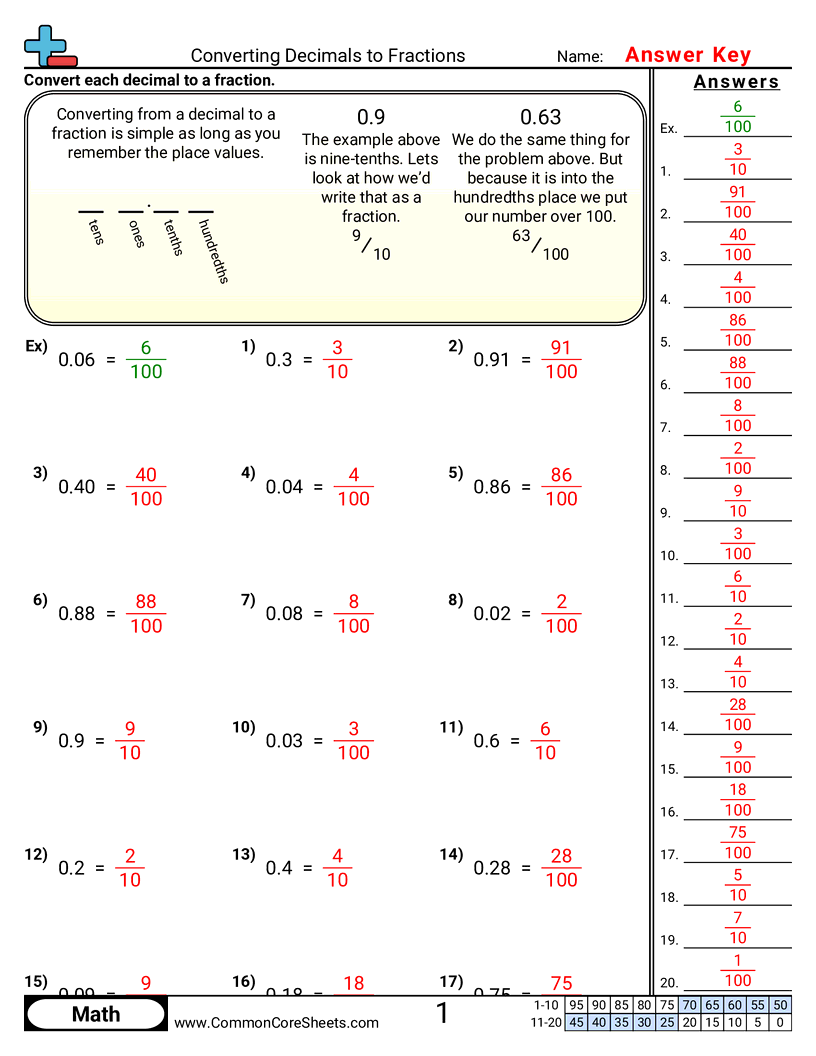
"This worksheet is designed to instruct students on the subject of mathematics, specifically converting decimals to fractions. With 20 problems that visualize decimal values equaling to fractions, it provides engaging examples and practical exercises. Flexible for any learning environment, this worksheet is customizable, can be effortlessly converted into flash cards, and is suitable for distance learning, making it an adaptable educational resource."
×Student Goals: Understanding of Decimals and FractionsAfter completing the worksheet, students will have a firm understanding of decimals and their corresponding fractions. They should grasp the important concept that fractions and decimals are just two different ways of expressing the same value. This understanding provides a strong foundation for more advanced mathematical concepts.Conversion SkillsThe completion of the worksheet will equip learners with the necessary skills to convert decimals into fractions effortlessly. They will understand the systematic process involved in transforming a decimal into both its reduced and non-reduced fraction forms. This skill is central to many aspects of mathematics and is crucial for subsequent learning stages.Enhanced Problem-Solving AbilitiesWorking through the problems on this worksheet requires logical reasoning and problem-solving skills. The students will be better at diagnosing the problem, understanding the steps it takes to solve it, and applying this approach to different, yet similar problems. These enhanced abilities extend well beyond mathematics and are beneficial to all other subjects.Confidence in MathematicsSuccessfully converting decimals to fractions can boost the confidence of the learners. Building assurance in their mathematical abilities will encourage them to tackle more challenging problems without fear of failure. This confidence is pivotal in stimulating a positive attitude towards mathematics and other numeracy-based subjects.Preparation for Advanced MaterialThe ability to convert decimals to fractions is important in higher mathematical contexts such as algebra, geometry, and calculus. By honing these skills now, students will be better prepared to manage future mathematical coursework. This worksheet sets the groundwork for these critical, more advanced mathematical concepts.Real-World ApplicationThe ability to convert decimals to fractions has many practical, real-world applications, including but not limited to understanding scientific data, making accurate financial decisions, or even dividing recipes in cooking. By mastering this skill, students will be able to handle numbers in various real-life situations more efficiently.
4nf6Open FolderOpen File×Description:
"This worksheet is designed to enhance children's understanding of the correlation between fractions, decimals, and percentages using clear visual aids. It offers 11 unique problems, enabling students to apply their learned concepts practically. Educators can customize this versatile resource, creating flashcards for a more interactive experience or integrating it into distance learning curricula. This focused approach aids in building a solid foundation for more complex mathematical concepts."
×Student Goals: Understanding of Basic Mathematical RepresentationStudents should demonstrate a solid grasp of basic mathematical representation by successfully completing each problem in the worksheet. This includes understanding fractions, decimals, and percentages, and their relations. They should be able to confidently convert fractions to decimals and percentages, and vice versa, thus displaying proficiency in manipulating different mathematical forms.Mathematical Literacy DevelopmentBy the completion of the worksheet, students should have improved their mathematical literacy. They're set to have deepened their understanding of mathematical concepts and terminology, especially those pertaining to fractions, decimals, and percentages. A boosted level of mathematical literacy will make them better at quickly recognizing and processing mathematical patterns, which is a key skill that will benefit them in future advanced mathematical endeavors.Analytical Skills EnhancementAfter engaging with the worksheet, students are expected to have enhanced their analytical skills. By navigating from fractions to decimals to percentages, and correlating their common value, students will have strengthened their analytical thinking. This is a critical skill not just in mathematics but in problem-solving in other academic spheres and real-life situations. It helps develop an independent thinking process that is essential to make them successful learners.Comprehension of Practical ApplicationsUpon completion, students are projected to appreciate the practical applications of what they have learnt. Fractions, decimals, and percentages are not just theoretical mathematical concepts; they come to life in many everyday scenarios. Whether it's managing personal finances, planning baking recipes, or analyzing sports statistics, these concepts are widely used. Understanding them can thus empower students to navigate their everyday life more effectively.Confidence in Mathematical AbilitiesFinally, students should gain enhanced confidence in their mathematical abilities. Successfully solving these exercises will give them a strong sense of achievement and boost their academic confidence. This belief in their own capabilities will motivate them to approach more challenging mathematical problems in the future with less fear and more determination. In learning, confidence is key, and through mastering this worksheet, students are setting up a positive foundation for all future learning.
4nf1Open FolderOpen File×Description:
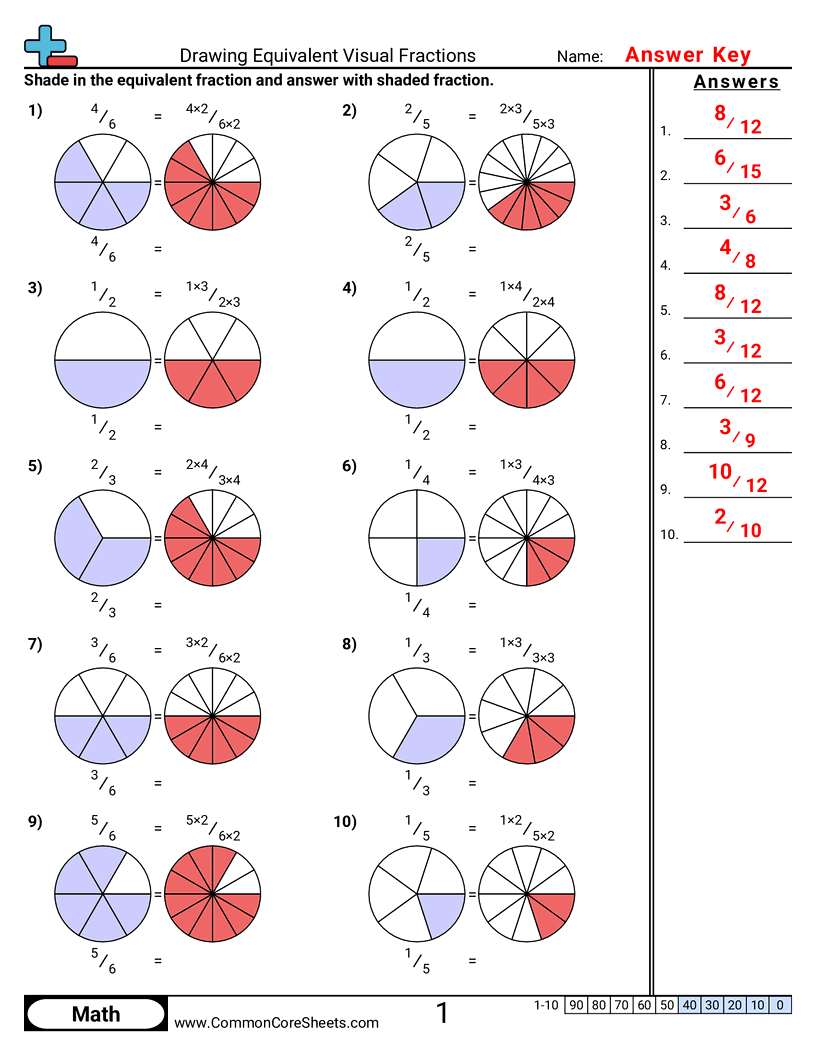
"This worksheet is designed to teach children fundamental math concepts, focusing specifically on visualizing equivalent fractions. The customizable, child-friendly format includes 10 unique problems, each creatively illustrated to enhance understanding. The worksheet's dynamic nature allows it to be easily converted into flashcards for versatile learning, or used effectively for distance learning. It is an innovative tool for making fractions easy and fun for kids to learn."
×Student Goals: Understanding of Equivalent FractionsAfter completing the worksheet, students should have a strong, foundational understanding of equivalent fractions. This fundamental math concept is integral to grasping more complex mathematical ideas down the road. The completed worksheet should provide tangible proof of their ability to interpret and manipulate fractions, proving they understand that different fractions can represent the same value.Mastery of Fraction MultiplicationThe worksheet is designed to test and reinforce a student's ability to multiply fractions. Upon completion, students should be comfortable with multiplying fractions, both in terms of the mathematical mechanics and understanding the implications of the operation. They should be able to multiply any given fractions, reducing them to their simplest form when necessary.Visual Representation of FractionsThe exercises included in the worksheet will also require students to draw visual representations of the fractions they're working on. Completing these problems should result in the student's ability to visualize fractions, which is extremely valuable in breaking down more complex problems. The visualization skill also makes it easier for students to understand and remember the concepts.Problem Solving and Critical ThinkingWorking through the equivalent fractions worksheet requires logical thinking and the application of problem-solving skills. Upon finishing the worksheet, students should have more confidence in their ability to approach math problems critically and strategically. This boosts their overall mathematical reasoning skills and prepares them for tackling diverse problems in the future.Mathematical Vocabulary ExpansionThis worksheet involves exposure to, and use of, specific mathematical vocabulary. As students solve the problems, they will need to use correct mathematical language, terms, and symbols. Therefore, upon completion, they should have broadened their mathematical lexicon, which is essential for eventual mathematical literacy.
4nf1Open FolderOpen File×Description:
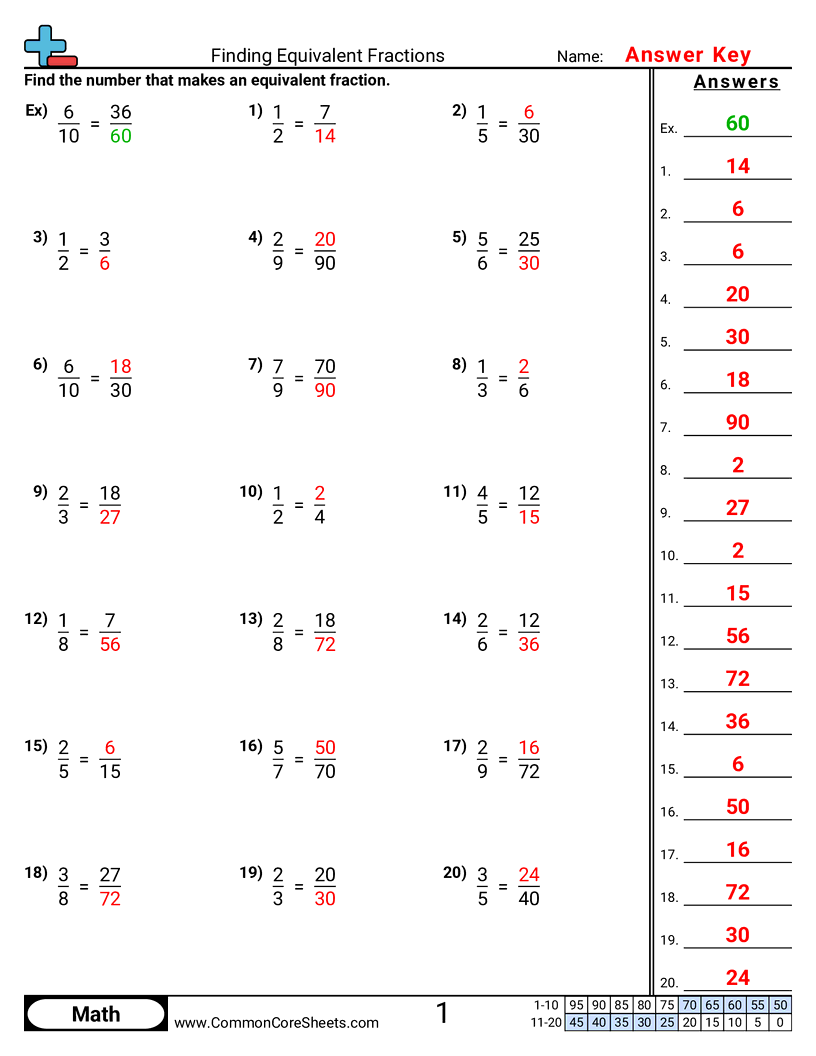
"This worksheet is designed to help children grasp the concept of equivalent fractions in math. It features 20 interactive problems, with examples such as 1/6 equals 2/12, 7/9 equals 28/36, and 3/6 equals 30/60. Perfect for distance learning, the worksheet can be customized for individual needs and even converted into flashcards to further facilitate understanding. Enhance your child's math skills through this engaging and adaptable tool."
×Student Goals: Understanding Equivalent FractionsAfter completing this worksheet, students should have a strong understanding of equivalent fractions. This fundamental concept in mathematics is critical as it underpins many more complex areas of study within the subject. By practicing to find equivalent fractions, students improve their problem-solving abilities and enhance their mathematical reasoning.Enhancing Calculation SkillsWorking through the worksheet will also help students to refine their calculation skills, especially their division and multiplication abilities. By repeatedly identifying equivalent fractions, students will become more fluent and confident in performing these calculations, helping them to improve their overall math competency.Improving Number SenseThe worksheet encourages the development of a strong number sense, which is the understanding of what numbers mean and their relationship to one another. By finding equivalent fractions, students will actively explore the relationships between numbers, leading to a deeper comprehension of mathematics.Developing Pattern RecognitionAs students work through the problems in the worksheet, they will also have opportunities to recognize and predict patterns. This is an important mathematical skill that will support them in diverse areas of study, such as algebra and geometry.Applying Mathematical ConceptsAt the completion of the worksheet, students will not only have bolstered their understanding of equivalent fractions but will also have enhanced their ability to apply this knowledge. Whether solving more complex mathematical problems or using these skills in real-world situations, they will be equipped with a crucial knowledge base, helping them excel in future learning endeavors.Building ConfidenceFinally, with each problem they successfully solve, students are building their confidence in solving mathematical problems. Overcoming challenges faced in this worksheet can foster perseverance and resilience, which are beneficial not just for math but for every aspect of their learning journey.
4nf1Open FolderOpen File×Description:
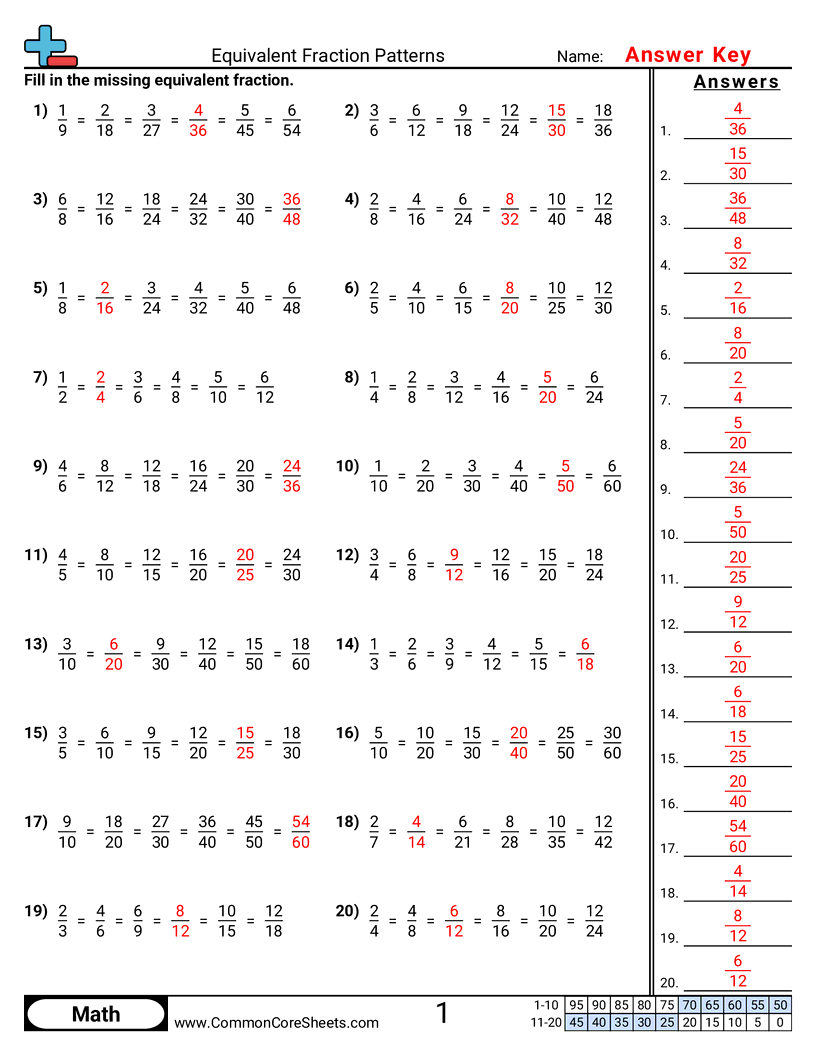
"This worksheet is designed to teach children about equivalent fractions through pattern recognition in math. It features 20 unique problems, where fraction equivalencies are visually represented in table format. The interactive nature of the content allows for customization, including the capacity to convert the worksheet into flash cards. This feature extends its usability, making it an excellent tool for distance learning and homeschooling environments."
×Student Goals: Understand Equivalent FractionsWith successful completion of this worksheet, students should develop a solid understanding of equivalent fractions. They should be able to recognize that different fractions can represent the same part of a whole, enhancing their numerical flexibility. This forms the basis for strong mathematical reasoning, feeding into other areas of number theory and arithmetic.Develop Problem-Solving SkillsThese carefully designed fraction problems should help students strengthen their problem-solving skills. By unraveling patterns and deducing the correct numerical value for each equivalent fraction, students exercise both inductive and deductive reasoning, preparing them for advanced math hurdles. This process refines their decision-making skills, teaching them to strategize and choose the most efficient route to a solution.Enhance Mental ArithmeticBeing repeatedly exposed to and working on these fraction problems will enhance students' mental arithmetic. They will be more comfortable and quicker at processing numbers mentally, which will be fruitful not just in mathematics, but across all subjects and day-to-day applications, increasing their number sense.Grasp Number PropertiesCompletion of this worksheet should aid students in grasping the properties of numbers, and how they interact in the context of fractions. They will have gained an understanding of the important mathematical concepts of ratio and proportion, thus extending their knowledge of numbers and paving the way for future mathematical learning.Application to Real-life SituationsThe learning attained from this worksheet extends beyond the classroom. It enables students to apply their knowledge to real-life situations. As fractions are ubiquitous in daily life scenarios, for instance, during cooking, shopping or time allocation in daily activities, comprehension of equivalent fractions can enhance practical problem-solving skills, empowering students to make accurate and efficient calculations.Builds a Foundation for Advanced MathUnderstanding fractions and equivalences, a subject matter of this worksheet, represents an essential mathematical concept that underlies more advanced topics. Successful completion will provide a solid foundation for future learning in fractions, decimals, pecentage calculations, algebra and even calculus. This core mathematical competency plays a crucial role in preparing students for advanced mathematical concepts and procedures.
4nf1Open FolderOpen File×Description:
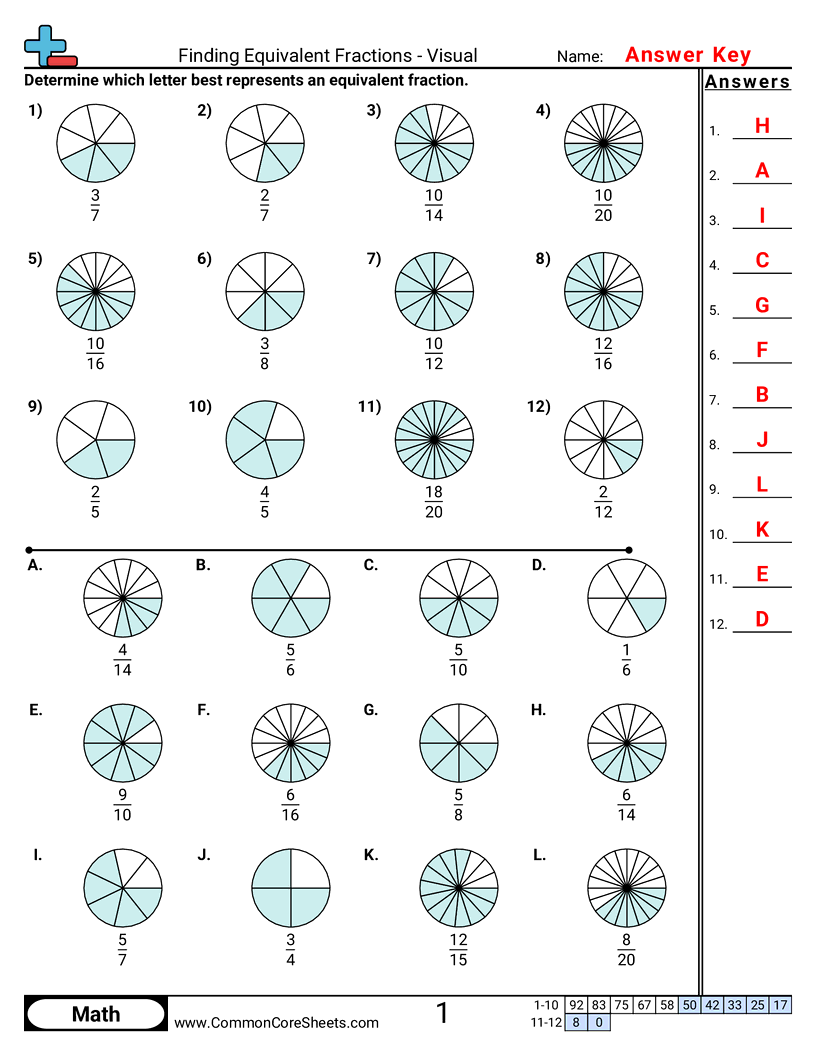
"This worksheet is designed to help children visually understand the concept of equivalent fractions in math. It provides 12 problems using vibrant diagrams to represent fractions and engage the student's interest. The flexible format allows it to be customized according to individual needs, converted into flashcards for easy review, or used in a distance learning setup to provide interactive math learning from home."
×Student Goals: Mastering Equivalent Fractions ConceptAfter successfully completing this worksheet, students should be able to confidently understand and demonstrate their knowledge of equivalent fractions. They will have gained much practice in finding equivalent fractions through visual aids which would significantly improve their skills. This worksheet is designed to aid them in visualizing what equivalent fractions look like, and how different fractions can represent the same value.Developing Problem-Solving AbilitiesSolving the problems presented in this worksheet would require students to engage their problem-solving skills. They will need to evaluate, analyze, and identify equivalent fractions. This worksheet will help enhance their cognitive development, fostering growth in analytical thinking and ability to recognize patterns. Over time, this will enhance the student's proficiency in working with other complex math problems.Boosting Confidence in MathMath can seem daunting to many students. However, having the ability to comfortably work through problems and see improvements serves as a confidence booster. As students find more success in dealing with these fraction problems, their confidence in their math skills is likely to increase. This, in turn, may foster a positive attitude towards learning and mastering other math topics.Application of Learned SkillsAfter completing the worksheet, students should be able to apply the skills they have learned to practical situations. The understanding of equivalent fractions can be used to simplify fractions or compare them. Moreover, they could apply these concepts when dealing with problems involving ratios, proportions, or probability, which they will encounter in more advanced math subjects.Fostering Self-Reliance and IndependenceThis worksheet is designed to promote self-reliance and independence. Students will find that they can work through the problems at their own pace, enhancing their ability to learn independently. This is a crucial lifelong learning skill that is applicable in many aspects of life beyond the classroom.
4nf6Open FolderOpen File×Description:
"This worksheet is designed to aid in understanding the relation between fractions, decimals, and percentages. With 17 problems, it gives children hands-on practice in converting between these equivalent forms of numbers. Highly customizable, the worksheet can be adapted to fit different learners' needs, successfully converted into flashcards, or seamlessly integrated into distance learning curricula, providing an engaging tool to enhance math proficiency."
×Student Goals: Master the concept of equivalent fractions, decimals and percentagesAfter completing this worksheet, students should have a thorough understanding of the concept of equivalency among fractions, decimals, and percentages. They should be able to seamlessly convert a value from one form to another, showing a solid understanding of the integral relationships between these three mathematical representations.Develop computational skillsThis practice will foster students' computational skills, necessary for more advanced mathematical procedures. They would be well-versed with calculations involving the transition from fractions to decimals to percentages and vice-versa, enhancing their ability to calculate quickly and accurately.Promote problem-solving abilityBy working through the problems in this worksheet, students will improve their problem-solving skills. They will learn how to approach and solve complex problems involving fractions, decimals, and percentages. This practice will encourage critical thinking and logical reasoning, fundamental skills that are used in everyday life and other academic subjects.Amplify number senseCompletion of this worksheet will enhance students' number sense. It would promote a deeper understanding of the nature of numbers and their relationships, particularly in the context of fractions, percentages, and decimal values. This translates into improved mathematical intuition and a swift sense for number manipulation.Improve precision and attention to detailHandling fractions, decimals, and percents would help students fine-tune their precision and heighten their attentiveness to detail. As comprehension of these topics demands meticulous calculation and exactness, students will strengthen these qualities through consistent practice.Boost confidence in mathSuccessfully completing this worksheet means not only understanding the relationship between fractions, decimals, and percentages but also being adept at manipulating them. This mastery can result in greater confidence while facing math problems, which can in turn encourage a positive mindset towards learning new mathematical concepts.
4nf6Open FolderOpen File×Description:
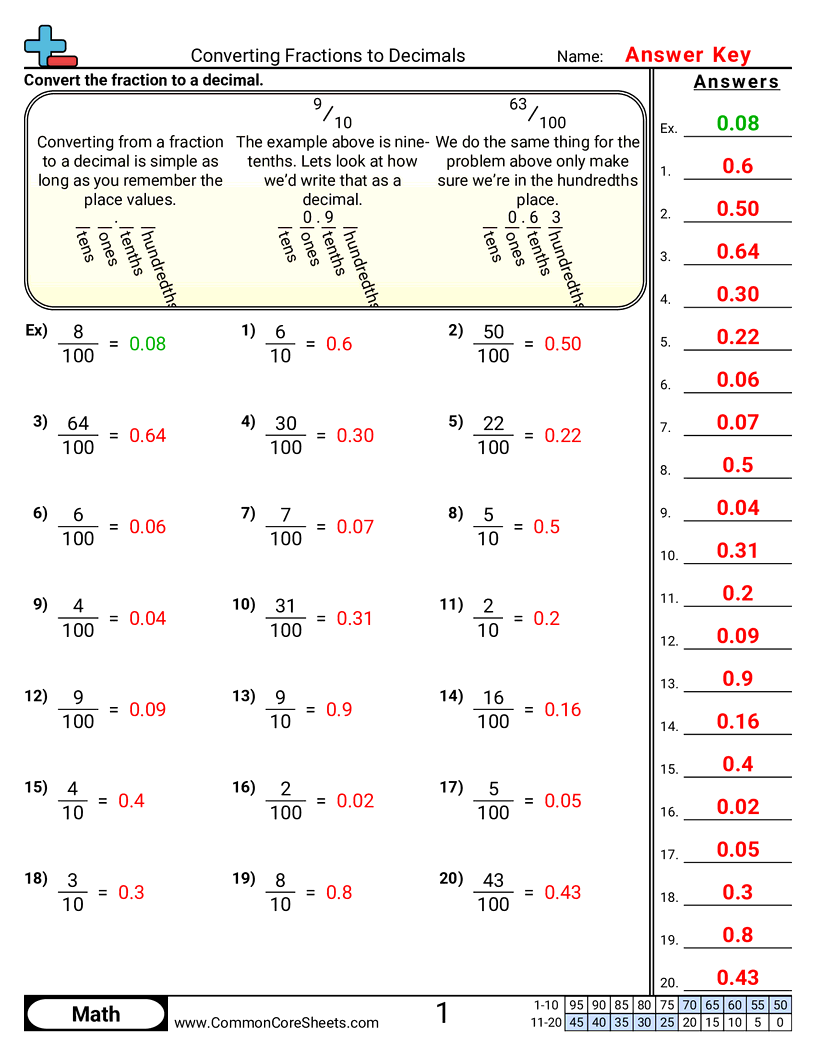
"This worksheet is designed to help children master the concept of converting fractions to decimals in a fun, engaging way. It offers 20 math problems where kids convert typical fractions into their decimal equivalents. Its interactive format offers adaptability and can be customized to suit individual learning needs. It could even be transformed into flash cards for additional practice or used in a distance learning environment to ensure continuous and effective learning."
×Student Goals: Understanding Fractions and DecimalsAfter completing the worksheet, students will have a clear understanding of how fractions and decimals are related. They will be able to effortlessly convert fractions to decimals and will know the underlying process behind it. This fundamental knowledge will allow them to navigate more complex math problems with ease.Mastery of Arithmetic SkillsBy practicing with twenty problems, students will achieve mastery in the arithmetic required to convert fractions into decimals. Their computation skills, coupled with an understanding of the place-value system used in decimals, will be significantly improved, enhancing their overall mathematical capabilities.Improved Problem-Solving SkillsThis worksheet is designed to foster mathematical inquiry, encouraging students to independently solve problems. After successful completion, they will have improved their problem-solving skills, which can be applied to other math topics and real-world scenarios.Boost in Mathematical ConfidenceBy successfully converting fractions to decimals, students will experience a significant boost in confidence, making them more likely to engage with mathematical topics in the future. This essential trust in their abilities can contribute positively to their overall academic performance.Preparation for Advanced Mathematical ConceptsThe knowledge of converting fractions to decimals is an integral part of more advanced mathematical concepts like algebra, percentage calculations, and data interpretation. Therefore, after completing the worksheet, students will be well-prepared for tackling these advanced topics when they encounter them.Enhancement of Analytical SkillsThe process of converting fractions to decimals involves step-by-step logical reasoning. As students navigate through these steps, they enhance their analytical skills — a trait that’s not only important in mathematics, but also beneficial in other subject areas and in everyday life.
4nf1Open FolderOpen File×Description:
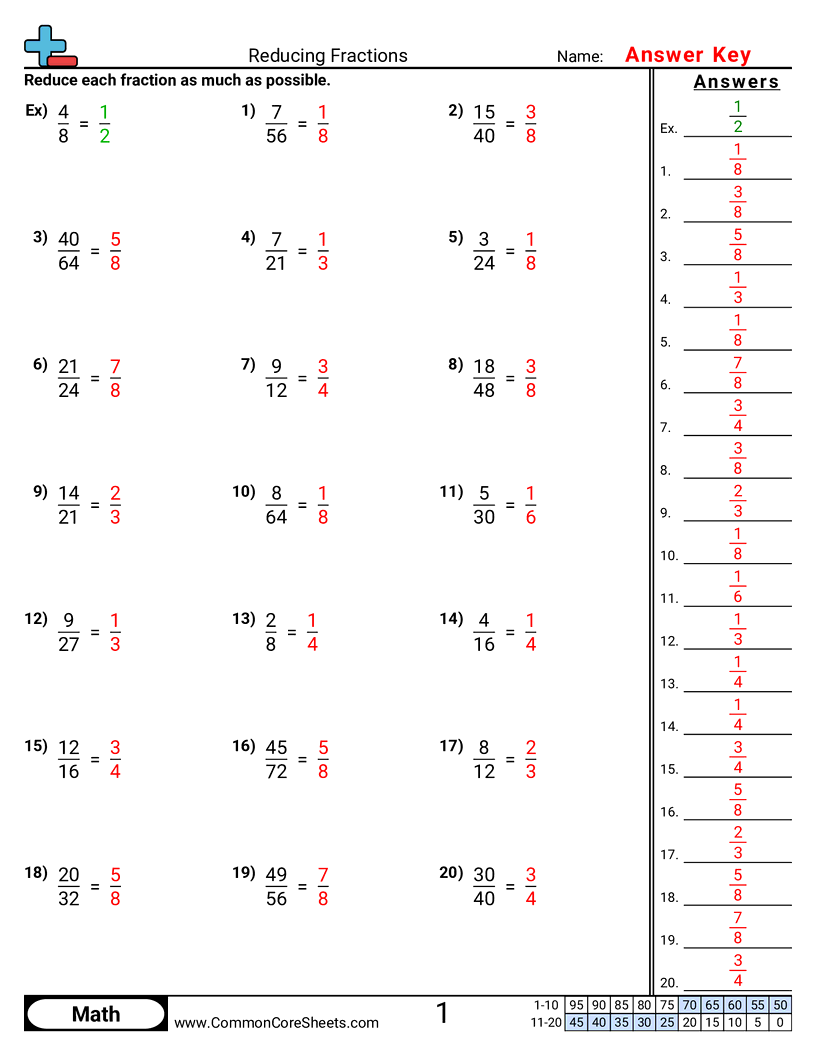
"This worksheet is designed to strengthen children's understanding of reducing fractions in math. It contains 20 problems that teach students to simplify fractions by finding their lowest terms. Customizable for varied learning needs, it can be converted into flashcards or utilized in distance learning platforms for enhanced flexibility. A valuable resource for homeschooling, tutoring, or in-class learning."
×Student Goals: