Numbers & Operations (N)6.N.1 Read, write, and represent rational numbers expressed as integers, fractions, decimals, percents, and ratios; use these representations in real-world and mathematical situations.6.N.1.1Use manipulatives and models (e.g., number lines) to determine positive and negative numbers and their contexts, identify opposites, and explain the meaning of 0 (zero) in a variety of situations.
Identifying Fraction Location Positive and Negative
6ns6cOpen FolderOpen File×Description:
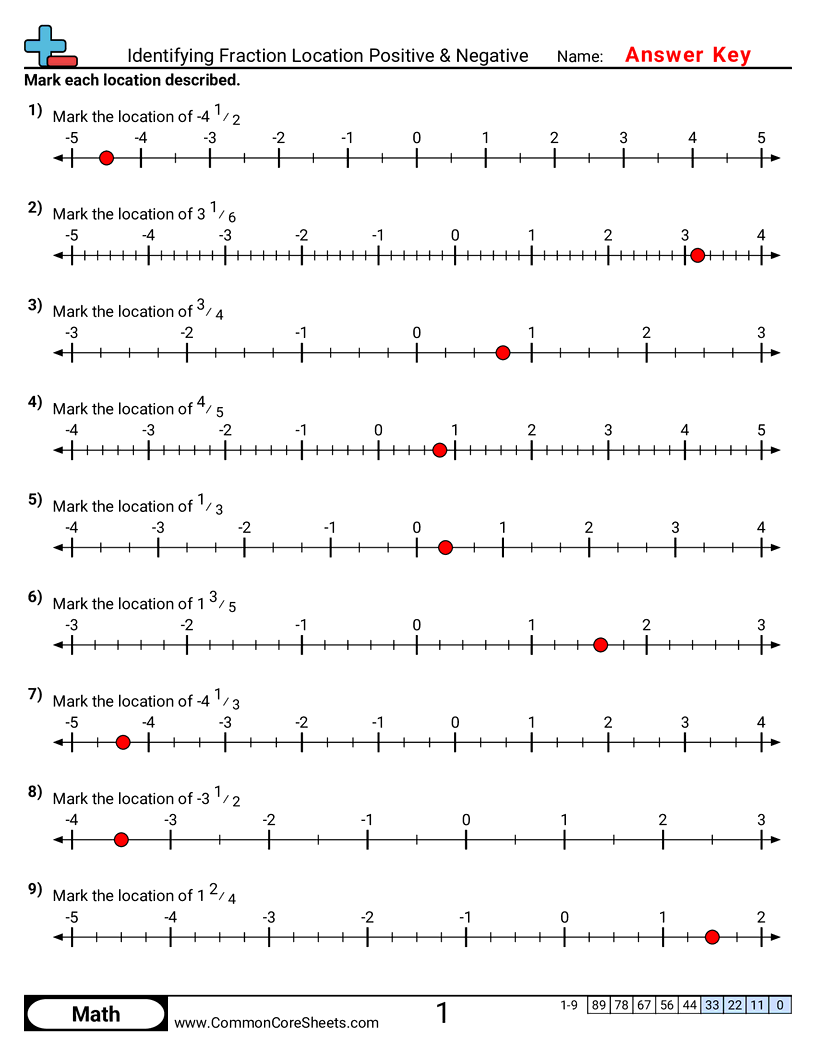
"This worksheet is designed to enhance children's understanding of fractions in both positive and negative contexts. It features nine unique math problems where students need to identify the locations of different fractions on a scale. Tailored to the needs of diverse learners, the content can be customized and converted into interactive flash cards. The worksheet also facilitates distance learning, providing a flexible resource for improving children's numerical skills."
×Student Goals: Understanding and Applying Mathematical ConceptsAfter completing this worksheet, students should be able to demonstrate a clear understanding of both positive and negative fractions. This includes the ability to identify where these fractions fall on a number line, improving their spatial awareness and conceptual understanding of maths topics. Previously abstract concepts such as negative numbers and fractions are made more concrete, aiding in their comprehension of further complex mathematical principles.Problem-solving skillsThis worksheet fosters problem-solving skills, encouraging students to apply the theoretical knowledge they've learned in practical examples. They have the opportunity to tackle a variety of problems that challenge their understanding and apply their skills. They will also learn to approach problems systematically, enhancing their cognitive development.Enhancement of Mathematical VocabularySuccessful completion of this worksheet enables students to expand their mathematical vocabulary. They will be familiar with terms such as 'fraction', 'negative', 'positive', and 'location'. This expanded vocabulary facilitates better communication of mathematical ideas, aiding their education journey.Thinking CriticallyWhen students understand and are proficient in identifying fraction locations both in positive and negative terms, they will be better equipped to reason logically and think critically. This skill will be invaluable throughout their academic and daily lives, as they will be able to approach different situations logically and analytically.Preparation for Advanced MathThe ability to identify and understand positive and negative fractions is fundamental to many more advanced areas of mathematics. Mastering these foundational skills would mean that students will be more prepared and confident in being introduced to more complex areas of math. This worksheet aids as a stepping stone for more complicated mathematical concepts.
6ns6cOpen FolderOpen File×Description:
"This worksheet is designed to teach children the concept of positive and negative coordinates in a fun, interactive way. Using geometric shapes and familiar objects like a star, heart, or moon, this customizable worksheet presents 20 problems ideal for learning via flashcards or distance education. With practice, students will master the math skill of reading coordinates effectively."
×Student Goals: Understanding of Coordinate SystemUpon the successful completion of this worksheet, the students will have a deeper understanding of the positive and negative coordinate system, a crucial concept in mathematics. They will learn the basics of graphing, addressing both the x and y coordinates, and how to plot points correctly using positive and negative numbers.Improved Problem Solving SkillsWork through the entire set of problems will help the students to strengthen their problem-solving skills. The 20 problems on the worksheet have been designed in such a way that they test the students' ability to interpret and work out solutions convincingly. Each problem presents a unique challenge, further motivating students to think critically and logically.Competency in Navigating 2D SpaceThe students will demonstrate a proficiency in navigating the two-dimensional space effectively. This skill will come in handy when carrying out analytical tasks in later grades, especially in subjects that require the use of diagrams and charts such as Geometry and Physics.Application of Knowledge to Real World ScenariosThe students will be able to apply the knowledge gained from the worksheet, not just in the academic context, but also in real-life scenarios. The understanding of coordinates is beneficial in a diverse range of fields, including Computer Science, Geography, Engineering, Architecture and more. This is, therefore, a significant step in equipping them with relevant skills for the future.Enhanced Math VocabularyStudents will further solidify their math vocabulary relevant to coordinate systems, including terms like 'axis', 'origin', 'quadrant', 'coordinates', 'positive', and 'negative'. Confident use of the appropriate mathematical language helps students to communicate their understanding effectively.Confidence and Independence in LearningCompleting the worksheet will also foster a notable level of confidence and independence in the students. Attempting, solving, and correcting errors all by themselves will encourage them to take charge of their learning process and not shy away from attempting challenging problems in future.
6ns6aOpen FolderOpen File×Description:
This worksheet is designed to reinforce children's understanding of positive and negative numbers, specifically focusing on finding their opposites. Comprising of 20 math problems, the exercise can be easily customized to suit varying learner needs. Its flexible format ensures utility as flashcards or as a resource for distance learning. This tool aims to instill foundational math skills for kids in a fun, engaging way.
×Student Goals: Understanding of Mathematical OppositesAfter completing this worksheet, students should have a solid understanding of mathematical opposites, particularly in relation to positive and negative numbers. The repetitive nature of the problems reinforces the concept that the opposite of a number is the number that is equally distant from zero on the number line, but on the other side. Students would be expected to quickly and accurately determine the mathematical opposites of both positive and negative numbers.Increased Numerical AgilityThis worksheet aims to enhance students' numerical agility. By frequently working with both positive and negative numbers, students will become more comfortable with number manipulation and gain a craftier mathematical intuition. These Attributes will be not only beneficial across many areas of math, but can also translate into improved number-related problem-solving abilities in everyday life.Preparation for Advanced MathematicsThe ability to find the opposites of positive and negative numbers is a fundamental part of more advanced levels of mathematics. A solid comprehension in this area can help students in tackling more complex mathematical topics as they move forward. These might include algebra, calculus, and even more specialized fields such as engineering or physics. This worksheet hence acts as a stepping stone to grapple with such subjects in the future.Skill Evaluation and ReinforcementThis worksheet serves to evaluate and reinforce established mathematical skills. By practicing, students can identify any areas of difficulty and work to rectify them. The variety of problems in the worksheet provides a comprehensive practice session, thereby enabling students to become proficient in this key area of math. The more practice they get, the more confident and competent they'll feel about their math abilities.Promotion of Independent LearningThis worksheet promotes independent learning by providing students with a stand-alone resource that they can work through at their own pace. This promotes a sense of responsibility for their own learning process and can potentially foster a more intrinsic motivation to delve deeper into math and understand its principles more thoroughly. It can also alleviate any anxiety they may possess about math by allowing them to process information at their own pace.
6ns6aOpen FolderOpen File×Description:
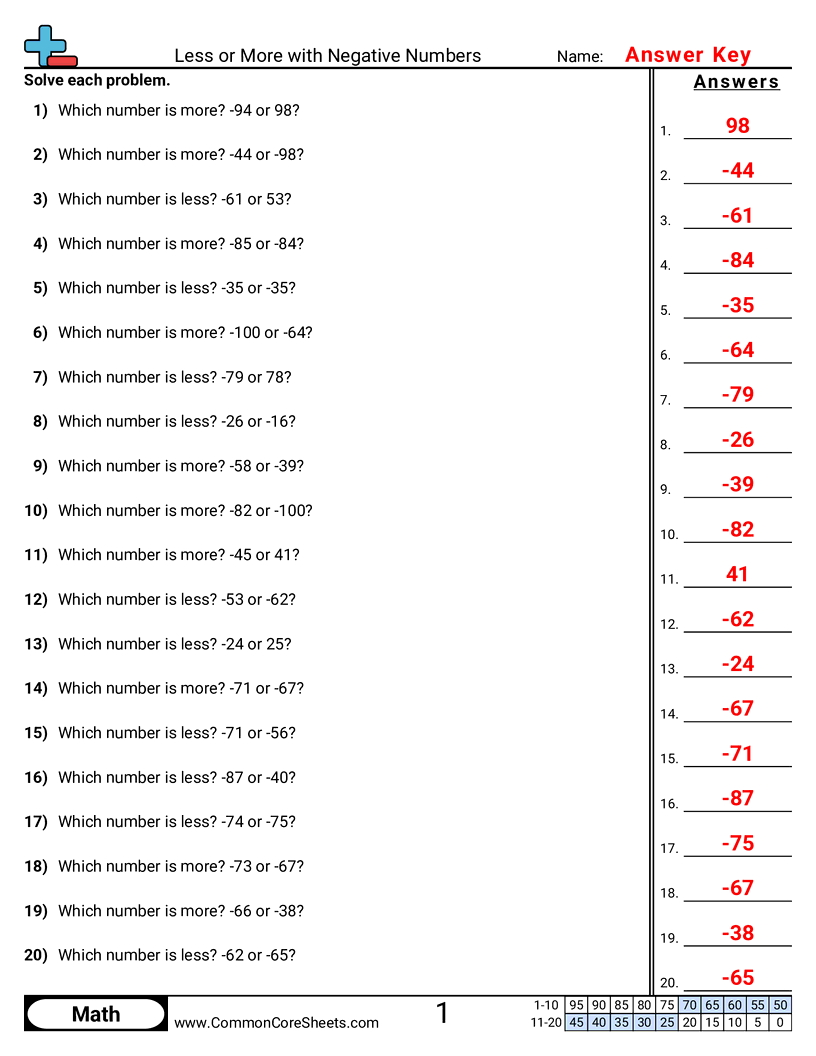
"This worksheet is designed to help children understand and compare negative numbers in a simple, engaging format. This educational tool, with 20 math problems, aids students to identify which numbers are less or more, even when negative. Ideal for distance learning, it's customizable to meet individual learning needs. The questions can also be converted into flashcards for additional practice. It's a versatile tool to strengthen number comprehension, making math more accessible and enjoyable."
×Student Goals: Enhance Mathematical SkillsetThrough completing this educational worksheet, children should wield amplified problem-solving abilities. Recognizing and comparing values of negative numbers will allow them to expand their comprehension of mathematics, strengthening their overall skill sets in this area. This exercise holistically nurtures fundamental skills that will be beneficial in higher-level mathematical topics and real-life situations.Comprehension of Negative NumbersA thorough comprehension of the concept of negative numbers is a significant accomplishment students will achieve. By determining which negative numbers are less or more, students gain a solid grasp on the numerical line, including its less intuitive negative portion. Once students can easily handle negative numbers, they are ready to progress to more complicated mathematical concepts.Foundation Building for Advanced Mathematical ConceptsUpon completion of the worksheet, students will have built a solid foundation for more complex mathematical concepts. Given the role of negative numbers in advanced mathematics subjects like algebra and calculus, understanding how to evaluate negative numbers is vital. This practice worksheet provides the means for students to confidently and accurately work with those numerals, furthering their mathematical prowess.Develop Critical Thinking and Logical ReasoningSuccessful completion of this worksheet ensures that students are developing critical thinking and logical reasoning skills. This is because they are required to analyze and solve the mathematical problems presented in the worksheet. Engaging, comparing and understanding negative numbers enables children to strengthen their critical thinking, equipping them for more complex theoretical problem-solving in the future.Improve Academic PerformanceAfter finishing this worksheet, students should be able to improve their academic performance in mathematics and other subjects that rely on numbers. Understanding the principles of comparing negative numbers can help students perform better in examinations and class assignments, leading to an overall improvement in grades and increased confidence in their academic abilities.Boost Confidence in MathBy overcoming the often challenging concept of negative numbers, students will experience a noticeable boost in their confidence regarding math. As they correctly compare negative values, they will feel more comfortable and motivated to tackle increasingly difficult mathematical tasks, seeing themselves as capable math learners. This newfound self-confidence can lead to even greater success down their academic path.