Numbers & Operations (N)6.N.1 Read, write, and represent rational numbers expressed as integers, fractions, decimals, percents, and ratios; use these representations in real-world and mathematical situations.6.N.1.2Compare and order positive rational numbers, represented in various forms, or integers using the symbols "<", ">", and "=".
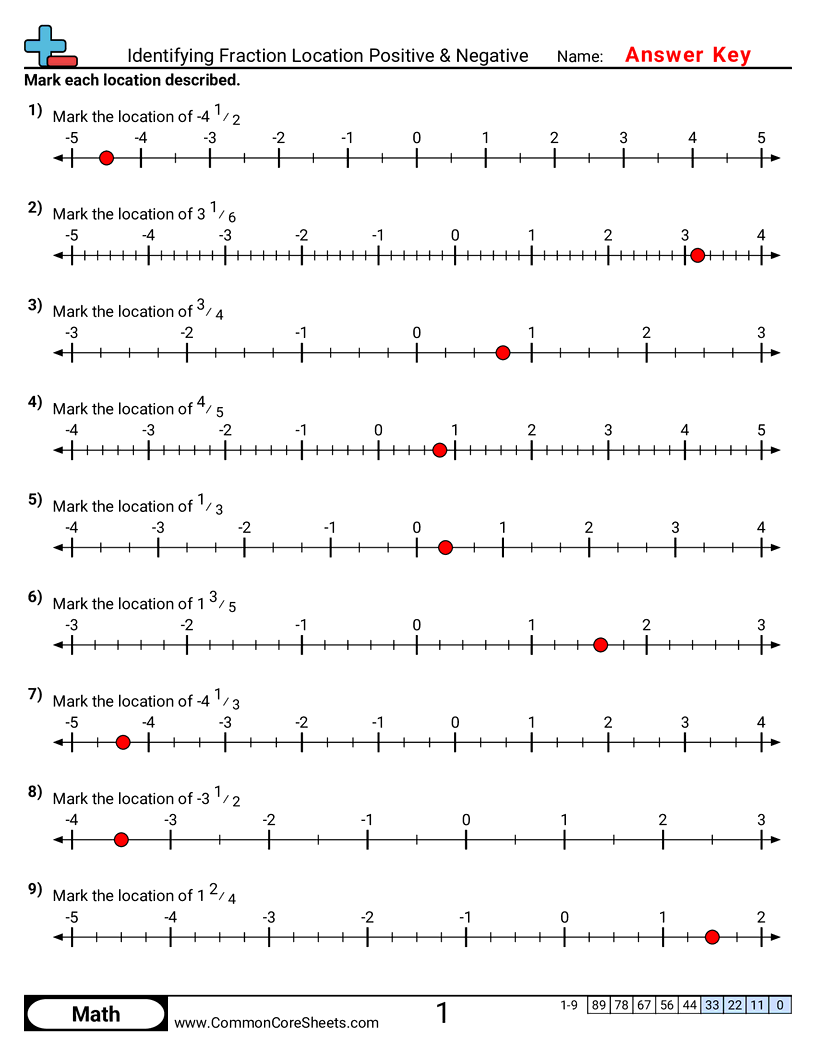
Identifying Fraction Location Positive and Negative
6ns6cOpen FolderOpen File×Description:
"This worksheet is designed to enhance children's understanding of fractions in both positive and negative contexts. It features nine unique math problems where students need to identify the locations of different fractions on a scale. Tailored to the needs of diverse learners, the content can be customized and converted into interactive flash cards. The worksheet also facilitates distance learning, providing a flexible resource for improving children's numerical skills."
×Student Goals: Understanding and Applying Mathematical ConceptsAfter completing this worksheet, students should be able to demonstrate a clear understanding of both positive and negative fractions. This includes the ability to identify where these fractions fall on a number line, improving their spatial awareness and conceptual understanding of maths topics. Previously abstract concepts such as negative numbers and fractions are made more concrete, aiding in their comprehension of further complex mathematical principles.Problem-solving skillsThis worksheet fosters problem-solving skills, encouraging students to apply the theoretical knowledge they've learned in practical examples. They have the opportunity to tackle a variety of problems that challenge their understanding and apply their skills. They will also learn to approach problems systematically, enhancing their cognitive development.Enhancement of Mathematical VocabularySuccessful completion of this worksheet enables students to expand their mathematical vocabulary. They will be familiar with terms such as 'fraction', 'negative', 'positive', and 'location'. This expanded vocabulary facilitates better communication of mathematical ideas, aiding their education journey.Thinking CriticallyWhen students understand and are proficient in identifying fraction locations both in positive and negative terms, they will be better equipped to reason logically and think critically. This skill will be invaluable throughout their academic and daily lives, as they will be able to approach different situations logically and analytically.Preparation for Advanced MathThe ability to identify and understand positive and negative fractions is fundamental to many more advanced areas of mathematics. Mastering these foundational skills would mean that students will be more prepared and confident in being introduced to more complex areas of math. This worksheet aids as a stepping stone for more complicated mathematical concepts.
6ns6cOpen FolderOpen File×Description:
"This worksheet is designed to teach children the concept of positive and negative coordinates in a fun, interactive way. Using geometric shapes and familiar objects like a star, heart, or moon, this customizable worksheet presents 20 problems ideal for learning via flashcards or distance education. With practice, students will master the math skill of reading coordinates effectively."
×Student Goals: Understanding of Coordinate SystemUpon the successful completion of this worksheet, the students will have a deeper understanding of the positive and negative coordinate system, a crucial concept in mathematics. They will learn the basics of graphing, addressing both the x and y coordinates, and how to plot points correctly using positive and negative numbers.Improved Problem Solving SkillsWork through the entire set of problems will help the students to strengthen their problem-solving skills. The 20 problems on the worksheet have been designed in such a way that they test the students' ability to interpret and work out solutions convincingly. Each problem presents a unique challenge, further motivating students to think critically and logically.Competency in Navigating 2D SpaceThe students will demonstrate a proficiency in navigating the two-dimensional space effectively. This skill will come in handy when carrying out analytical tasks in later grades, especially in subjects that require the use of diagrams and charts such as Geometry and Physics.Application of Knowledge to Real World ScenariosThe students will be able to apply the knowledge gained from the worksheet, not just in the academic context, but also in real-life scenarios. The understanding of coordinates is beneficial in a diverse range of fields, including Computer Science, Geography, Engineering, Architecture and more. This is, therefore, a significant step in equipping them with relevant skills for the future.Enhanced Math VocabularyStudents will further solidify their math vocabulary relevant to coordinate systems, including terms like 'axis', 'origin', 'quadrant', 'coordinates', 'positive', and 'negative'. Confident use of the appropriate mathematical language helps students to communicate their understanding effectively.Confidence and Independence in LearningCompleting the worksheet will also foster a notable level of confidence and independence in the students. Attempting, solving, and correcting errors all by themselves will encourage them to take charge of their learning process and not shy away from attempting challenging problems in future.
6ns7aOpen FolderOpen File×Description:
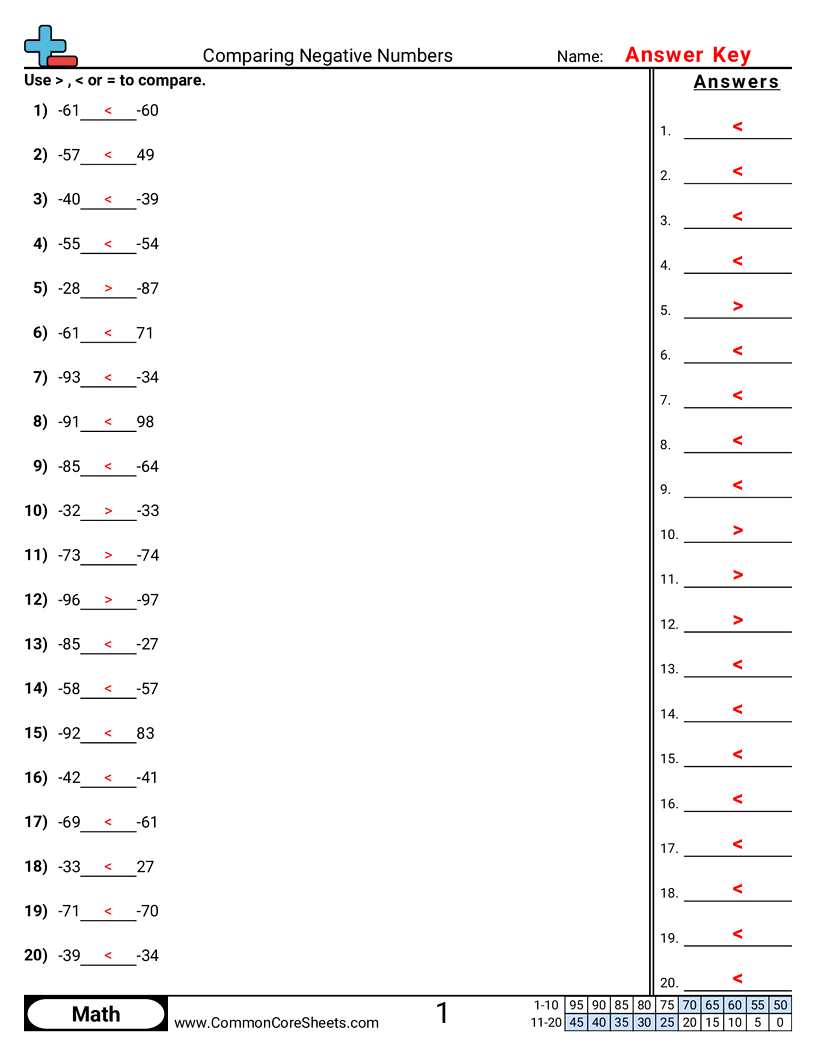
"This worksheet is designed to help children understand and practice comparing negative numbers. Offering 20 math problems, students will gain competence in recognizing which negative numbers are larger or smaller. The worksheet is versatile; it can be customized to meet individual learning needs, converted into flash cards for interactive learning, or utilized for distance learning to ensure consistent math proficiency development."
×Student Goals: Understanding Negative NumbersAfter completing the Comparing Negative Numbers worksheet, students should have a solid understanding of how negative numbers function in mathematics. They should be able to accurately identify and interpret negative numbers, differentiating them from positive numbers. Further, they should recognize negative numbers in various contexts, whether standalone or within mathematical equations, and be able to determine their place value.Comparing and Ordering Negative NumbersOne key objective of this worksheet is to equip students with the ability to compare and order negative numbers. They should be able to determine whether a negative number is greater or less than another negative number and to accurately arrange a sequence of negative numbers in ascending or descending order. Such skills are fundamental in various mathematical operations and real-world applications.Applying Negative Numbers to Real-World ScenariosStudents should be able to apply the concept of negative numbers to real-world situations. This includes understanding contexts where negative numbers are used, such as temperatures below zero, owing money, or any scenario that involves loss or going below a certain level. This strengthens their comprehension and makes math learning more relatable and practical.Problem-Solving SkillsBy working through the problems provided in the worksheet, students should develop enhanced problem-solving skills. They should be able to apply logical thinking, strategize possible solutions, and select the most effective approach to solve a problem. Moreover, students should demonstrate perseverance and resilience in tackling challenging problems.Enhancing Numeracy SkillsUpon completion of the worksheet, students should demonstrate improved numeracy skills. This includes, but is not limited to, mental math, number sense, and arithmetic fluency. These skills are crucial to their overall mathematics proficiency and serve as bedrock for more complex mathematical concepts in future learning.
6ns7aOpen FolderOpen File×Description:
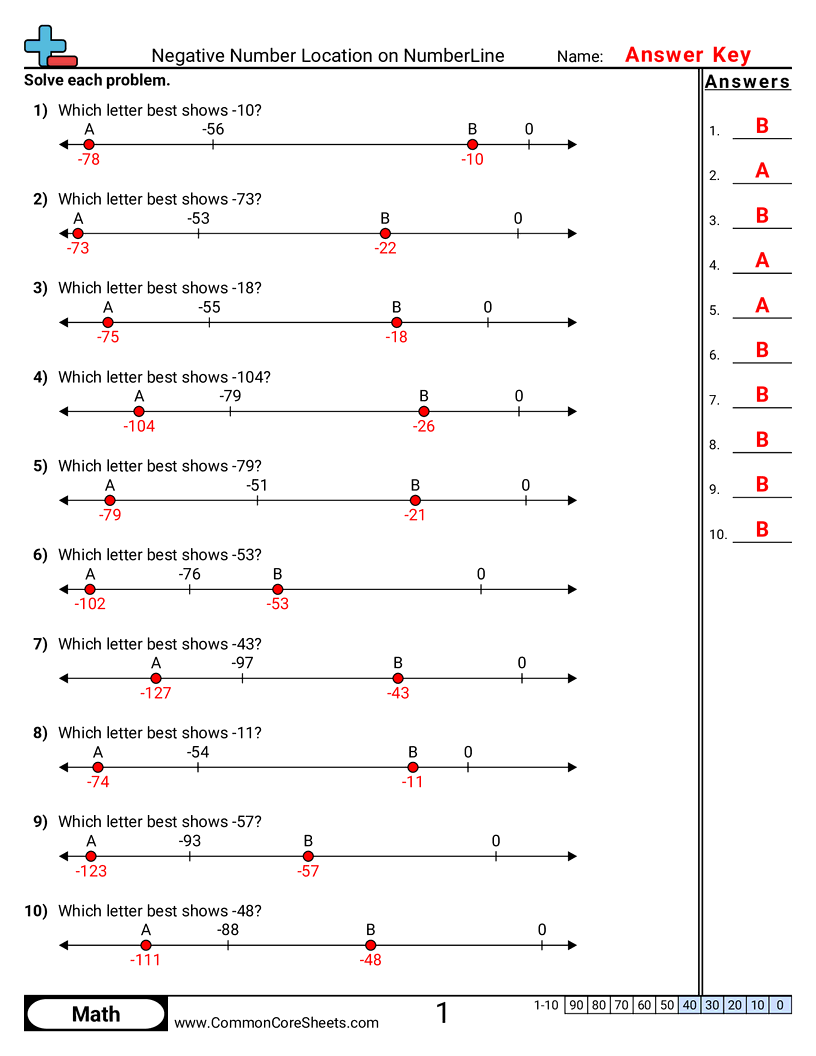
"This worksheet is designed to help children understand the concept of negative numbers and their placements on the number line. Featuring 10 customizable problems, students practice identifying where negative numbers fall amongst other values. Perfect for distance learning, this worksheet can also be easily converted into flash cards, boosting engagement and knowledge retention. A versatile tool essential for expanding mathematical skillset."
×Student Goals: Understanding Negative NumbersAfter completing the worksheet, students should have a clear understanding of negative numbers. They should be able to identify and place them accurately on a number line. This basic understanding of negative numbers is essential in higher mathematical calculations that involve the use of both positive and negative numbers.Development of Practical Math SkillsCompletion of the worksheet ensures that students develop practical skills to solve math problems involving negative numbers easily. They should be able to determine the location of a negative number amidst other numbers on a number line, enhancing their practical mathematical skills and fluency in solving math problems.Enhancement of Cognitive SkillsCompleting this worksheet also improves students' cognitive skills. Determining the location of negative numbers on a number line requires a certain level of thinking and reasoning, which is a good exercise for cognitive development. It encourages students to apply their concentration skills, thus improving their overall cognitive function.Preparation for Advanced Math TopicsUnderstanding of negative numbers and their placement on the number line prepares students for tackling advanced mathematical topics. Concepts like algebra and coordinates, which involve negative numbers, become easier to grasp. Students' progression in mathematics becomes smoother and more seamless.Understanding the Concept of Position and OrderBy accurately determining the positions of negative numbers on the number line, students comprehend the concept of order and position. They learn that numbers have an implicit order, whether positive or negative, and each number occupies a specific position in relation to others on the number line.Improvement in Problem-Solving SkillsSolving problems in this worksheet enhances students' problem-solving skills. They need to understand the problem and apply the right strategy to locate the negative number on the number line. This nurtures their ability to think critically and logically, thereby improving their problem-solving capacity.Confidence in Handling Math ProblemsSuccessfully completing this worksheet can help build confidence in students' mathematical abilities. Through accurately locating negative numbers on a number line, students gain affirmation in their ability to solve math problems. This boosts their confidence, making them more prepared for future complexities in math.