Data & Probability (D)7.D.1 Interpret and analyze data, creating the most appropriate display using a variety of tools.7.D.1.1Design simple experiments; collect data; compute mean, median, mode, range, and IQR; draw conclusions and make predictions.
6sp4Open FolderOpen File×Description:
"This worksheet is designed to educate children on the essentials of creating a box plot on a number line in math. It features 7 distinct problems that progressively challenge students to analyze number sets and determine their min, max, quartile values, bolstering crucial statistical literacy. Its customizable nature allows it to be converted easily into flash cards or adapted for distance learning students."
×Student Goals: Data RepresentationAfter completing the worksheet, students should have a firm grasp on how to represent a set of numerical data on a number line via a box plot. This includes understanding how data points align on a number line and how they relate to real-world scenarios. Students will become proficient in visualizing data sets and identifying outliers, maximum and minimum values.Quantitative ReasoningThe worksheet is designed to improve students' quantitative reasoning skills. They will learn how to derive meaningful statistics from a data set, such as quartiles, and make reasonable predictions. They will be able to analyse a dataset and establish its range, median, and quartile values, making for a strong foundation in statistical analysis.Critical Thinking and Problem SolvingAs students complete the problems on the worksheet, they are exercising and developing their critical thinking and problem solving skills. Each question serves as a challenge that makes students interpret the problem, map out a strategy to solve it, and then execute that strategy. By doing so, students could transfer these problem-solving skills to other complex math problems.Understanding Core Math ConceptsThis worksheet helps students gain a thorough understanding of core mathematical concepts. These include critical concepts such as quartiles, median, range, and outliers, all fundamental to understanding data analysis. With this understanding, students will be better equipped to tackle more intricate analyses.Confidence in MathA crucial accomplishment from this worksheet is the confidence it instills in students about their mathematical abilities. By solving these problems, students prove to themselves that they can tackle challenging mathematical tasks. This boost in self-esteem can positively affect their attitude towards upcoming mathematical challenges, instilling a positive and determined mindset.
6sp4Open FolderOpen File×Description:
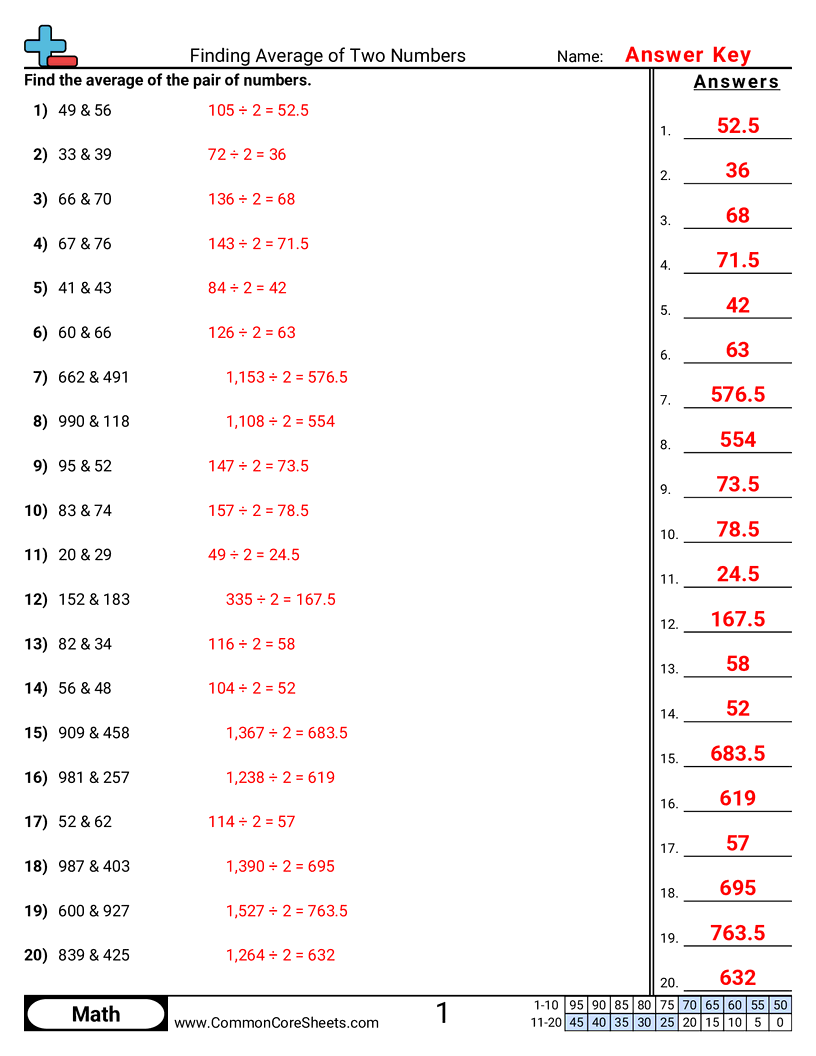
"This worksheet is designed to help children understand the concept of finding the average of two numbers. Filled with 20 mathematical problems, each showcasing easily understood examples, it's a perfect way to reinforce math skills. It's adaptable for any learning environment, easily customized, and convertible to flashcards, making it suitable for distance learning and self-study, all while maintaining engagement and enhancing children's grasp on the concept."
×Student Goals:
6sp4Open FolderOpen File×Description:
"This worksheet is designed to enhance children's mathematical abilities while learning about Quartiles. It comprises 12 engaging problems that instructively prompt kids to order numbers and identify quartiles. Not only can it be customized to suit different learning levels, it can also be conveniently converted into flashcards for standalone practice. Plus, its compatibility with distance learning makes it a highly flexible educational tool which is apt for current and future teaching approaches."
×Student Goals: Problem Solving SkillsBy completing this worksheet, students will enhance their problem-solving skills. They will learn how to tackle mathematical problems from different angles and develop strategies that will help them solve similar problems in the future. These essential skills will not only help them excel in mathematics but also in other areas of learning and in life generally.Understanding of QuartilesThe worksheet will provide students with a solid understanding of quartiles, an important aspect of statistics. They will learn how to calculate lower, median, and upper quartiles of a given data set. These skills will be beneficial when dealing with data in other aspects like science, economics, and social studies. The concept will provide the students a better perspective on data distribution in different data segments.Arranging DataThe students will become proficient at arranging numbers in ascending order, a fundamental skill needed for calculating quartiles and understanding data in general. Arranging numbers or data not only helps students understand mathematical value but also Order of Magnitude which is a valuable competency in subjects like Science as well.Application of Mathematical ConceptsAccording to the problems presented in the worksheet, it's evident that students will learn the practical application of mathematical concepts. They will learn how to use these mathematical principles in real-world situations like data analysis and interpretation. This shows the applicability of mathematical knowledge past the classroom setup.Awareness of Variability within DataThe worksheet allows students to express data variability through computation of quartiles. This crucial skill helps them better comprehend the dispersion and central tendency in a data set. They will learn to understand that within any given set of data points, numbers can vary significantly and it's this variability that quartiles help to express in a clear, concise way.Independent LearningAfter completing this worksheet, students will have improved their independent learning skills. It encourages autonomy by challenging students to comprehend and solve each problem without assistance. This self-sufficiency is a key life skill that will help students in future studies and beyond.
6sp5cOpen FolderOpen File×Description:
"This worksheet is designed to enrich students' understanding of number sets in Math. It accommodates 10 problem sets that encourage pattern recognition and analysis. This versatile resource can be customized to meet individual learning needs, easily converted into flash cards for interactive study, and seamlessly integrated into distance learning curriculums. A productive tool for refining mathematical abilities."
×Student Goals: Develop Analytical SkillsUpon completing the worksheet, students will possess enhanced analytical skills. They will be able to critically collate and examine different sets of numbers with precision, noticing trends, patterns and sequential arrangements.Enhance Numeracy SkillsStudents will advance their numeracy skills, essential for further mathematics learning. They'll learn to apply their number knowledge to different sets and practically understand the relationship between them.Boost Confidence in Problem SolvingThe skills obtained from handling the problems on this worksheet can fuel students' confidence in their problem-solving abilities. The capability to solve different number sets equips them with the self-assurance to tackle numerical problems in a variety of contexts.Improve Calculation AbilitiesBy numerically analyzing different number sets, students will undoubtedly improve their calculation abilities. They will develop quick mental arithmetic skills and a robust understanding of number manipulation strategies.Master Pattern RecognitionSuccessfully working through these problems will enable students to ensure proficiency in pattern recognition. They will adeptly identify patterns within numerical sequences and demonstrate increased speculation about future numbers within a given sequence.Develop Logical ThinkingThe number sets given in the worksheet will enforce students to utilize their logical thinking skills. They will understand how to discern sequences, trends and patterns using logical reasoning, effectively boosting their decision-making skills.Cultivate PersistenceWorking their way through these problems helps students to cultivate an important attribute of persistence. They learn to persevere when facing tricky number sets and don’t easily give up, fostering resilience and stamina.Enhance Attention to DetailAs students work through each number sequence, they will enhance their attention to details. Their ability to focus and concentrate will significantly improve and can be applied to other areas of learning and life.
6sp5cOpen FolderOpen File×Description:
"This worksheet is designed to help children examine number sets through engaging word problems involving real-life scenarios. In studying patterns of sports scores, car count, pencil sharpening, playground activities, and pizza sales, children will determine the mean, median, mode, and range. The worksheet is versatile & can be customized for individual learning, converted into flash cards or employed in distance learning to enrich mathematical understanding."
×Student Goals: Understanding of Statistical ConceptsAfter completing the worksheet, students will have a deeper understanding of basic statistical concepts, including mean, median, mode, and range. These are fundamental concepts in mathematics which provide foundational knowledge for future studies in more advanced statistical and mathematical analysis.Enhanced Analytical SkillsThrough solving the problems in this worksheet, students will enhance their analytical skills. They will be able to sort numerical data, calculate averages, identify the middle number in a data set, determine the number that appears most frequently, and identify the difference between the smallest and largest numbers in a set - also known as the range.Real-World Problem-Solving AbilityThis worksheet incorporates real-world scenarios into math problems, thereby boosting students' ability to apply mathematical concepts to solve real-life problems. This will improve their problem-solving skills and ability to transfer learned knowledge to unfamiliar contexts. Thus, making mathematical learning more meaningful and applicable to everyday life situations.Increased Numerical FlexibilityBy working with different number sets and calculating the mean, median, mode, and range for each set, students will gain an increased flexibility in working with numbers. This experience will enhance their overall numerical fluency - an important skill in all fields of math.Improved Attention to DetailThe task of examining number sets and calculating various measures requires students to pay careful attention to the presented data, enhancing their attention to detail. This skill is not only vital in mathematics but also in many other fields of study and areas of life.
6sp5cOpen FolderOpen File×Description:
"This worksheet is designed to teach children about finding the mean in mathematics. By solving the 15 math problems, kids will tackle and master the concept of averaging numbers. The worksheet promotes a versatile learning approach as it can be personalized, converted into flashcards, or used for distance learning environments. Interactive and engaging, it caters to different learning styles and paces, making the study of mean more accessible and enjoyable."
×Student Goals:
6sp5cOpen FolderOpen File×Description:
"This worksheet is designed to hone children's understanding of the mathematical concept of finding the median. It includes 15 problems, presenting a series of numbers where students identify and highlight the median. Furthermore, it boasts versatile functionality and can be customized to cater to individual learning needs. It also serves as a resource for distant learning, and can be conveniently converted into flash cards to aid memory reinforcement and mathematical fluency."
×Student Goals: Master median calculationKid mathematicians completing this worksheet will become proficient in the process of sorting numbers and selecting the middle value, or median. They will learn to find the median in various sets of numerical data, understanding that it represents the middle position. Even when dealing with larger sets or more complex numbers, children will enhance their ability to quickly and correctly calculate the median.Strengthen data handling skillsThis worksheet will significantly refine students' data handling skills. They will become capable of making sense of sets of data by calculating the median. This will also plant strong roots for future understanding of statistical concepts since median is a crucial concept in statistics. They will be able to arrange and analyze data sets in an orderly and logical fashion.Improve critical thinkingBy proceeding through this worksheet, children will be encouraged to flex their critical thinking skills. They will gain the capacity to reason, analyze, and logically deduce the median from a series of numbers. This logic-based thinking style is particularly valuable and translates into a wide range of academic and real-world situations.Enhance numerical agilityA thorough exploration of this worksheet will expose students to a variety of numbers - aiding in their numeracy development. Their ability to recognize and sort numbers will dramatically improve. Furthermore, their mental agility with numerical sequences will be enhanced, contributing to their overall mathematical proficiency.Boost confidence in mathematical abilitiesBy the end of this worksheet, students will feel a sense of accomplishment. Successfully calculating the median repeatedly will boost their confidence in their problem-solving abilities. This would foster self-belief in their mathematical skills and encourage them to take on more challenging numerical tasks, aiding their journey towards becoming capable mathematicians.
6sp5cOpen FolderOpen File×Description:
"This worksheet is designed to help children understand and practice the concept of finding the mode in math, through 15 carefully curated problems using varied number ranges. It promises flexibility as it can be customized to fit individual learning needs, converted into flash cards, or used in distance learning. Perfect for reinforcing and mastering mode identification."
×Student Goals: Understanding the concept of ModeUpon completing this worksheet, students will develop a clear understanding of the concept of mode in mathematics. They will learn how to identify the most frequent numbers in a given set, and can effectively apply this strategy in different contexts. From basic number sets to broader applications, this new skill will serve as the foundation for further statistics studies.Enhanced analytical skillsWorking through these problems will also enhance students' analytical skills, as they will need to sort through data to analyze and understand patterns, particularly which numbers appear most frequently. Students will strengthen their analytic abilities by regularly practicing these problem-solving skills, which are not limited to mathematics and are widely applicable in various academic areas.Problem-solving abilitiesAs the complexity of the problems increases in the worksheet, students will develop finer problem-solving abilities. They will understand that finding the mode is not always straightforward and that a set may have one mode, more than one mode, or no mode at all. This will challenge students to consider unique situations within the data, boosting their critical thinking skills.Improved precision and attention to detailThis worksheet will also emphasize precision and detail. Students will need to pay close attention to each problem to identify the mode correctly. By focusing on this accuracy, they will enhance their ability to identify and rectify mistakes independently, hence, amplifying their self-confidence in problem-solving.Preparation for advanced statistical studiesFinally, by mastering the concept of the mode, the students will set a foundation for more advanced statistical studies. Knowledge of the mode is a precursor to understanding advanced topics such as means, median, range, and standard deviation. Therefore, completing this worksheet effectively prepares students for more advanced mathematical studies.
6sp5cOpen FolderOpen File×Description:
"This worksheet is designed to enhance children's mathematical skills by focusing on the concept of finding the range in a series of numbers. The sheet, composed of 15 problems, encourages practice and exploration of numerical patterns and variations. Suitable for distance learning, the worksheet also offers flexibility with a convert-to-flashcards feature for an interactive learning experience."
×Student Goals: Understanding the concept of RangeUpon competently working through this worksheet, students should have a profound grasp of the statistical concept of 'range'. They will be able to effortlessly calculate the range for a set of data points. This understanding empowers them to measure the spread or the dispersion in a set of data, an essential skill in statistics.Critical Thinking and Problem-Solving SkillsThis worksheet will also help students to develop critical thinking and problem-solving skills. By finding the range, students are prompted to evaluate a set of varying numbers, identify the smallest and the largest, and understand their relation to each other. By doing this, students are propelled to implement logical reasoning.Familiarity with numerical dataAnother significant achievement that the students will acquire after completing this worksheet is gaining the ability to handle numerical data with ease. Dealing with several numbers simultaneously will advance their numerical power and improve their mental arithmetic.Preparation for more complex topicsUnderstanding range is a fundamental step in learning more complex concepts in statistics. After successfully completing this worksheet, learners will be set for more challenging topics like calculating the mean, median, mode, and even standard deviation.Increased ConcentrationThis worksheet will boost the concentration level of the students. To find the range, one needs to stay focused and maintain consistency while going through each data set. Thus, the worksheet is useful in improving the ability of students to handhold a piece of extended information.Practical Application of MathFinishing this worksheet successfully also means that students are ready to apply their learned concept in real-world situations. Understanding of range is used in various fields like finance, economics, social sciences, geography, to name a few. From determining temperature variance to analyzing stock market fluctuation, this worksheet will provide the initial base for applying math in practical life.
6sp5cOpen FolderOpen File×Description:
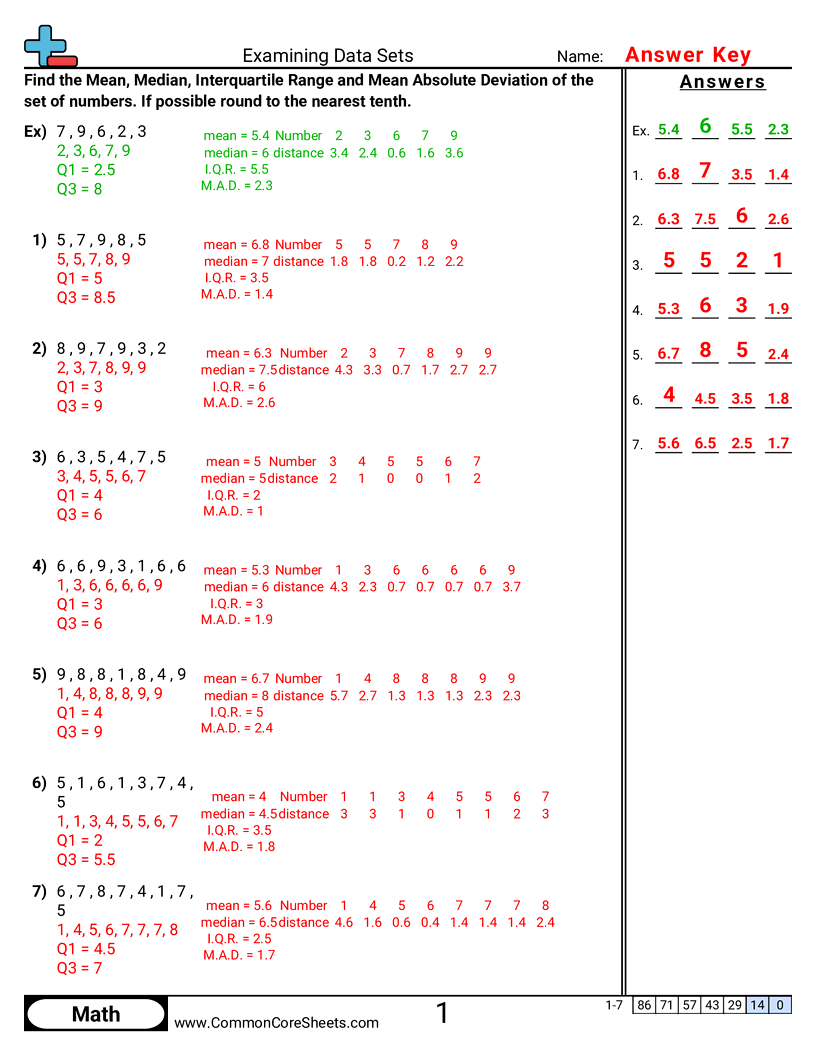
"This worksheet is designed to improve children's understanding of math, particularly data sets. It features seven problems, each detailing different numerical sequences, and challenges learners to examine and analyze key statistical concepts, including mean, median, I.Q.R., and M.A.D. Valuable for distance learning, the worksheet can be customized to suit individual learners and potentially converted into flash cards for more dynamic study sessions."
×Student Goals: Data AnalysisAfter completing this worksheet, students will gain substantial skills in analyzing data sets. They'll learn how to organize data in a meaningful way, improve their understanding of different statistical measures such as mean, median, and mode, and appreciate the differences and uses of these measures in real life scenarios.Evaluation of Quartiles and Interquartile RangeStudents will learn how to compute the first (Q1) and third (Q3) quartiles of a data set and understand their significance. Furthermore, they'll gain the ability to find the Interquartile Range (IQR), which provides a measure of statistical dispersion, or how data is spread around the mean.Calculation of Mean Absolute DeviationCompleting this worksheet will equip students with the skill to calculate the Mean Absolute Deviation (M.A.D.), a measure that indicates the average distance of each data point from the mean. This understanding will enable students to examine the dispersion or variability in a data set profoundly.Understanding DistributionsThe worksheet involves an array of different data sets, contributing to a deeper understanding on how data can be distributed. Students will learn how to observe patterns and variations in the data distribution, developing a more intuitive sense for statistics.Application of Mathematical ConceptsBy finishing the worksheet, students will enhance their ability to apply various mathematical concepts to real-life situations. They will gain a more profound understanding of the practical uses of statistics in numerous professional fields like economics, sociology, psychology, and many others.Problem-Solving SkillsThis worksheet will also aid in improving the students' problem-solving and critical thinking skills. It requires them to apply different statistical approaches and techniques to solve problems, thereby improving their logical reasoning and mathematical skills.