Data & Probability (D)7.D.1 Interpret and analyze data, creating the most appropriate display using a variety of tools.7.D.1.2Use proportional reasoning to display and interpret data in circle graphs (pie charts) and histograms.
6sp4Open FolderOpen File×Description:
"This worksheet is designed to educate children on the essentials of creating a box plot on a number line in math. It features 7 distinct problems that progressively challenge students to analyze number sets and determine their min, max, quartile values, bolstering crucial statistical literacy. Its customizable nature allows it to be converted easily into flash cards or adapted for distance learning students."
×Student Goals: Data RepresentationAfter completing the worksheet, students should have a firm grasp on how to represent a set of numerical data on a number line via a box plot. This includes understanding how data points align on a number line and how they relate to real-world scenarios. Students will become proficient in visualizing data sets and identifying outliers, maximum and minimum values.Quantitative ReasoningThe worksheet is designed to improve students' quantitative reasoning skills. They will learn how to derive meaningful statistics from a data set, such as quartiles, and make reasonable predictions. They will be able to analyse a dataset and establish its range, median, and quartile values, making for a strong foundation in statistical analysis.Critical Thinking and Problem SolvingAs students complete the problems on the worksheet, they are exercising and developing their critical thinking and problem solving skills. Each question serves as a challenge that makes students interpret the problem, map out a strategy to solve it, and then execute that strategy. By doing so, students could transfer these problem-solving skills to other complex math problems.Understanding Core Math ConceptsThis worksheet helps students gain a thorough understanding of core mathematical concepts. These include critical concepts such as quartiles, median, range, and outliers, all fundamental to understanding data analysis. With this understanding, students will be better equipped to tackle more intricate analyses.Confidence in MathA crucial accomplishment from this worksheet is the confidence it instills in students about their mathematical abilities. By solving these problems, students prove to themselves that they can tackle challenging mathematical tasks. This boost in self-esteem can positively affect their attitude towards upcoming mathematical challenges, instilling a positive and determined mindset.
6sp4Open FolderOpen File×Description:
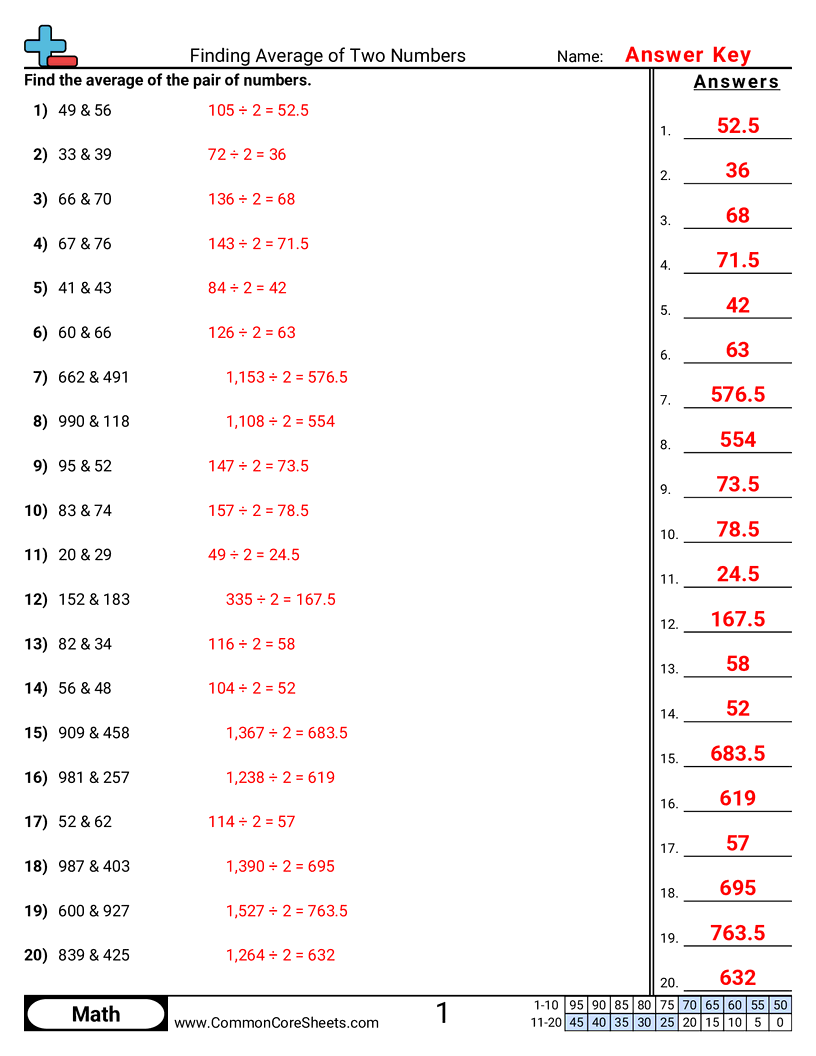
"This worksheet is designed to help children understand the concept of finding the average of two numbers. Filled with 20 mathematical problems, each showcasing easily understood examples, it's a perfect way to reinforce math skills. It's adaptable for any learning environment, easily customized, and convertible to flashcards, making it suitable for distance learning and self-study, all while maintaining engagement and enhancing children's grasp on the concept."
×Student Goals:
6sp4Open FolderOpen File×Description:
"This worksheet is designed to enhance children's mathematical abilities while learning about Quartiles. It comprises 12 engaging problems that instructively prompt kids to order numbers and identify quartiles. Not only can it be customized to suit different learning levels, it can also be conveniently converted into flashcards for standalone practice. Plus, its compatibility with distance learning makes it a highly flexible educational tool which is apt for current and future teaching approaches."
×Student Goals: Problem Solving SkillsBy completing this worksheet, students will enhance their problem-solving skills. They will learn how to tackle mathematical problems from different angles and develop strategies that will help them solve similar problems in the future. These essential skills will not only help them excel in mathematics but also in other areas of learning and in life generally.Understanding of QuartilesThe worksheet will provide students with a solid understanding of quartiles, an important aspect of statistics. They will learn how to calculate lower, median, and upper quartiles of a given data set. These skills will be beneficial when dealing with data in other aspects like science, economics, and social studies. The concept will provide the students a better perspective on data distribution in different data segments.Arranging DataThe students will become proficient at arranging numbers in ascending order, a fundamental skill needed for calculating quartiles and understanding data in general. Arranging numbers or data not only helps students understand mathematical value but also Order of Magnitude which is a valuable competency in subjects like Science as well.Application of Mathematical ConceptsAccording to the problems presented in the worksheet, it's evident that students will learn the practical application of mathematical concepts. They will learn how to use these mathematical principles in real-world situations like data analysis and interpretation. This shows the applicability of mathematical knowledge past the classroom setup.Awareness of Variability within DataThe worksheet allows students to express data variability through computation of quartiles. This crucial skill helps them better comprehend the dispersion and central tendency in a data set. They will learn to understand that within any given set of data points, numbers can vary significantly and it's this variability that quartiles help to express in a clear, concise way.Independent LearningAfter completing this worksheet, students will have improved their independent learning skills. It encourages autonomy by challenging students to comprehend and solve each problem without assistance. This self-sufficiency is a key life skill that will help students in future studies and beyond.