Number and Operations—Fractions Develop understanding of fractions as numbers.1Understand a fraction 1/b as the quantity formed by 1 part when a whole is partitioned into b equal parts; understand a fraction a/b as the quantity formed by a parts of size 1/b.
3nf1Open FolderOpen File×Description:
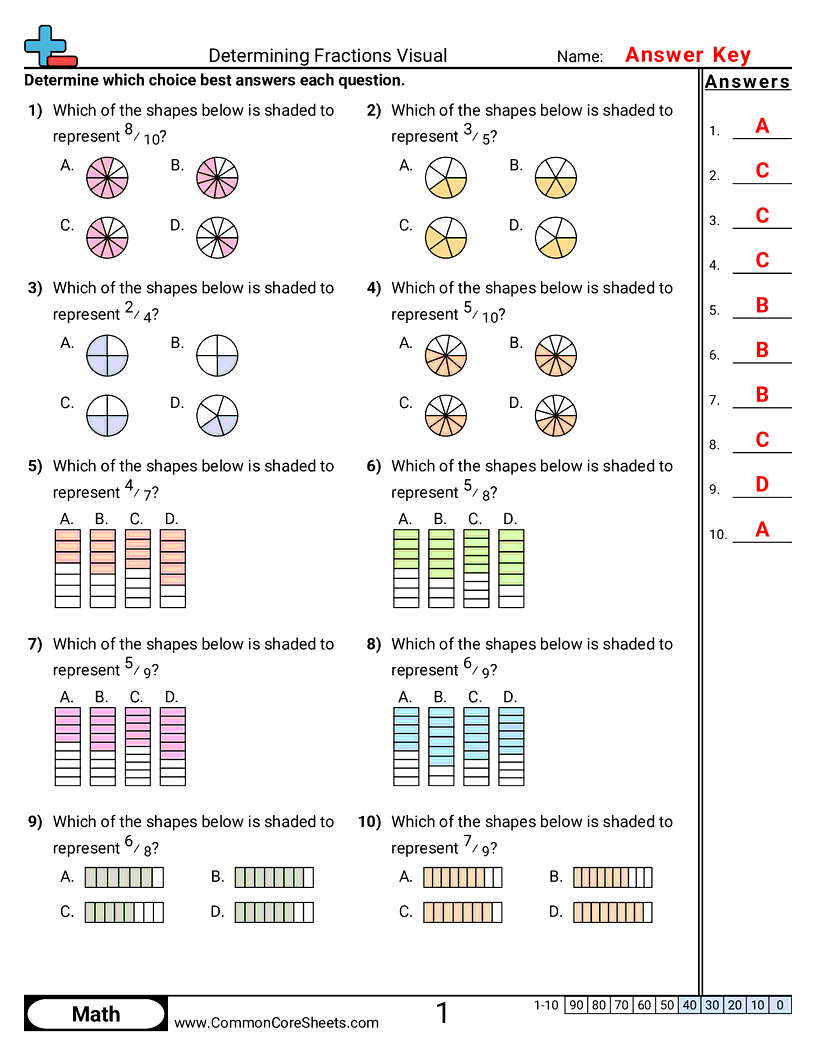
"This worksheet is designed to teach children about fractions through visualization. With ten interactive problems, students are asked to identify the shape that correctly represents certain fractions. Every problem can be customized to meet individual learning needs. Notably, its dynamic nature makes it suitable for use in distance learning, and each problem can also be transformed into fascinating flashcards."
×Student Goals: Conceptual Understanding of FractionsUpon the completion of this worksheet, students should have a firm understanding of fractions - the basic concept and how they represent parts of a whole. They will be able to identify and determine fractions in a visual and intuitive manner, strengthening their grasp on the subject.Mastery in Fraction VisualizationStudents will master the technique of visualizing fractions as part of a shape. They will be confident in identifying which part of a shape represents certain fractions. This skill significantly helps in comprehending more complex mathematical problems as they progress in their coursework.Problem-Solving AbilityBy solving a variety of fraction problems, students sharpen their problem-solving abilities, critical thinking, and analytical skills. They should be able to apply these skills not only to similar math problems but to real-life situations as well, demonstrating a practical understanding of fractions.Comparison of FractionsAfter completing the worksheet, students will be able to compare different fractions visually. This skill makes it easier for them to grasp the concept of fraction equivalency, simplification, and comparison - foundational skills in further mathematical education.Fosters Independent LearningThis self-guided exercise bolsters independent learning. The confidence earned from successfully solving the problems promotes self-reliance in their learning journey, fostering a willingness to tackle new, more demanding topics autonomously.Enhanced Numeracy SkillsWith each fraction problem, the pupil refines their numeracy skills. The ability to determine fractions visually aids cognitive development, enhances numeric literacy, and lays a formidable foundation for more complex mathematical computations.
3nf1Open FolderOpen File×Description:
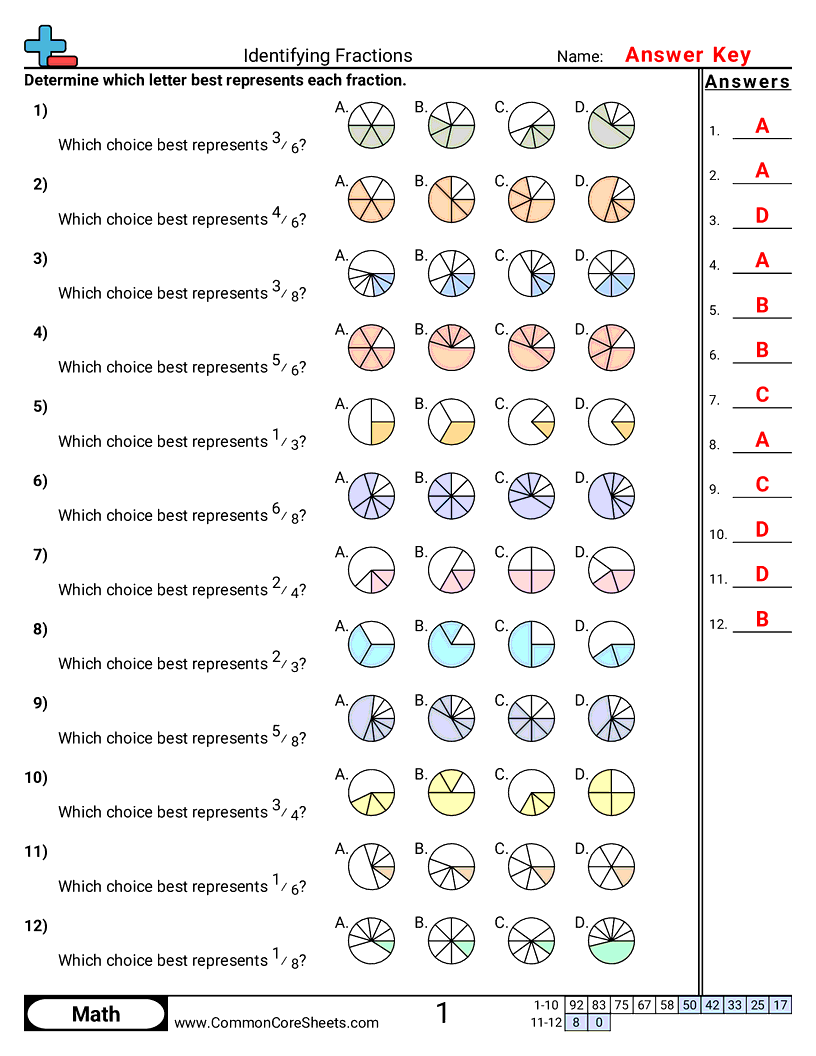
"This worksheet is designed to help children identify fractions through a series of 12 math problems. The interactive format allows the child to choose from multiple answers, enhancing understanding of the concept. Adaptable for diverse learning formats, the worksheet can be customized, converted into flash cards, or utilized in a distance learning environment for an engaging study experience."
×Student Goals: Understanding of FractionsBy the end of this worksheet, students should have a clear understanding of basic fractions. They will be able to correctly identify various fractions when presented with visual or numerical options. This understanding forms the foundation for more complex operations with fractions.Mathematical ConfidenceStudents should gain confidence in their mathematical abilities, particularly in dealing with fractions. A solid grip on the concept of fractions plays a major role in many mathematical calculations involved in everyday life. Having this confidence early on would augur well for their overall mathematical ability.Problem-Solving SkillsThe completion of this worksheet helps improve students' problem-solving skills. While the focus is on fractions, the skills acquired can translate to other aspects of problem-solving. This ability to choose the correct answer from multiple options aids in the development of critical thinking.Visual InterpretationStudents should also enhance their visual interpretation skills. The ability to visually represent fractions is a skill on its own, beyond just mathematical ability. It serves as a bridge between the abstract idea of fractions and their more concrete representations.Application SkillsAfter successfully finishing this worksheet, learners should be able to apply their acquired skills in real-life scenarios. Recognizing fractions is an advantage in everyday scenarios, like reading a clock, dividing resources, identifying car speeds on road signs, etc. This direct application of academic learning to life skills is an essential factor that education aims to achieve.Preparation for Advanced TopicsUnderstanding fractions is just the tip of the iceberg. Once students have a grasp of this concept, they are more prepared to tackle advanced mathematical topics such as decimal points, percentages, ratio and proportion, etc. This worksheet serves as a stepping stone to these more advanced topics, thereby enriching students' mathematical journey.
3nf1Open FolderOpen File×Description:
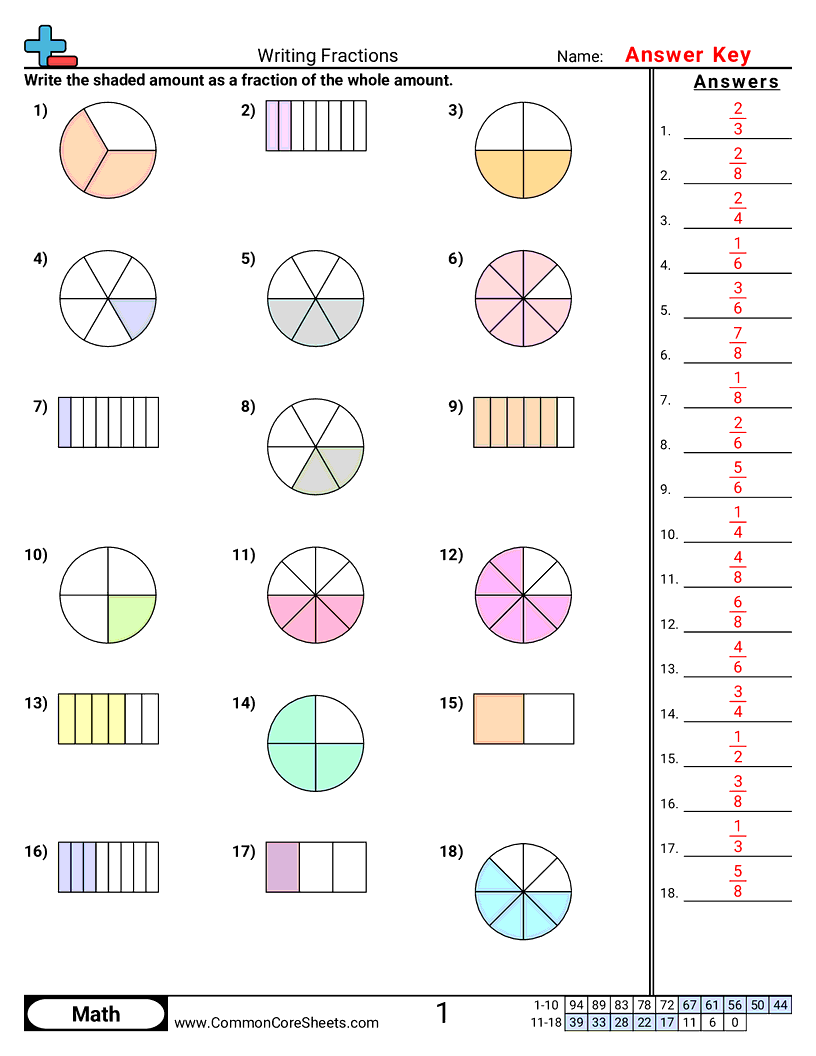
"This worksheet is designed to strengthen children's understanding of writing fractions. It contains 18 problems focusing on various aspects of the subject matter, creating an interactive and engaging learning experience in math. The worksheet is customizable, perfect for transforming into flash cards, and aligns seamlessly with distance learning needs. This resource simplifies the concept of fractions, making learning mathematics an enjoyable and productive process."
×Student Goals: Understand Basic Concepts of FractionsUpon completion of this worksheet, students should have a solid understanding of the basic concepts of fractions. They should be able to identify the numerator and denominator of a fraction and understand what these components represent. This foundational knowledge of fractions is integral to further mathematical learning and can be applied to more advanced concepts such as ratio and proportion.Perform Basic Fraction OperationsStudents should also be able to perform basic operations with fractions such as addition, subtraction, multiplication, and division. They should understand when these operations are applicable and how to execute them correctly. This acquired capability will enable students to solve an array of mathematical problems using fractions, contributing to their overall math proficiency.Simplify FractionsAnother accomplishment students should gain from completing the worksheet is the ability to simplify fractions. This means students will know how to identify and create equivalent fractions, a crucial skill that simplifies calculation and aids in comprehending more complex mathematical relations involving fractions. With this skill, fractions can be manipulated with increased efficiency, thus eliminating unnecessary complexities.Use Fractions in Practical SituationsBeing able to apply fractions to practical situations is another accomplishment students should achieve. This means using fraction-based problems to represent and solve real-world scenarios. This practical application will not only further students' understanding of fractions in a tangible context but also cultivate a connection between their mathematical learning and daily life.Display Kindergarten ReadinessLastly, completion of this worksheet should assist the student in exhibiting readiness for next-level mathematics. This means progressing towards being adequately equipped with the knowledge and skills necessary to tackle more complicated fraction-related problems as they advance in their academic journey. With this accomplished, students will be prepared to face challenges with confidence and competence.