Number and Operations—Fractions Develop understanding of fractions as numbers.2Understand a fraction as a number on the number line; represent fractions on a number line diagram.aRepresent a fraction 1/b on a number line diagram by defining the interval from 0 to 1 as the whole and partitioning it into b equal parts. Recognize that each part has size 1/b and that the endpoint of the part based at 0 locates the number 1/b on the number line.
3nf2aOpen FolderOpen File×Description:
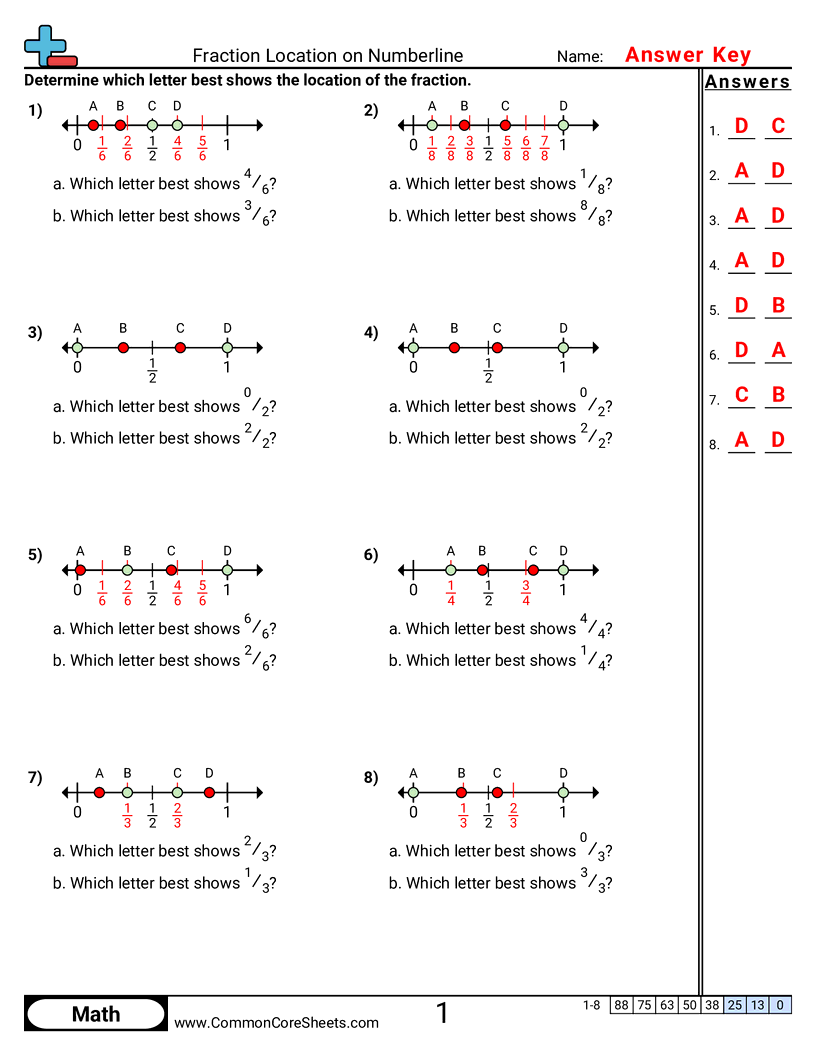
"This worksheet is designed to help children master the concept of fraction location on a number line. Offering 8 diverse problem sets, kids identify the correct placement of specific fractions. The worksheet is highly customizable to suit different learning requirements. It can be easily converted into flashcards for more interactive learning or utilized in distance learning platforms to facilitate math education beyond traditional classroom settings."
×Student Goals: Understand FractionsBy completing the worksheet, students should gain a solid understanding of fractions. This foundation will be crucial for them to grasp more complex numerical concepts in the future. They'll learn about number numerators and denominators, as well as how these components influence a fraction's value. The task demands students to visualize fractions on a number line, which helps them appreciate the relative sizes of different fractions and their relation to whole numbers. This understanding can then be applied in various real-life scenarios, such as measuring ingredients for cooking or calculating distances.Develop Problem-solving SkillsThe worksheet serves as an excellent tool for enhancing students' problem-solving abilities. Each problem poses a unique challenge that requires students to apply their knowledge and analytical skills to find the required fraction on the number line. Through this process, they learn to approach problems methodically, improve their critical thinking skills, and, most importantly, do not fear facing mathematical tasks. These problem-solving abilities are not only relevant to their math lessons but are also applicable to other subjects and real-world situations.Enhance Numerical LiteracyCompletion of this worksheet means that the students have enhanced their numerical literacy. This implies that they've been exposed to the skills necessary to interpret and work with numbers in all aspects of life, from budgeting to measuring and beyond. They'd understand how fractions fit into the broader picture of numerical literacy, appreciating their prevalence and relevance in daily undertakings. Importantly, this stage of numerical literacy is a stepping stone towards more difficult concepts, such as percentages and ratio calculations.Improve Visual-spatial UnderstandingWith a focus on mapping fractions on a number line. This worksheet promotes visual-spatial understanding. It trains students to mentally arrange and manipulate numbers and fractions within a defined space. It also challenges them to identify the relative positions of different fractions on the number line. Consequently, this understanding aids in the honing of spatial awareness which is beneficial in other areas of education such as geometry, engineering, physical sciences, and even day-to-day tasks that require spatial judgement.Boost Confidence in MathematicsLastly, upon completion of the worksheet, students should feel a lot more confident in their mathematical abilities. By mastering these foundational fraction-related tasks, they will realize that they are fully capable of understanding and conquering mathematical challenges. This new-found confidence can have a profound effect on their overall attitude towards learning and education, encouraging them to tackle more complex mathematical problems and concepts without hesitation.
3nf2aOpen FolderOpen File×Description:
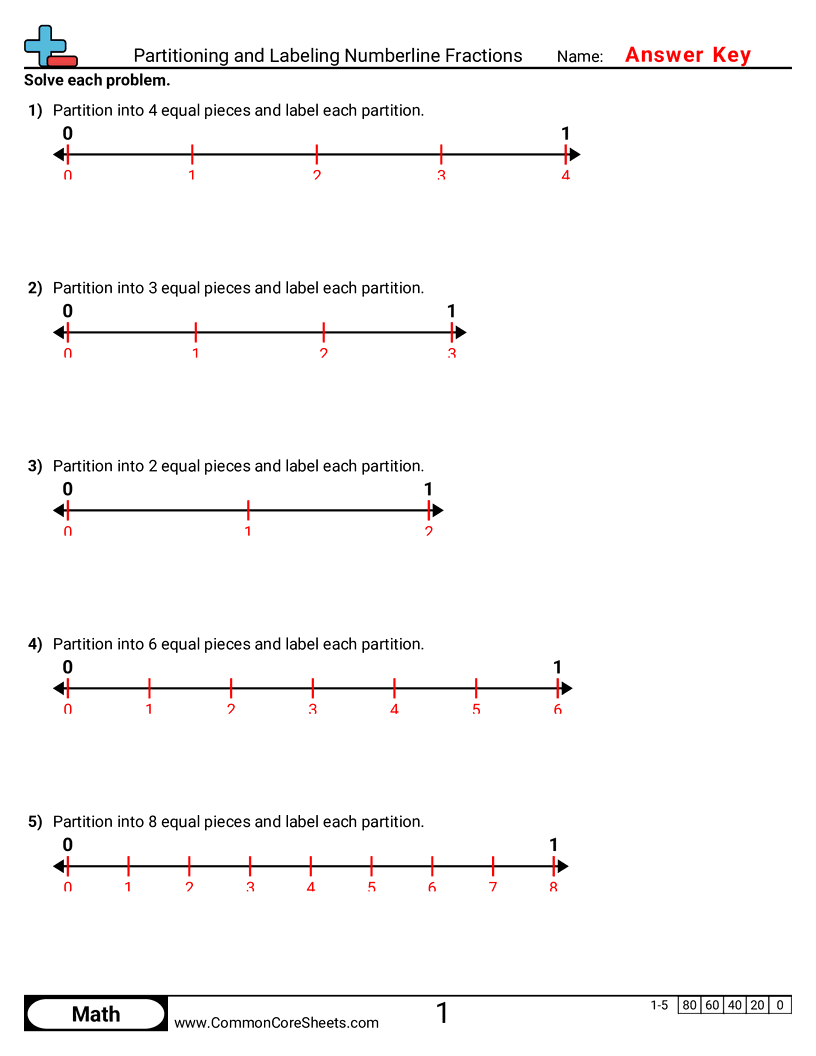
"This worksheet is designed to help children grasp and master the concept of partitioning and labeling on number lines, demonstrating understanding of fractions. Comprised of five unique questions, students will partition number lines into 2, 3, 4, 6 and 8 equal pieces. It offers customizability for individual learning and can easily be converted into flashcards for an interactive experience. Moreover, it's perfectly suitable for distance learning. This worksheet illuminates math concepts, making them approachable and comprehensible."
×Student Goals: Understanding of Fractional ConceptsUpon completing this worksheet, students should have a solid understanding of basic fractional concepts. They will learn that a fraction represents a part of a whole and that different fractions can represent the same value (for example, 2/4 and 1/2). Understanding fractions is crucial as it lays the foundation for more complex mathematical concepts in the future.Proficiency in Partitioning NumberlinesThe worksheet also equips students with the skill to accurately partition number lines into equal segments. This ability allows them to visually represent fractions and better understand their underlying principles. Partitioning is a critical skill for understanding interval scale and shapes the students' ability to deal with both ratio and proportion.Improved Numerical Labeling SkillsAfter finishing the worksheet, students will have improved proficiency in labeling each partition on the number line with corresponding fractional values. This enhances their number sense, links fractions to linear measurement, and cultivates their understanding of the relative nature of number size. This skill directly feeds into the ability to interpolate in missing number sequences and handle data interpretation in graphical forms such as bar and line graphs.Enhanced Comparison SkillsChildren will develop the ability to compare fractional values by analyzing number lines. This can be a practical way for them to understand that with fractions, a bigger denominator does not necessarily mean a larger value – an essential principle that students often struggle with in early fractions work.Introduction to Equivalent FractionsThough it is not explicitly mentioned in the worksheet, students will begin to develop intuition for the concept of equivalent fractions. They may notice, for example, that partitioning a number line into 4 pieces and shading in 2 will visually look the same as partitioning into 2 pieces and shading in 1 (i.e., that 2/4 = 1/2). This preps them for later math instruction where equivalent fractions are formally introduced.Building a Foundation for More Advanced Fractional ConceptsFinally, this worksheet provides a strong foundation for the learning of more advanced fractional concepts in the future. When they understand where fractions come from and how they work on a number line, they will find it much easier to grasp operations with fractions like addition, subtraction, multiplication, and division.