Geometry Graph points on the coordinate plane to solve real-world and mathematical problems.2Represent real world and mathematical problems by graphing points in the first quadrant of the coordinate plane, and interpret coordinate values of points in the context of the situation.
5g2Open FolderOpen File×Description:
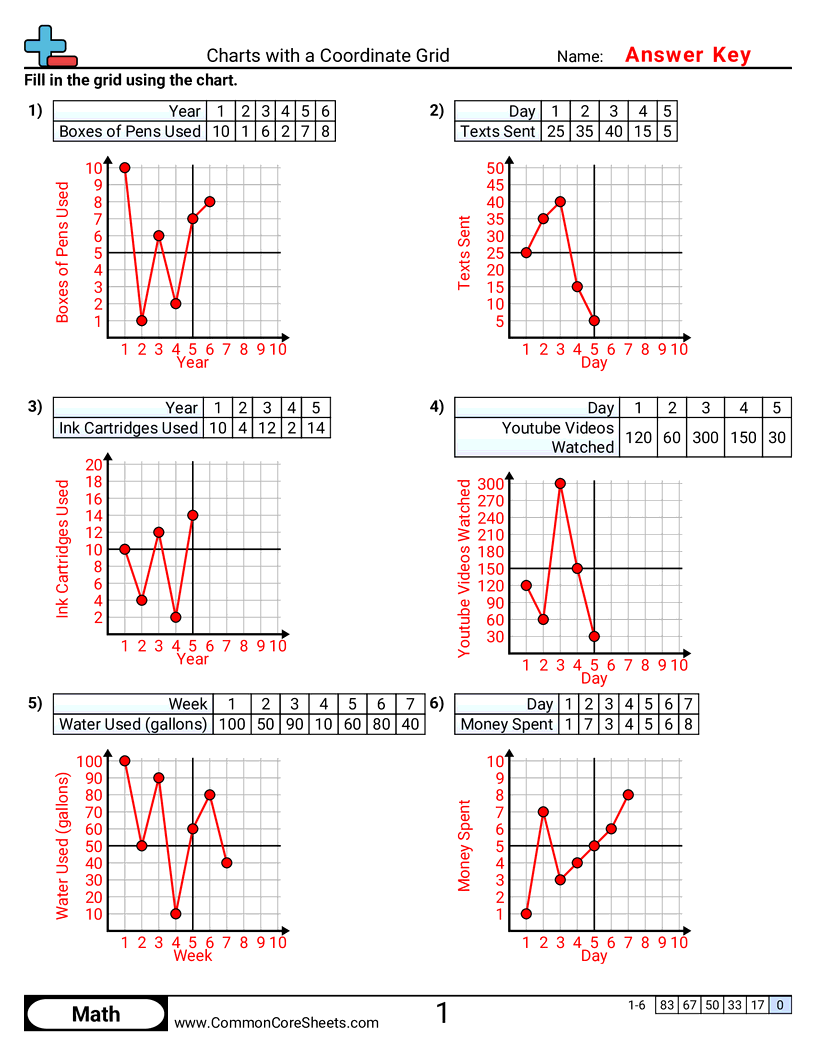
"This worksheet is designed to enhance children's understanding of math through engaging problems related to coordinate grid charts. Six distinct problems tackle concepts such as days and meals sold, weekly TV watched hours, sales hourly rates, weekly water usage, daily YouTube video consumption, and yearly pen use. It's customizable to meet individual learning needs, perfect for converting into flashcards, and fits seamlessly into distance learning methodologies."
×Student Goals: Develop Mathematical SkillsAfter completing the worksheet, students will be able to enhance their mathematical skills. This process will help them understand numerical concepts better and apply them in different contexts. They will be capable of working with numbers in a more analytical way. The experience will add to their cognitive abilities, letting them realize patterns, relationships, and logic in a mathematical framework.Understand Coordinate GridThe worksheet will help students comprehend the concept of a coordinate grid. They will understand how to plot numbers on a grid, recognize the importance of coordinates and their location. This will allow them to interpret data in a more visual form. The ability to present data on charts will enable simplified complexity in the information to be understood more easily.Improve Problem SolvingThis assignment will sharpen the students' problem-solving abilities. They will learn how to approach mathematical problems methodically, which will enhance their decision-making process. By solving different types of problems, students will gain a range of strategies that can be adopted to crack mathematical puzzles.Interpret Data and GraphsAfter going through the exercises, students will develop an improved ability to interpret data and graphs. They will learn how to read, understand and analyze the data presented in various graph forms. They will be able to decipher the purpose of display graphics, interpret the significant data points, and draw accurate conclusions from the visual representations of numerical data.Enhance Logical ReasoningFinishing this worksheet will contribute to honing students' logical reasoning. By manipulating numbers and analyzing patterns, they will be able to develop coherent arguments and improve their capacity to think logically. This skill will help students beyond mathematics, assisting them in all subjects that require logic and reasoning.Application of Practical Life ConceptsFinally, the tasks will let students apply mathematical concepts to everyday life. The charts and grids present data on common subjects like calories burned, water used, and so on. This encourages students to think of math as not just an abstract field of study but as a practical tool that can be used to understand and navigate the world around them.
5g2Open FolderOpen File×Description:
"This worksheet is designed to fortify children's understanding of coordinates in math through a variety of shapes and symbols. Comprising 20 problems, ranging from squares and stars to unique shapes like a music note and lightning, it enhances problem-solving skills. Ideal for distance learning, this worksheet can be customized based on unique learning needs and even converted into flashcards for dynamic study sessions."
×Student Goals: Enhance Analytical SkillsBy successfully completing the coordinates worksheet, students get the opportunity to enhance their analytical skills. Analyzing and interpreting the patterns of coordinates can be a challenging task, but doing so can significantly improve a child's ability to think critically and logically.Develop Problem-Solving SkillsWorking on the problems in this worksheet will promote problem-solving skills among students. Each problem is different, requiring them to think in varying ways to find the solutions. Such exercises contribute to their capability to handle more complex problems in the future.Improve Geometry KnowledgeThis worksheet allows students to explore different geometric shapes and structures. In the process, they will gain a better conceptual understanding of basic geometry. They will be able to recognize and differentiate between various shapes such as circles, triangles, squares, etc., which are fundamental in the study of geometry.Strengthen Mathematical VocabularyStudents will undoubtedly strengthen their mathematical vocabulary upon completion of this worksheet. The exercise introduces and reinforces geometry-related terms and concepts. This improved familiarity with the language of mathematics better prepares them for future mathematical studies.Boost ConfidenceSuccessfully determining coordinates and navigating the problems in the worksheet helps build confidence in a child's mathematical capabilities. With every problem they solve, their self-assurance will grow, instilling in them the belief that they can tackle complex mathematical problems or any challenges they might face in their academic journey.Promote Attention to DetailThe worksheet encourages precision and attention to detail. Students will need to pay careful attention to each coordinate and shape to arrive at the correct answer. This focus on precision will help them excel not just in mathematics, but in all areas requiring attention to detail.Develop Coordinate Plane UnderstandingLastly, completing the worksheet should equip students with a solid foundation in understanding the coordinate plane. This is a valuable skill in mathematics, which will be useful in later studies, especially in subjects like calculus, physics, and more advanced geometry.
5g2Open FolderOpen File×Description:
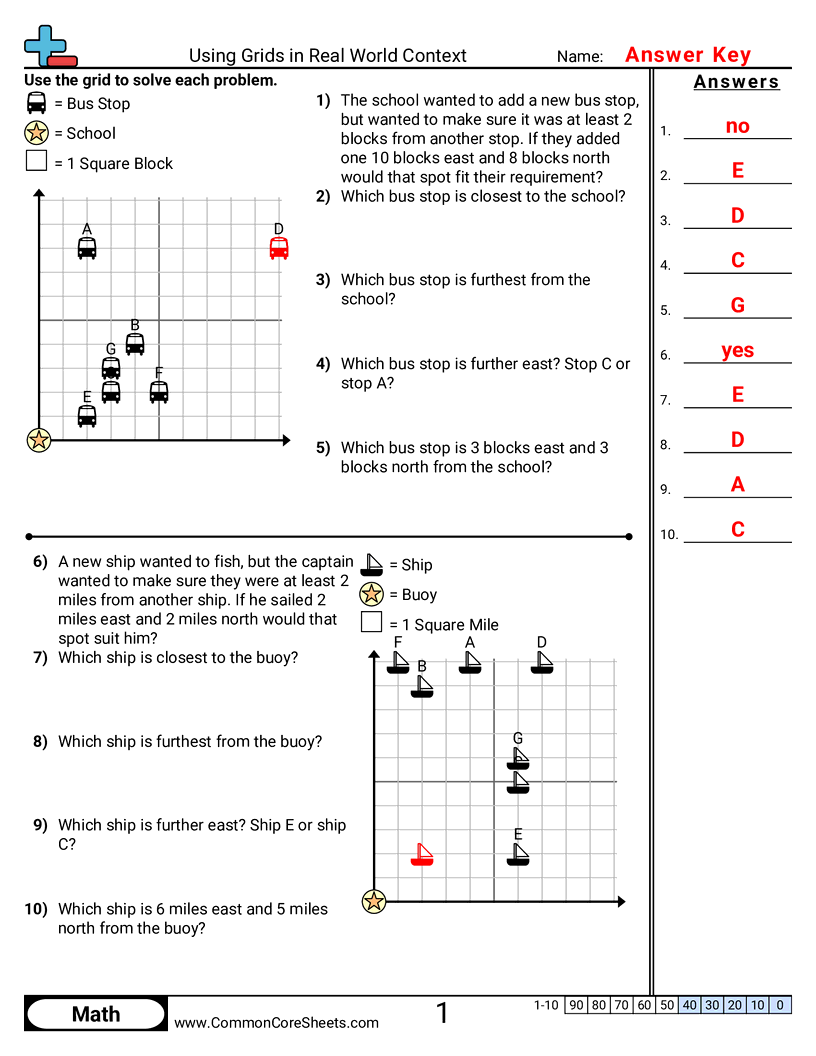
"This worksheet is designed to enhance children's practical understanding of grids through real-world scenarios, using a set of 10 math problems. It focuses on spatial concepts, such as distance and coordinates. The problems presented can be easily customized, converted into flashcards, or adapted for distance learning, offering versatile solutions to make grid learning engaging and effective."
×Student Goals: Understanding the Concept of GridsStudents will develop a basic understanding of the concept of grids after completing this worksheet. They should be able to recognize grids as a tool for locating points within a given area, as well as be familiar with the terms 'east', 'west', 'north', 'south' as they relate to grid navigation.Application of Mathematical ConceptsStudents will be able to successfully apply mathematical concepts by interpreting and solving problems that involve distances and location. They should be able to differentiate between distances closer and further from a certain point. This worksheet makes them adept at handling practical mathematical problems common in real-life scenarios, such as determining the placement of a bus stop or a well using a set of given rules.Developing Analytical and Planning SkillsBy completing this worksheet, students will learn to use analytical and planning skills to solve problems. They will understand how decisions are made attending to specific criteria and they will be able to make inferences, analyses, and predictions based on the information available on the grid.Improving Critical Thinking SkillsThe worksheet fosters the enhancement of critical thinking skills. Students should be able to process the provided information, make informed decisions, and offer possible solutions to problems. These skills are essential in today's rapidly changing world, not only in academics but also in everyday life challenged with complex scenarios.Boosting Sarial ReasoningThis worksheet will enhance the students' spatial reasoning abilities. They will become more adept at using grids to locate directions and comprehend the relative positions of different points, understanding the relationships between different objects and spaces.Better Problem-Solving AbilitiesThe worksheet enables the students to strengthen their problem-solving skills. They will learn to identify the problem, decipher the underlying requirements, apply appropriate methods, and arrive at solutions. They will become more proficient at solving various types of problems involving distances and locations on a grid.